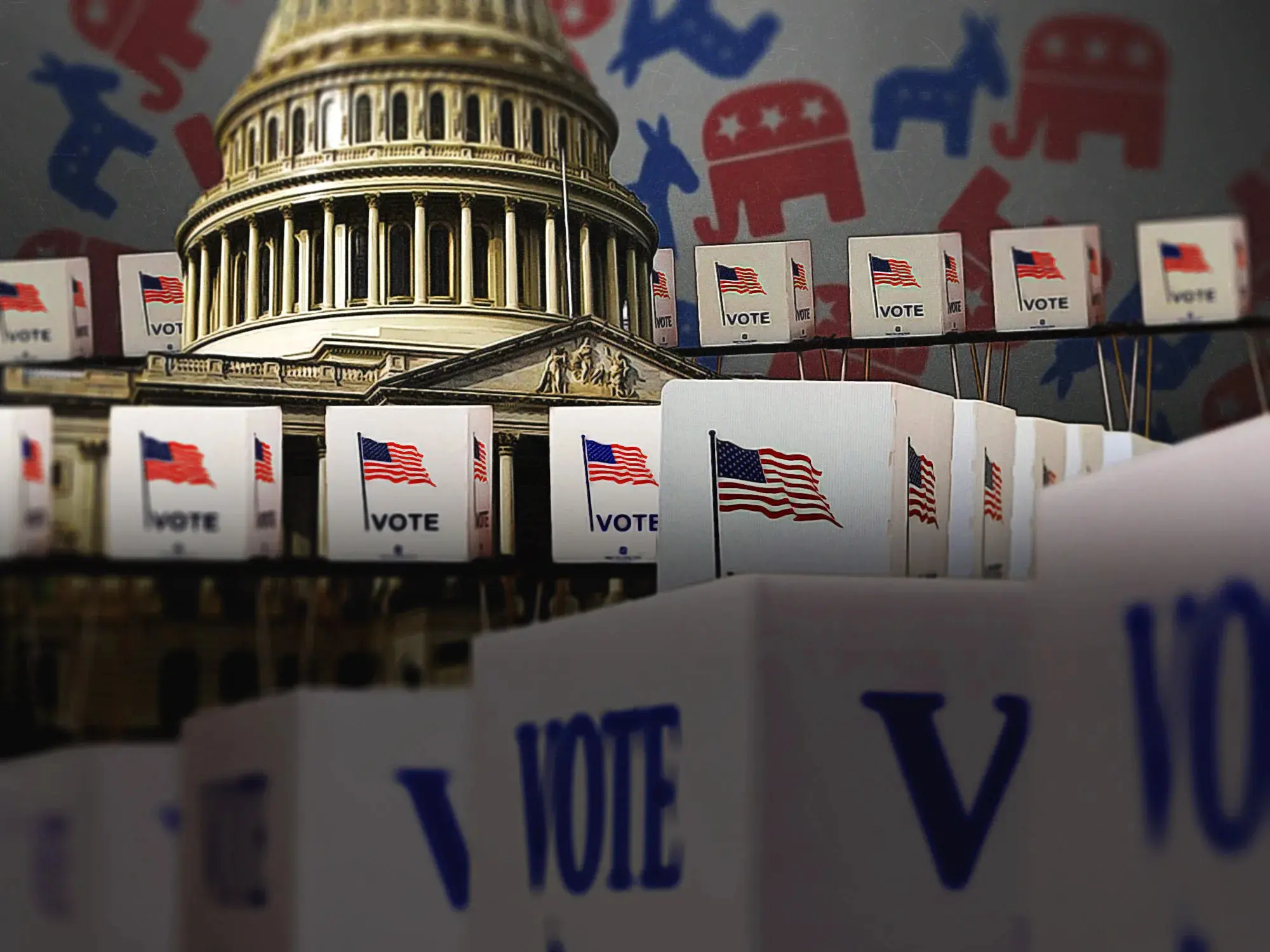
There is something beautiful about the way established democracies function. In the run-up to the midterm elections in the United States (US), speculation suggested that redistricting and the deployment of significant financial resources would favour the Republican Party and could undermine the electoral verdict. Contrary to such perceptions, the Democratic Party has registered a landslide victory in the elections.
In the Senate, the Democratic Party controls about 54 seats, while the Republican Party holds 44. In the House of Representatives, the Democrats won about 254 seats, while the Republicans won about 162. The Democrats won not only in swing states such as Georgia, Michigan, New Hampshire, and North Carolina, but also in Republican strongholds such as Iowa, Kansas, Texas, and even South Carolina. The scale of anti-incumbency is evident in the fact that, after a few decades, Texas has elected a Democratic senator and a Democratic governor, and Kansas has elected its first Democratic senator since 1932.
What explains the electoral outcome? It appears that the Iran war has proved to be very costly for the Republican Party. During the 2024 presidential campaign, Donald Trump promised ‘no more wars.’ However, while the intervention in Venezuela turned out to be brief, the Iran War proved to be a different ballgame altogether. In fact, Vice President JD Vance noted that the Iran War led to the midterm electoral defeat.
President Trump initiated the Iran war without ending the war in Ukraine. During the 2024 presidential election campaign, President Donald Trump promised to end the war in Ukraine within 24 hours of being sworn in as President. Unable to end the Ukraine war, the US administration sought to curtail the flow of financial resources to Moscow by penalising countries for buying oil from Russia, without providing alternative, cost-effective energy sources to many emerging and developing countries. When the flow of oil through the Strait of Hormuz was curtailed during the Iran War, global oil prices increased substantially. The rise in global oil prices also raised energy prices for domestic consumers in the United States; consequently, rural voters dependent on energy resources for agricultural and related activities grew discontented. To overcome the discontent, U.S. President Donald Trump quickly concluded the diesel agreement with Russia. However, it proved to be rather late in the day to have an impact on energy prices before the Midterms. Sustained high energy prices have had a negative impact on the Republican Party’s electoral fortunes.
High inflation rates seem to have played an important role in nudging many voters toward Democrats. According to Associated Press exit polls, about 39% of voters said the economy was a principal factor in their voting decision. Republicans have not pursued their policy of fiscal conservatism. In the initial months, there were attempts to reduce the expenditure of the federal government. However, those efforts seemed more like episodic exercises than a long-term approach to structurally rejig the governance apparatus to ensure a lean, efficient administrative mechanism. Furthermore, external military interventions significantly increased government expenditure.
The harsh policies on immigration ensured that various ethnic minority communities moved away from the Republican Party. It is likely that some of the Latino, African American, and a host of voters from other communities, who voted for Trump two years ago, may now have voted for the Democratic Party. Overall, a constellation of economic (inflation) and political (immigration and foreign policy) factors has generated strong anti-incumbency against the Trump administration.
The midterm election results do have implications for American politics and policymaking. The Democrats now control the House of Representatives and the Senate. The U.S. president will therefore find it very difficult to pass his legislative agenda through Congress. Of course, over the decades, there were many instances when the president belonged to one party, and the House and Senate were controlled by the other, and the legislative agenda passed through negotiations and some give-and-take. However, that possibility looks a little bleak at the moment, given Trump’s proclivity for a combative approach. President Trump has already said he would use the veto power to block legislation passed by a Democratic-controlled legislature. The appointment of a new chief of staff is also being interpreted as an indication that Trump will double down on his agenda, which may generate friction with the Democratic Party.
Meanwhile, given the scale of discontent with President Donald Trump, Democrats are unlikely to sit across the table to negotiate with the executive to prevent a policy logjam. Therefore, a considerable policy paralysis in the United States is on the horizon. Furthermore, the Democrat-led legislature is likely to scrutinise President Trump’s decision-making and his family’s financial dealings. The word ‘impeachment’ is once again finding traction in the media.
The Republican Party will also reassess its strategy. Before the midterm elections, given Trump’s popularity and his ability to win elections, the Republican Party adopted Trump’s agenda as its own. Now that Trump’s governance style and politics are proving costly, the Republican Party may reassess its leaning toward Trumpian agendas. Republican candidates with presidential aspirations are reportedly considering distancing themselves from President Trump’s administration.
The Democratic Party faces new challenges. Many voters who were loyal to the Republican Party have now voted Democratic. It remains to be seen whether the Democratic Party can retain these new voters. If the Democratic Party returns to a hardline culture agenda, it may push new voters back into the Republican fold. Agenda setting will depend on new stars and presidential hopefuls such as Andy Beshear, Gavin Newsom, James Talarico, JB Pritzker, Jon Ossoff, Josh Shapiro, Pete Buttigieg, and others. Established leaders such as Barack Obama, Rahm Emanuel, Kamala Harris and others should nudge the young leaders to adopt a more prudent strategy. They will have to take note of the fact that many Democrats, such as Senator-elect Talarico (Texas), Senator-elect Adam Hamilton (Kansas) and others, have campaigned “around Christian faith and court a segment of voters who had drifted towards Republicans.” The Republicans may have lost this election, but for Democrats to win the Presidential election in 2028, agenda-setting will play a critical role.
In recent years, there has been considerable discussion on polarisation in the US democracy. Addressing polarisation will require at least some leaders in both parties to confront fundamental fault lines in society while competing for power. It will require considerable statesmanship from leaders in both parties to perform the delicate tango of cooperation and competition at the same time.
The copyright of this article remains with the Politeia Research Foundation ©️PRF.