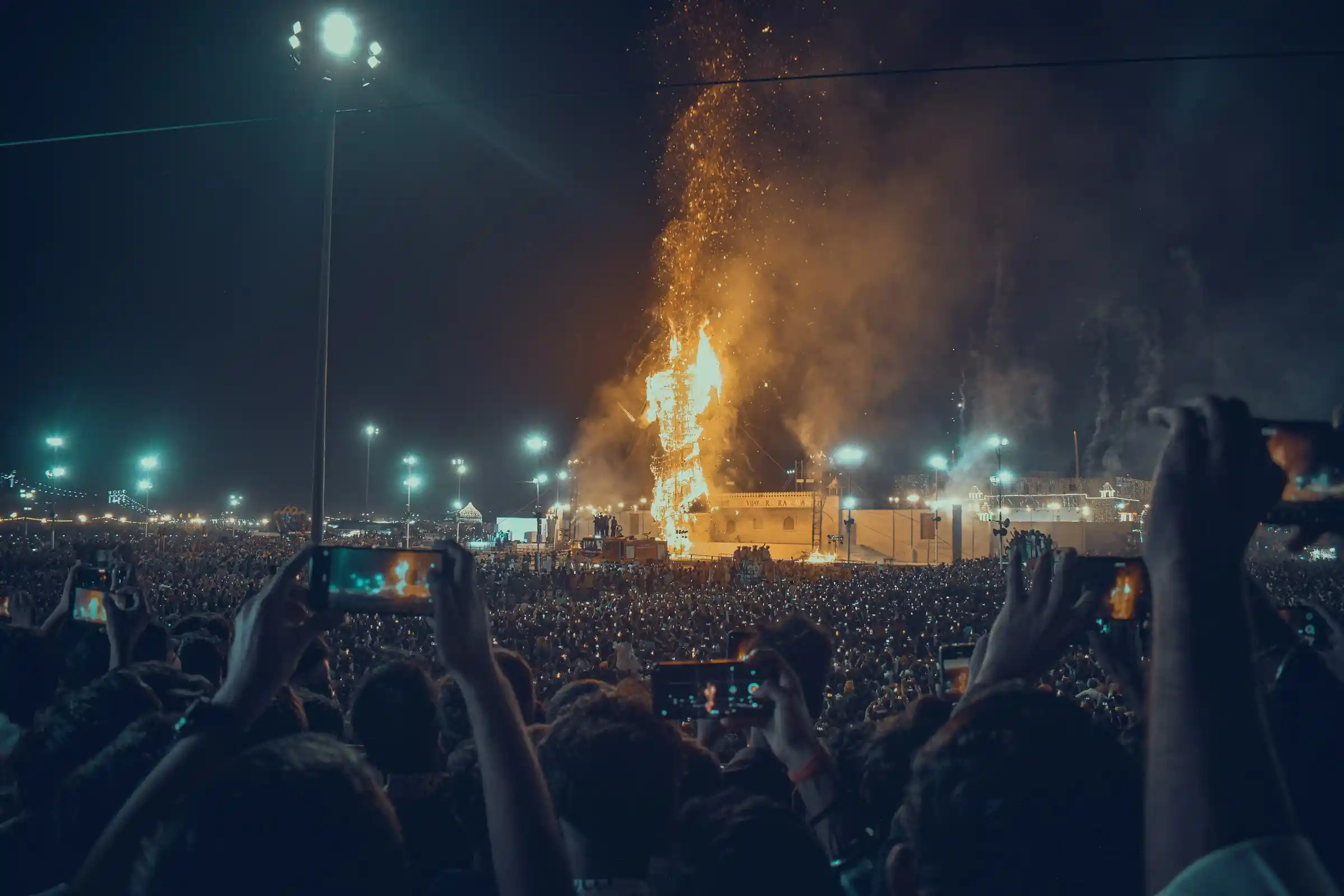
Delhi, the capital of India, traces its roots to Indraprastha, the city founded by the Pandava princes, the protagonists in the Mahabharata. It has no remarkable connection with the Ramayana, the other Hindu epic. Nonetheless, prime ministers from Nehru to Modi show up unfailingly at the Ramlila Maidan on Dussehra to shoot an arrow targeting a gigantic effigy of Ravana, the ten-headed villainous antagonist. As the arrow finds its mark, Ravana bursts into flames to the sound of crackers. The fireworks conclude the finale of the traditional celebration of the victory of good over evil, commemorating the climactic event in the Ramayana.
In Mysore, the erstwhile capital of one of the largest and most prosperous states in pre-independence India, an elephant caparisoned in brocade, carrying the idol of Chamunda, the battle goddess, leads the procession. Tradition bound the Maharaja to follow on another elephant in full regalia. At night, the entire city turns up to see the palace beautifully illuminated.
The day after Vijayadashami/Dussehra honours the celestial engineer Vishwakarma, when all mechanics and craftspeople worship their tools of trade.
Mysore is renowned for its gold mines, elephants, sandalwood forests, exquisite silks and patronage of classical music—both Hindustani and Carnatic. The British rebuilt Bangalore, founded by the legendary warrior Kempa Gowda, but the Cantonment, with its salubrious climate and modern amenities, couldn’t match the mystique of Mysore, where one can savour fluffy dosai, melt-in-the-mouth idli and enjoy the exceptionally rich Mysore Paak, a sweet prepared with gram flour and ghee. Dussehra is the time to splurge and wash down savouries and sweets with strong filter coffee that carries the aroma of beautiful plantations.
The scale and flavour of Dussehra are very different in Kullu, in the northern state of Himachal Pradesh, abutting Punjab, Jammu and Kashmir, Haryana, Uttar Pradesh and Uttarakhand. Curiously, the tiny state has preserved its unique way of celebrating this festival.
Interestingly, no Ravana effigies are erected and set ablaze here. Various local village deities are ceremonially carried in palanquins by colourfully costumed villagers to the accompaniment of folk music. All the divine guests are accommodated in the large maidan, where they camp for a week in tents. After the ritual visit to the shrine of Raghunath (another name for Shri Ram), they repose in the large ground, where revellers form impromptu circles and dance exuberantly.
Dhaam, the traditional community meal cooked by professional Brahmin cooks, is shared. The vegetarian menu comprises lots of lentils and madra, a special delicacy prepared with rajma or Mukund Badi (soft stuffed dumplings). On the periphery of the ground, kiosks and stalls sprout to sell savoury and sweet snacks. With changing times, the fare has changed. Not only are local dishes like siddu (stuffed steamed bread) on offer, but also momos, samosas, jalebi, masala dosa, idli and chow mein.
In Nepal, Dussehra is the most important festival of the year. Referred to by the generic term tyaar, Dassain, literally meaning the tenth day, is the culmination of festivities lasting a fortnight. It celebrates the killing of the dreaded demon Mahishasur by the fierce Goddess Kali. People participate countrywide—in the hills and valleys—sacrificing goats and buffaloes and feasting together. Sela roti, kheer, offal and shurua are enjoyed. Blessings are sought from elder relatives, and alms are given to ward off misfortune.
Banaras has the longest run-up to the grand finale of Dussehra at Ramnagar Palace, presided over by Kashi Naresh (the Maharaja of Benaras). For a month preceding this day, the entire city is transformed into a stage, with performances following a traditionally prescribed path and designated places where significant events in Rama’s life in exile are enacted.
The audience of enthusiasts moves along with the show, nourishing itself with kachori, alu ki tarkari, jalebi, malaiyo and creamy lassi. The nip in the air announces the advent of winter, and those advancing in years look for the fortifying magdal, a rich halva-like confection. Those addicted to paan exhale strong fumes of spicy zarda, saffron-tinted chewing tobacco.
In countless villages and towns in UP, Bihar and Madhya Pradesh, Dussehra means time out with family at local melas (fairs), with quaint attractions like merry-go-rounds and rickety wooden Ferris wheels, and opportunities to splurge on sweet and savoury snacks.
In the evening, effigies of Ravana, smaller than those in Delhi and Benaras but no less glitzy, are set ablaze. Sparks dance like glowworms, and flames leap towards the sky.
Ravana’s ten heads symbolise the vast knowledge he possessed. But his fall reminds us that mere knowledge is not enough. Arrogance and lack of self-control inevitably lead to a tragic end. The word Dussehra refers not only to the ten heads of Ravana but also to the relief it promises from ten types of distress if one leads a virtuous and disciplined life.