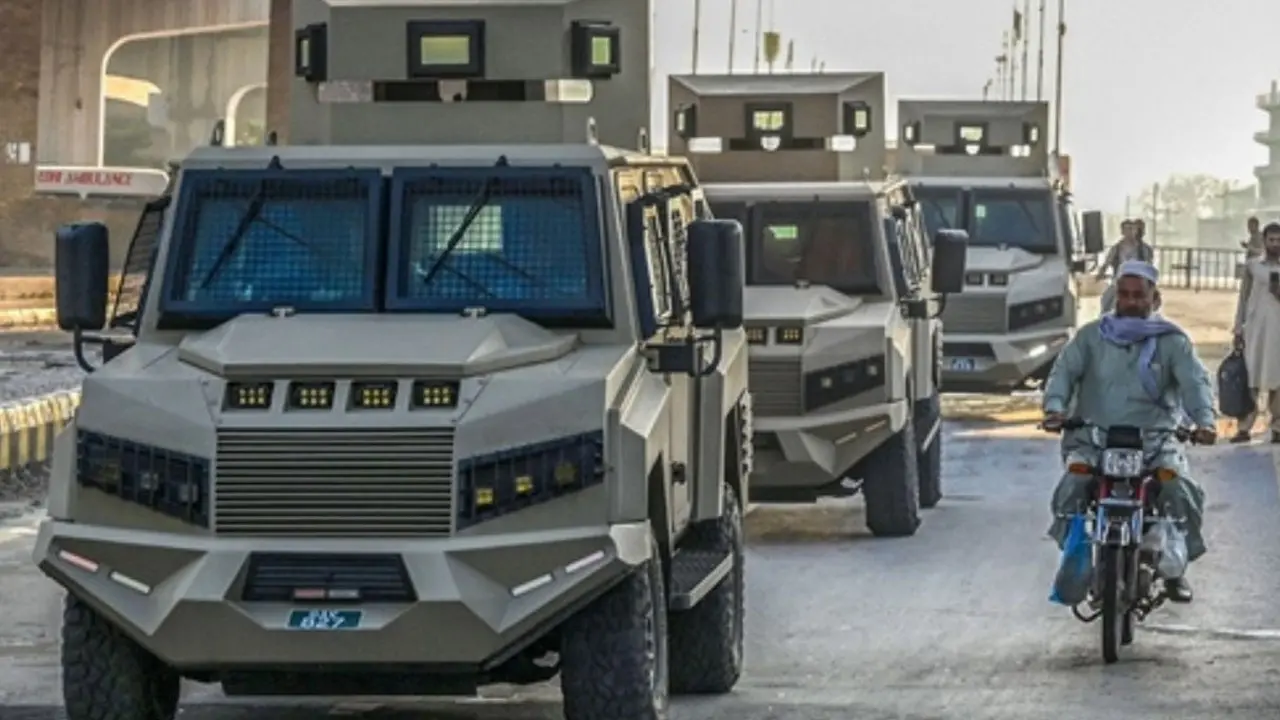
Pakistan has declared an emergency in its conflict-ridden province, Khyber Pakhtunkhwa(KP), to counter an aggressive surge in terrorist activity. Still, beyond the plain security reading, there are political implications. KP has been the only bastion of jailed Imran Khan’s Party, PTI, for thirteen years, and with the imposition of an emergency by Pakistan’s political and security establishment, mainly the Army, PTI’s government has now been dismissed, and Imran Khan’s stronghold is now under Governor rule, with complete control by Islamabad and the Army.
Another Gamble
This is not new in Pakistan. The security establishment in Islamabad has been launching counter-terror operations for years. The most recent was launched two years ago, a counter-terror operation named Azm-e-Istekham to quell the surge in terrorism inside its home. The operation aims to combat various terrorist outfits in and out of Pakistan, specifically those armed groups that are crossing from Afghanistan. Despite the campaign and major state allocations (such as anti-terrorism funding for Khyber Pakhtunkhwa and Balochistan), militant groups like the Tehreek-e-Taliban Pakistan (TTP) and the Baloch Liberation Army (BLA) have continued high-profile attacks, such as the Jaffar Express hijack last year and the Mangi Dam attack this year, which killed 27 police personnel.
According to reports, last month’s estimates are worrisome. September 2026 recorded a 12-year high in monthly militant violence with 225 attacks in a single month, resulting in over 100 security force fatalities. Even decades back, a deadly school attack in Peshawar led to a promising National Action Plan that delivered some results. Still, some analysts saw those measures as ineffective and merely a political tool to pacify tensions and fear among civilians. Pakistan’s counter-terror efforts resemble security cosmetics rather than a hardcore security pursuit. However, this time there is a shift, with the ante being raised in KP.
Terror Instrument And Necessity
Pakistan’s national security strategy is India-centric, with rhetoric about nuking India if certain thresholds are breached. Further, its focus on Kashmir, according to Pakistan, will deter and counter India. Without a doubt, Pakistan puts its strategic focus on Kashmir to destabilise India through unconventional methods such as terrorism. But Pakistan’s romance with terror goes beyond a strategy, at least for India. Pakistan’s terror strategy in the case of India is activated and tempered by radical and Islamic Jihadism. Zia-ul-Haq’s famous Bleed India with a Thousand Cuts to Operation Tupac serve as glaring examples of how radicalism in the Pakistan Army bred, which resulted in sheltering and weaving terror outfits against India. The allowance of weaving terror and nurturing them is a strategic tool for Pakistan and perhaps an irreparable one too for achieving its national security goals against India. Terrorism finds a soft place in Pakistan’s national security doctrine and therefore it cannot be eliminated, and only occasional trimming and selective counter-terror operations can help Pakistan to paddle along with strategy and terror. There are a few groups that are becoming too radical and causing a threat to Pakistan’s existence, such as Tehreek-e-Taliban. Still, even that is also nurtured by a former Pakistani president for its Afghanistan rendezvous and fighting against India. One more observable point is that Pakistan has never directly or indirectly attempted to dismantle the capacity of “terror outfits.”
This was one of the main reasons for the weak execution of Pakistan’s National Action Plan. To maintain strategic necessity and keep its national security doctrine unconventional, Pakistan makes artificial attempts, like occasionally trimming long grass. In short, counter-terror operations are just a cover, while the terror mechanism and breeding of various outfits is a necessity.
The Pattern Shift
This time, the escalation doesn’t follow the general security playbook, i.e., launching a counter-terror operation. This time, Pakistan banked on one of its riskiest options: pressing the political button with full force, backed by the Army, i.e., imposing emergency/governor rule in the province. While the security argument is weak to justify the imposition of the emergency, despite all operational preparedness and counter-terrorism efforts by Pakistan, there was no real change or improvement in the situation; history itself stands as strong evidence that these efforts are driven by desperation and pressure, not by necessity, as terror is Pakistan’s state instrument, which it readjusts in accordance with external and internal circumstances.
Parvez Musharraf’s deception to navigate US pressure after 9/11 is a classic case. Parvez Musharraf adopted a cautious approach that, on the one hand, gave the US what it wanted and, on the other, allowed him to play his deceptive game by covertly exfiltrating his army and intelligence personnel seconded to the movement, along with some key Taliban operatives, including Taliban forces and their al-Qaeda guests, who thus found their way across the highly porous Afghanistan-Pakistan border into the FATA. This decision was guided by a desire to secure strategic depth vis-à-vis India and to maintain covert relations with the Taliban, so that, later on, Pakistan could retain tactical flexibility to operate terror bases against India. Even Musharraf’s counter-terror operation codenamed Operation Al Mizan, which ran for four years from 2002-2006 in the frontier region, also failed to yield substantive results.
After examining the security argument, there is ample scope for a political argument in this pattern shift, as discussed above. Khyber Pakhtunkhwa was only the stronghold of Imran Khan’s PTI, and its dismissal will put Pakistan’s PTI political survivability in limbo. Such political actions, dressed up as a security necessity, also reflect Pakistan’s political history.
The Crises
The timing of the emergency declaration is worth noting. The decision almost coincided with Imran Khan’s PTI long march plan, where thousands of supporters of Pakistan’s jailed former Prime Minister Imran Khan started a long march to Islamabad to demand his release. Therefore, imposing an emergency and locking down PTI’s stronghold seems like a politically convincing argument. However, playing a political gamble under security cover has serious consequences. Two critical instances demonstrate that whenever Pakistan used force on a full spectrum in the provinces, it led to more serious crises and political instability. In 1973, Prime Minister Zulfikar Ali Bhutto accused the administration of orchestrating tribal unrest and working with foreign powers after weapons were discovered at the Iraqi Embassy, and as a result dismissed the National Awami Party (NAP) led coalition government under Chief Minister Sardar Attaullah Mengal. The dismissal triggered a bloody, multi-year guerrilla war in the province. In solidarity, the NAP government in the neighbouring North-West Frontier Province (NWFP/KP) did the same.
Similarly, Nawaz Sharif dismissed the Sindh provincial assembly in 1998 following the high-profile assassination of former Sindh Governor Hakim Said, accusing coalition partners within the provincial government of harbouring criminal elements. This triggered political instability in Pakistan and stripped Sharif of key political allies. The subsequent military-led anti-crime operations widened the rift between the government and the army. The tables turned in 2009 when then-President Asif Zardari imposed Governor’s Rule for two months in Punjab Province to prevent Sharif’s PML-N from mobilising the provincial machinery.
After decades, the imposition of Governor’s rule returned to Balochistan in 2013, following a horrific sectarian bomb attack in Quetta that killed more than 80 Shia Hazara Muslims. While it temporarily cleared the streets, the removal of the elected government failed to yield long-term security gains. Sectarian outfits and Baloch separatist groups continue. Despite two months of Governor’s rule from January 2013 to March 2013, 4 terror attacks occurred in February, including the Lakki Marwat Army Post Attack by the TTP, the Peshawar Mosque bombing, and an assassination attempt on Khyber Pakhtunkhwa Chief Minister Ameer Haider Khan Hoti, who narrowly escaped a TTP suicide bombing.
The Real Gamble
Considering both security and political arguments, the political ones seem to carry more weight than the security ones because Pakistan’s security reasons for imposing governor rule are limited to pacifying and diverting attention, with limited counter-terrorism cleanups. The political ones have actually deterred opposition parties from mobilising, as in Punjab and Sindh, reinforcing the fact that such emergency imposition has more political value than security value. Though for Imran Khan’s PTI this would be a real political test to remain relevant and, most importantly, ensure its survivability; for the Pakistan Government and the Army, this perhaps is not a security measure but another political and security gamble, and as history tells us, it could open a front for new crises leading to more alienation of Pashtuns(mostly populated in KP region) and security upheavals.