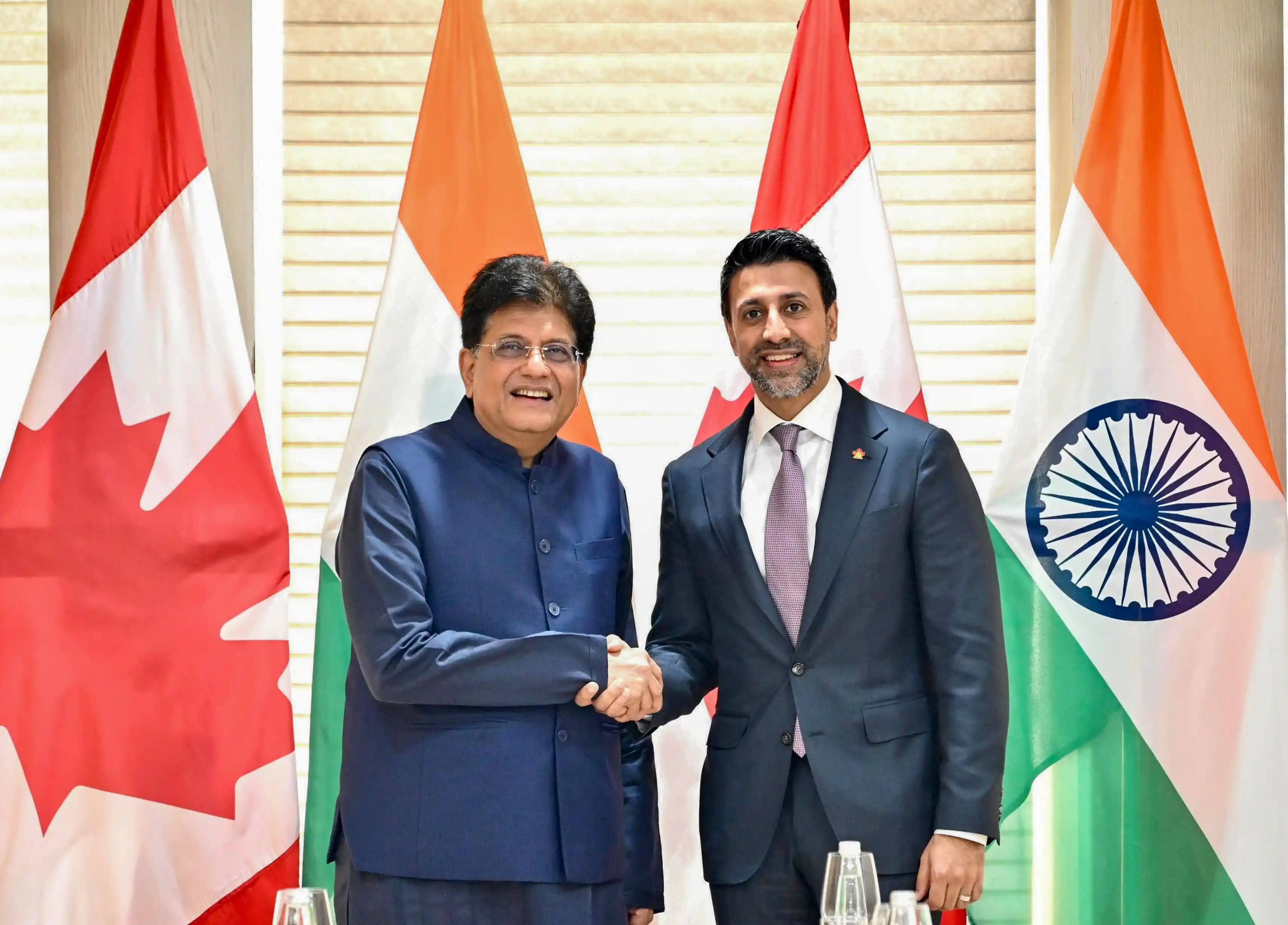
The renewed engagement between New Delhi and Ottawa offers an opportunity to move beyond recent tensions. The real test is whether both countries can build an economically ambitious relationship that addresses security concerns and withstands future political shocks.
India and Canada are approaching an important juncture in their bilateral relationship. After a prolonged period of diplomatic estrangement, renewed engagement suggests that both governments recognise the costs of allowing differences to overshadow substantial economic complementarities and shared strategic interests. The October 2026 visits of Canadian Foreign Minister Anita Anand and International Trade Minister Maninder Sidhu, preceded by security consultations between David Morrison and National Security Adviser Ajit Doval, signal a determined effort to rebuild confidence.
The objective should not be to recreate the relationship that existed before the rupture, but to build a more resilient partnership. This requires stronger economic foundations, credible security cooperation and institutional safeguards against another diplomatic crisis of the kind witnessed in 2024.
From diplomatic repair to strategic opportunity
Anand met External Affairs Minister S. Jaishankar and Prime Minister Narendra Modi in New Delhi on 14 October. Sidhu led a major Canadian trade mission to India as negotiations for a Comprehensive Economic Partnership Agreement (CEPA) continued towards the end-2026 target set by the two Prime Ministers.
India offers Canada a large and expanding market, industrial capacity and a growing technology ecosystem. It also provides Ottawa an opportunity to diversify its trade and investment relationships and reduce its concentration on the United States. Canada, in turn, brings strengths in energy, critical minerals, agriculture, aerospace, advanced technologies, education and institutional investment. Both countries have compelling reasons to diversify supply chains and strengthen economic resilience.
The political foundation for the current phase was laid during Prime Minister Mark Carney’s visit to India from 27 February to 2 March 2026, following renewed engagement between Carney and Modi at the G7 summit in 2025. Their Joint Leaders’ Statement identified cooperation in energy transition, civil nuclear energy, critical minerals, food security, trusted digital ecosystems, resilient supply chains, skills and talent mobility. It also established an ambition to expand bilateral trade to C$70 billion by 2030 and conclude CEPA negotiations by the end of 2026.
The leaders supported the reconstitution of the India–Canada CEO Forum, a Finance Ministers’ Economic and Financial Dialogue, stronger security cooperation and regular trade and investment engagement. These mechanisms are intended to sustain cooperation even when political disagreements arise.
In their telephone conversation on 13 October, Modi and Carney reaffirmed their commitment to concluding CEPA at the earliest opportunity. Modi’s anticipated visit to Canada in December could provide another opportunity to demonstrate that the reset is producing tangible results. The political framework is in place; implementation will determine its credibility.
Security, sovereignty and the challenge of trust
The current engagement builds on Anand’s visit to India in October 2025, Sidhu’s subsequent engagement with Commerce and Industry Minister Piyush Goyal, and Carney’s visit in early 2026.
A particularly significant step was Morrison’s visit to India from 5 to 7 October 2026, at Doval’s invitation. Morrison held a senior role in Canada’s foreign-policy establishment during the period when bilateral relations deteriorated sharply. Discussions covered transnational organised crime, terrorism and violent extremism, human and drug trafficking, cybercrime, extortion and extradition. The two sides also agreed to deepen practical cooperation, improve institutional communication and explore structured dialogues on cybersecurity and economic security.
The experience of 2024 points to the need for a structured early-warning mechanism. Designated senior officials should be able to communicate emerging concerns promptly, assess their implications and refer unresolved issues to the national security advisers or foreign ministers. Regular reviews and agreed procedures for information-sharing would help prevent misunderstandings from escalating into wider diplomatic crises. Such a mechanism would not eliminate disagreements, but it could prevent them from repeatedly derailing the partnership.
For India, the activities of pro-Khalistan extremist organisations operating from Canadian territory have long been a source of concern. The legitimate concern is whether Canadian territory is being used to facilitate intimidation, violence or other unlawful activities directed against India’s sovereignty and territorial integrity.
As I have maintained for some time, Khalistani extremists are not merely a threat to India; they also threaten Canada’s own security and way of life. This is not simply an Indian assessment. The Canadian Security Intelligence Service (CSIS), in its 2025 Public Report, identified the continuing involvement of Canada-based Khalistani extremists in violent extremist activities as a national security threat to Canada and Canadian interests. The 1985 bombing of Air India Flight 182, which killed 329 people, most of them Canadians, remains a stark reminder of the consequences of violent extremism.
CEPA and investment: the test of delivery
The fifth round of CEPA negotiations took place in Ottawa from 5 to 9 October. Sidhu’s trade mission, from 12 to 17 October, brought nearly 300 Canadian business delegates to India, with engagements in Mumbai and Bengaluru across aerospace, clean technology, information and communications technology, life sciences and agri-food.
The target of expanding annual two-way trade to C$70 billion by 2030 is ambitious, but ministerial visits and declarations alone will not deliver it. The quality of CEPA matters more than the date of its conclusion. An agreement that leaves major market-access barriers or regulatory obstacles unresolved would offer limited value. The objective must be a commercially meaningful settlement that gives businesses greater predictability and improves access to each other’s markets.
CEPA should be accompanied by investment facilitation, regulatory clarity and mechanisms for resolving operational bottlenecks. Progress should be measured through contracts, joint ventures, investment commitments and sustained growth in goods and services trade, rather than the size of delegations or the frequency of meetings.
Energy offers a tangible foundation. The long-term uranium supply agreement between India and Canada’s Cameco, valued at approximately C$2.6 billion, demonstrates the potential for cooperation in a strategically important sector. Critical minerals, liquefied natural gas, clean energy, hydrogen and battery technologies offer further opportunities. Canadian pension funds and institutional investors can contribute to India’s infrastructure and industrial development, while Indian enterprises can expand their presence in Canada.
Education and talent mobility are equally important. Students, researchers and professionals have long connected the two societies. Joint research, institutional partnerships and predictable mobility arrangements can sustain these links while supporting economic growth.
Economic interdependence cannot eliminate political disagreements, but it can give both governments stronger incentives to manage them responsibly. The priority must be to translate commercial opportunities into sustained business activity rather than allow them to remain aspirational.
Institutions that can outlast political cycles
A durable partnership requires coordination at three interconnected levels.
At the government-to-government (G2G) level, the Ministry of External Affairs and Global Affairs Canada should provide strategic direction through the bilateral security dialogue, the Ministerial Dialogue on Trade and Investment, the India–Canada Strategic Energy Partnership and the Finance Ministers’ Economic and Financial Dialogue. Each mechanism should have clear objectives, timelines and periodic reviews. The proposed early-warning channel should form part of this architecture, with procedures for escalating unresolved concerns and tracking agreed actions.
At the think-tank-to-government (T2G) level, the Observer Research Foundation and Vivekananda International Foundation, alongside Canadian institutions such as the Asia Pacific Foundation of Canada, the Macdonald-Laurier Institute and the Centre for International Governance Innovation, can convene informed dialogue and develop policy options on trade, technology, governance and the Indo-Pacific.
At the think-tank-to-think-tank (T2T) level, collaboration on critical minerals, energy security, artificial intelligence, resilient supply chains and agricultural technology can generate practical proposals. The India–Canada CEO Forum, chambers of commerce and sectoral industry associations should complement these efforts by identifying investment opportunities and resolving commercial bottlenecks.
A partnership built to withstand disagreement
India and Canada have taken meaningful steps towards restoring their relationship. The Morrison–Doval dialogue, ministerial visits and renewed leadership-level engagement suggest that both governments recognise the value of moving forward. The next phase must demonstrate that this momentum can survive difficult questions while delivering economic gains.
For New Delhi, the priority is to convert political engagement into tangible economic opportunities while ensuring that security concerns receive serious attention. For Ottawa, a more predictable relationship with India offers commercial opportunities, supply-chain diversification and a stronger economic presence in the Indo-Pacific. Both governments also have an interest in preventing violent extremist networks from exploiting the openness of democratic societies or undermining the security of their citizens.
The measure of success will not be the number of visits exchanged or declarations issued. It will be whether businesses invest with confidence, institutions function consistently and both governments demonstrate respect for each other’s sovereignty.
India and Canada have an opportunity to build a partnership that is economically consequential and strategically relevant. Its durability will depend on their ability to manage disagreements without repeatedly putting the entire relationship at risk.