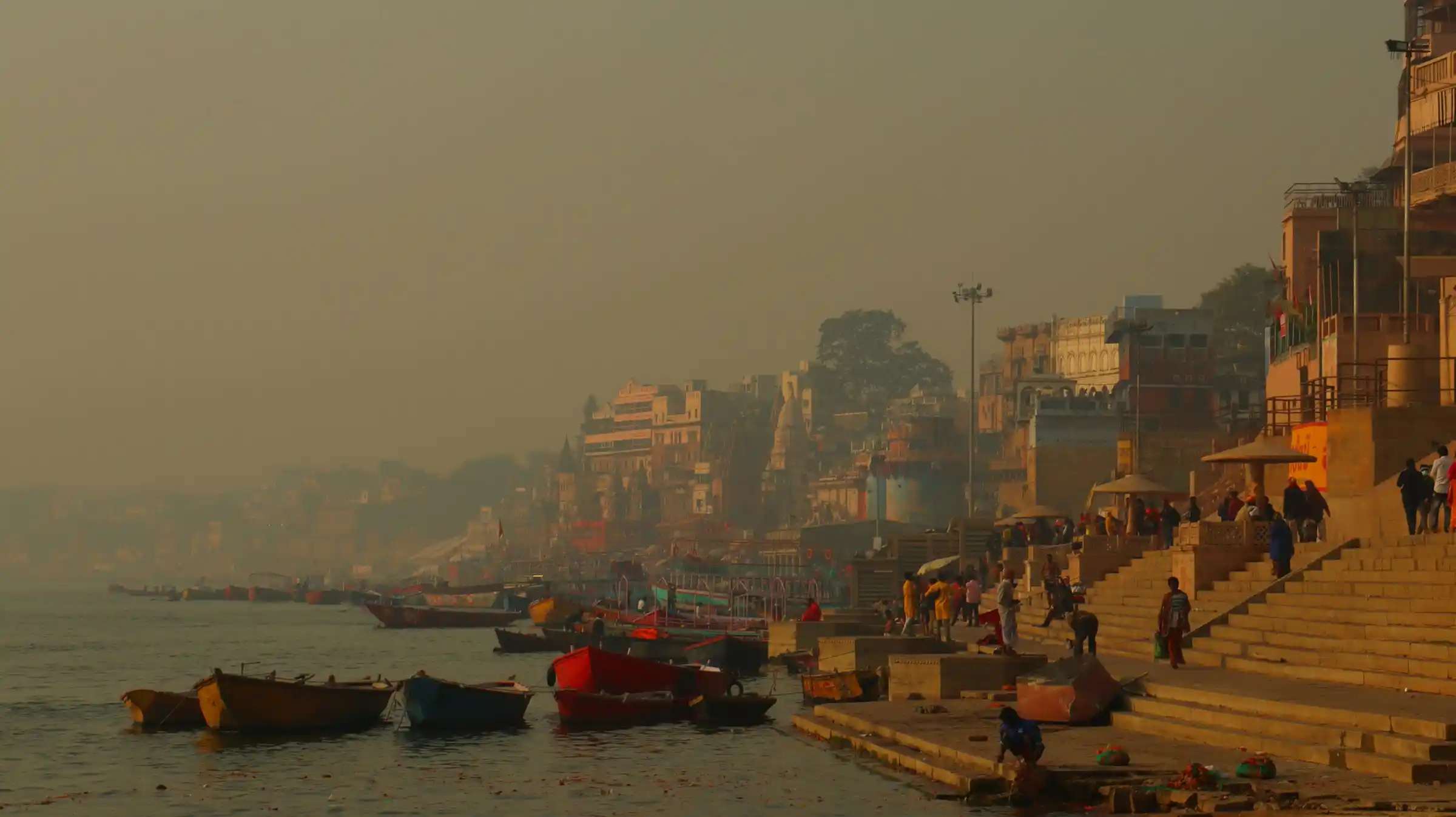
Subah-e-Banaras is one of the popular phrases that evoke images of the sacred city where mornings begin before sunrise. Many residents get up early and head straight for the river to take a ritual dip in the Ganga and offer salutations to the radiant sun with water held in their cupped palms. Afterwards, they walk leisurely to their favourite roadside kiosk for a brunch of kachori-subzi and jalebi.
Sleepy tourists are shepherded by multilingual guides for another ritual—the boat ride downstream to enjoy the sunrise, followed by a visit to the Vishwanath Temple via the newly constructed corridor that, for the protesting purists, has changed the historic character of the city.
Another tempting boat ride coincides with sunset as darkness begins to descend, marking the time for the beautifully choreographed Ganga Aarti. Multi-coloured reflections created on the rippling waves by heavy brass oil lamps are mesmerising. Alas, the giant LCD panels and neon signs installed in recent years have dealt a mortal blow to the traditional spectacle.
Benaras is derived from the word Varanasi, denoting the confluence of two rivulets, Varuna and Asi, which today have a drain-like appearance. It is also called Kashi, City of Light, where Siva manifested himself as a jyotirlingam—a limitless pillar of light. This is home to the Great God, Mahadeva-Shiva, when he descends from his abode, Kailas, in the snow-covered Himalaya. The principal shrine in the city is dedicated to him as Vishwanath—the Lord of the Universe. The temple of goddess Annapurna, the compassionate mother who feeds the entire universe, stands by its side.
Ganga, considered the holiest river in the land, suddenly turns northwards, girdling the ghats in an expansive crescent. The bathing ghats were repaired and rebuilt by Rajmata Ahalya Devi Holkar of Indore in the 18th century. Their beauty was captured in beautiful pen-and-ink sketches by James Princep, a young subaltern serving the East India Company. Ghalib, the great Urdu poet, once compared the majestic stream to a mirror that reflects the celestial beauty of its face.
Devout Hindus believe that death in Kashi guarantees deliverance from the misery of the painful cycle of rebirth. Devout Muslim residents revere Ganga equally and love their city no less. Bismillah Khan, the peerless shehnai player who took what was till then a plebeian instrument to sublime heights, refused to move to Pakistan at the time of Partition, sighing disarmingly, “How can I leave my birthplace and live there where Ganga Maiyya (loving mother) doesn’t flow?”
Legendary courtesans and embodiments of refinement—Rasoolan Bai, Siddheshwari Devi and Girija Devi—have been the custodians of the priceless musical heritage of Thumri and Dadra. Sitara Devi did the same for the Benaras style of Kathak dance. The flautist Hari Prasad Chaurasiya belongs to the city.
Tabla maestros like Gudai Maharaj, Shanta Mahraj and Kanthe Mahraj have enriched the performances of vocalists and instrumentalists at home and abroad.
Benaras has for millennia provided a stage for scholarly debates and inspired poets in residence. Its allure brought the ‘Beat Guru’ Allen Ginsberg here in the late 1950s. The Frenchman Allen Danielloue, the brilliant translator of the Kamasutra, lived here for years.
Tulsidas composed his Awadhi classic Ramcharitmanas, making Valmiki’s Ramayan accessible to millions who didn’t know Sanskrit. Kabir, a weaver by profession, a trenchant critic of the caste system and superstitious practices in all creeds, and a major voice of protest in the social reformist Bhakti Movement, was his contemporary.
When the Benaras Hindu University (BHU) was founded by Pt. Madan Mohan Malviya, it attracted the best talent in the land—philosophers, physicists, polymaths and musicians—Dr Radhakrishnan, Meghnad Saha, the Kosambi duo, father and son, and Pt. Onkar Nath Thakur.
Kalabhawan at BHU houses one of the richest art collections—a gift by a passionate collector, Rai Krishna Das.
The vegetarian food in the city has many iconic dishes—lip-smacking chaat and drool-worthy confections made with both grains and milk that cater to the endless stream of pilgrims. Thandai (thickened milk enriched with almond paste, rose petals, cardamoms and raisins, and spiked with well-ground hemp leaves) is the signature all-seasons beverage. The flavours of Benaras include juicy langda mangoes and magahi paan (betel leaves).
The repertoire of non-vegetarian delicacies is exceptionally rich, with dishes flavoured differently from similarly named culinary cousins in Awadh. This isn’t surprising, as almost forty percent of the city’s population comprises Muslims who migrated centuries ago as master weavers and embroiderers specialising in zardozi—working with silver and golden threads to create dazzling brocades.
Benaras is always fragrant with roses, marigolds and many varieties of jasmine offered by pilgrims in worship to deities and used to adorn the idols or lingam. Fumes rising from incense carry a strong whiff of sandal, agaru and camphor. These mask the smell of burning flesh escaping from the pyres on historic cremation grounds like Manikarnika.