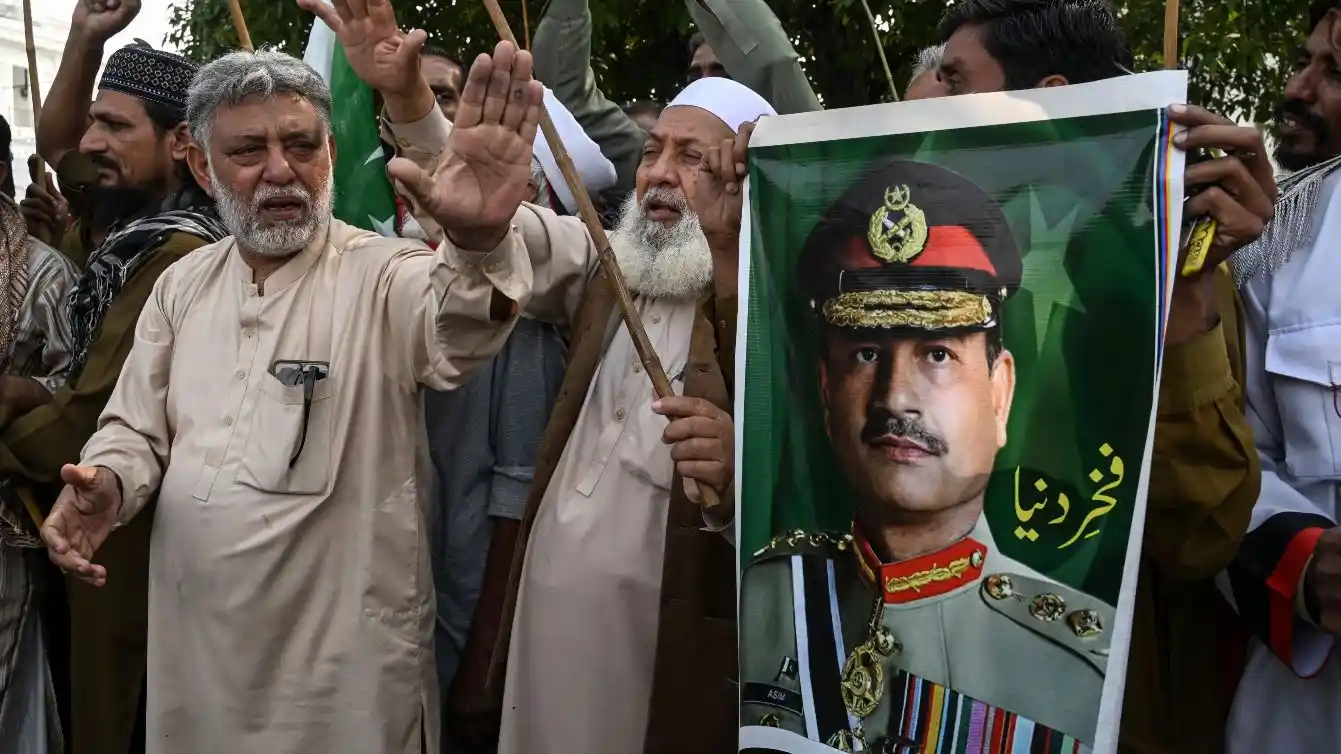
Pakistan is facing challenges on almost every front. The diplomatic depth created by Munir’s Mecca-and-West Asia propaganda diplomacy is now fading. Pakistan’s security establishment is confronting a hard reality, prompting it, especially the Army, to pivot towards Inter Services Intelligence (ISI) to recalibrate its security response, make hierarchical changes, and induct hardliners to stabilise internal chaos within the establishment.
The Hard-lining Of ISI
The institutional hardlining, or, put differently, the radicalisation of institutions by hardcore Islamists in Pakistan’s context, is an old playbook of the Mullah Generals or the dictatorial tendencies of Pakistan’s military establishments whenever the security establishment faces continuous crises and requires a hardening of the security response and stabilisation of internal infighting. Loyalty is one factor, but a more crucial one is setting the stage for a harder hierarchy to counter growing instability from outside and, more particularly, within.
The Cold War and Afghan Years
Pakistan’s security establishment was reeling from politico-military crises after Zia’s coup and his takeover as military dictator of Pakistan. Lt General Ghulam Jilani, his close confidant whom General Ayub Khan appointed ISI chief, played a key role in staging the coup and, if some reports are to be believed, kept Zia informed about Bhutto’s political moves after the 1977 elections. Zia rewarded Jilani by making him Defence Secretary and later Governor of Punjab. But many believe Jilani consolidated his power as ISI Chief to purge pro-Bhutto factions and align the ISI with Zia’s thinking and martial law. After the coup, when Jilani became Defence Secretary, he acted as Zia’s principal administrator, overseeing the political establishment’s dismantling of dissent against Zia’s martial law and laying the groundwork for Zia’s prolonged martial law regime.
The Afghan War
By 1979, Zia’s regime faced internal and external instability. Zia had executed former Prime Minister Bhutto in April 1979, triggering massive internal unrest and public anger. Externally, the U.S. Carter regime had a strained relationship with Zia’s regime. The Carter regime, which prioritised human rights and democracy, largely distanced itself from the military dictatorship. However, the tipping point came in April 1979, when the U.S. discovered Pakistan’s secret uranium enrichment facility at Kahuta. In response, the Carter administration enforced the Simanghnit Amendment and cut off all economic and military assistance to Pakistan. As the regime deteriorated, Zia appointed Lt Gen Akhtar Abdur Rahman as DG ISI within two months, in June. According to reports, Rahman was considered an institutional hardliner and intensely secretive, with a cold, no-nonsense approach, and tried to leverage the Soviet Invasion of Afghanistan as an opportunity to rebuild ties with the US and bring the CIA-ISI relationship closer, bypassing Pakistan’s civilian Intelligence agency, the Intelligence Bureau, which was earlier used to coordinate and contact with the CIA. Rahman gradually consolidated immense power over Pakistan’s mujahideen, funding Operations and the ISI’s Afghan network. He systematically crushed internal dissent and eliminated insubordination by sidelining officers with independent political ambitions or commando backgrounds that didn’t fit his top-down vision. He transformed the ISI from a disjointed domestic surveillance bureau into a heavily armed, highly disciplined vanguard.
Rahman not only became the chief architect of Afghan Jihad against the Soviets but also established its networks and operational structure within the ISI. Rahman, who remained at the helm until 1987, laid the groundwork for replicating the Afghan model in Kashmir.
Another Crises
Three months after Zia’s death, fresh elections were held in Pakistan, leading Benazir Bhutto to form a coalition government. However, this was perhaps the first time when ISI became hyperactive in interfering in Pakistan’s politics. Lt General Hamid Gul, who succeeded Rahman as DG ISI, was said to have been instrumental in strengthening ISI’s financial and audit controls, enabling the agency to manage Afghan operations more efficiently and establish financial supply networks. Gradually, under Gul’s leadership, ISI assumed a strong sense of autonomy over financial affairs in Afghanistan. He did not even welcome the US’s interference in the conduct of operations in Afghanistan. Lt General Hamid Gul was saved by Zia when the civilian government of Pakistan under PM Junejo ordered a high-level parliamentary inquiry into the Ojhri ammunition disaster and explicitly recommended against ISI DG Hamid Gul, but before anything could materialise, Zia dissolved Junejo’s government.
But the real crisis began after Benazir Bhutto took over. Hamid Gul, as DG ISI, covertly helped the consolidation of the opposition Islami Jamhuri Ittihad(IJI) coalition under the leadership of Nawaz Sharif against Benazir Bhutto; however, soon after the Jalalabad controversy, where Hamid Gul bypassed the civilian government in the final days of Afghan operations, it led to an intelligence fiasco that gave Bhutto a chance to remove Gul from DG ISI. The then Army Chief, General Aslam Baig, supported Bhutto’s move, as many disliked Gul for wielding such immense power as DG ISI.
Later, ISI became the centre of political showdowns: Bhutto’s appointee as the new DG ISI did not enjoy the command and was often bypassed by juniors, who instead took orders and reported to General Baig. After a year, ISI retaliated with active support for General Baig and engineered a no-confidence motion against Bhutto in the infamous political scandal(Operation Midnight Jackal), where ISI actively bought the loyalties of politicians to topple her democratically elected government. But Pakistan’s Intelligence Bureau sided with Benazir and exposed ISI’s Operation Midnight Jackal. Armed with this definitive proof, Bhutto went public with the evidence. She successfully neutralised the defections within her ranks, and on November 1, 1989, she narrowly survived the no-confidence vote by a margin of 12 votes.
As the 1990 elections approached, Benazir could not survive another attempt to oust her by manipulating the elections to prevent her from being re-elected. This time, General Baig, again with the DG Military Intelligence, Lt. General Assad Durrani, who had been appointed as ISI DG, led the effort. General Baig was facing immense pressure to be court-martialled due to the exposure of a political scandal and needed to retain military control over ISI, which was rife with factionalism due to hyper-politics in the agency since Hamid Gul. Durrani temporarily brought the ISI back under tight GHQ oversight, re-harmonising the damaged relationship between the Army’s operational wings and its premier intelligence agency.
The Musharraf Crises
After 9/11, the ISI was heavily invested in supporting the Taliban regime in Kabul. However, when General Pervez Musharraf chose to support the U.S.’s War on Terror after immense pressure from the U.S. security establishment, it triggered a massive, explosive ideological rift within the Pakistani military hierarchy. The then-DG ISI, Lt. Gen. Mahmood Ahmed, along with several hardline Corps Commanders, fiercely opposed Musharraf’s policy of aligning with the U.S. and assisting in anti-Taliban operations. Musharraf removed Mahmood Ahmed and placed a hardened, unflinchingly loyal institutionalist, Lt. Gen. Ehsan ul Haq, in charge of the ISI. He initiated an extensive internal purge, tracking down, court-martialing, or forcibly retiring pro-Taliban or Islamist-leaning intelligence officers. By enforcing Haq’s unyielding adherence to official state policy, he ironed out the split between the ISI and Musharraf’s military.
The Munir Era
The 2022 political crises in Pakistan again relied on the ISI’s historical hardline strategy to defuse then-Imran Khan’s hyper-political actions, steering away from military and intelligence influence through Khan’s close confidant. The then-DG ISI, Lt. Gen. Faiz Hameed, had developed an intimate political alignment with Prime Minister Imran Khan, creating a direct rift with Army Chief General Qamar Javed Bajwa, including the removal of the then ISI chief in 2019 and now COAS and Field Marshal of Pakistan Asim Munir. When Asim Munir assumed office as the new COAS in late November 2022, he restructured the intelligence and military establishment and inducted hardliners; notably, high-ranking officers, including former DG ISI Faiz Hameed himself, were taken into military custody and subjected to court-martial proceedings to send a shockwave through the ranks.
The Recent Reshuffle
Just a few days ago, Pakistan’s ISI and military top brass underwent a reshuffle; perhaps for the first time in a long time, Pakistan’s security establishment has seen such a heavyweight reshuffle. The scenario under which such a reshuffle is taking place is also of key importance, as Pakistan is reeling under multiple instabilities, from political and financial to security, descending into what can be called a polycrisis.
The pattern of ISI relying on hardliners’ book seems quite relevant even in the recent reshuffle, where, according to reports, Maj. Gen. Adil Iftikhar Warriach was appointed Director General of Military Intelligence (DGMI) and is soon to be promoted to Lt General, brought in directly from field command at the 7 Infantry Division in North Waziristan, a major counterterrorism theatre. Many saw the DG MI post as a launchpad for the next ISI Chief’s slot. Another name is Maj. Gen. Muhammad Shamriaz Khan, appointed DG S (Special Operations) at ISI, was brought in from the Pakistan Rangers Sindh, where he served as DG Pakistan Rangers Sindh Division. S Division of ISI focuses on Special operations and proxy warfare and directly works with ISI’s division handling Indian affairs.
Two more names were brought in from outside: one is Major General Jawwad Riaz, hailing from the 11th Baloch Regiment and incumbent DG of the Pakistan Coast Guard, appointed as DG Personnel in ISI, and another is Major General Sajid Mehmood, brought in from the 32nd Punjab Regiment, appointed as DG Z Branch of ISI, responsible for crucial infrastructure security, technology matters, and the China–Pakistan Economic Corridor (CPEC).
This reshuffle in the ISI and the military clearly indicates two things: first, it hardlines inter-agency coordination to aggressively counter politico-security threats inside Pakistan, as reshuffled officers are hardcore and selectively picked. Second, it sets the stage for the next ISI chief, who is currently operating in interim charge with Pakistan’s NSA Asim Malik since May last year, to consolidate more military-ISI control to influence and navigate through the current crises and strengthen security and strategic response not only in Pakistan but also in the region as a whole, especially against India.