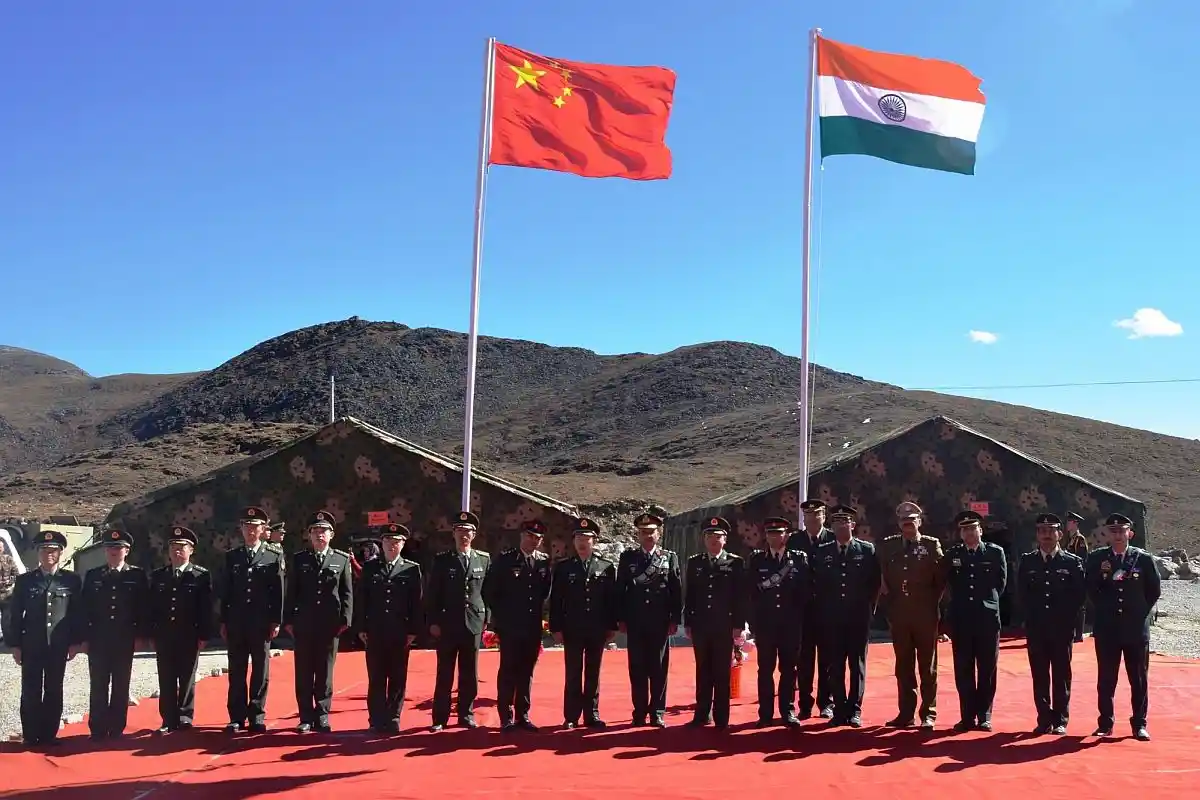
The Ministry of Defence’s Annual Report for 2025–26 states that 2025 witnessed a “significant reduction in deployment of People’s Liberation Army (PLA) Forces opposite Northern Borders.” It also notes that ten combined-arms brigade-sized formations remained deployed in areas along the Line of Actual Control (LAC) and in traditional training areas.
The movement of Chinese formations away from some forward positions may signal a change in deployment patterns. However, it would be premature to interpret these developments as evidence of a comprehensive Chinese withdrawal or a reduction in overall military preparedness.
Military effectiveness depends not only on the number of soldiers positioned near the frontier, but also on roads, tunnels, airfields, communications, logistics, reserves and surveillance. The more consequential questions are how quickly a threat can be detected, how soon reinforcements can reach an exposed sector, and whether forces can be sustained once deployed.
This development also needs to be considered alongside the cautious improvement in India–China relations since 2025. Political, diplomatic and military contacts have resumed, creating some room for risk reduction even though the boundary dispute remains unresolved.
From confrontation to cautious engagement
The crisis following the Galwan Valley clash in 2020 transformed the bilateral relationship. The unprovoked violence at the LAC led to expanded military deployments, deepened mistrust and affected almost every aspect of India–China ties.
The understanding on patrolling and disengagement reached in October 2024 created the first significant opening after years of tension. During 2025, this was followed by a gradual restoration of high-level contact.
Meetings between External Affairs Minister S. Jaishankar and Chinese Foreign Minister Wang Yi, together with Wang Yi’s visit to India from 18–20 August 2025, helped reopen discussions on the border, air connectivity, visas, trade and people-to-people exchanges.
On 18–19 August 2025, Wang Yi and National Security Adviser Ajit Doval co-chaired the 24th round of talks between the Special Representatives on the boundary question. The mechanism remains an important political channel, but it cannot substitute for negotiations on the alignment of the LAC or a final boundary settlement.
The Working Mechanism for Consultation and Coordination on India–China Border Affairs (WMCC) has likewise provided an institutional channel for addressing border-related concerns. Such mechanisms matter in a relationship where a local incident can quickly acquire national significance.
The 25th round of Special Representatives’ talks was held in Beijing on 25 August 2026. The resumption of the Kailash Mansarovar Yatra, efforts to restore direct air links and the revival of institutional exchanges added to the impression of cautious normalisation.
Military-to-military contacts also widened. On 6 and 7 September 2026, India and China held senior commander-level flag meetings at Wacha–Damai in the eastern sector, providing another channel for managing tensions.
The meeting between Prime Minister Narendra Modi and President Xi Jinping on 12 September 2026, on the sidelines of the BRICS Summit in New Delhi, offered another political signal. Both leaders stressed that differences should not become disputes. Modi underlined the importance of peace and tranquillity in the border areas, while both sides reaffirmed the need for a fair, reasonable and mutually acceptable resolution of the boundary question. Xi emphasised the importance of partnership rather than rivalry.
These developments do not amount to a settlement. Concerns relating to the LAC, Arunachal Pradesh, trade imbalances, military infrastructure and China’s relationship with Pakistan remain. They do suggest, however, that both governments may be seeking to place some guardrails around their rivalry.
The military picture beyond troop numbers
The reported reduction in Chinese forward deployment should therefore be viewed as part of a broader military and diplomatic recalibration.
A formation moved to a traditional training area is not necessarily removed from the strategic equation. If adequately equipped, trained and positioned within rapid-reinforcement distance, it could still be mobilised when circumstances require. The military value of a formation depends on its readiness, transportability, acclimatisation, communications and logistical support.
The central issue, therefore, is not simply how many soldiers are deployed along the LAC. It is how much combat power each side can bring to a particular sector—and how quickly it can do so.
Infrastructure and technology
The Himalayan environment makes permanent forward deployment expensive and physically demanding. Extreme altitude, harsh winters, difficult terrain and long supply lines impose a heavy burden on personnel and equipment.
Infrastructure can alter this equation. Roads, bridges, tunnels, airfields, heliports, logistics hubs, fuel depots, ammunition storage and secure communications networks allow forces to be positioned farther from the frontline while retaining the ability to move forward rapidly. They also facilitate dispersal, rotation and redundancy.
China’s infrastructure development across the Tibetan plateau has strengthened the PLA’s ability to sustain forces and reinforce sensitive sectors. It may therefore reduce the need to maintain the same density of troops at every forward position. India’s own improvements in roads, bridges, tunnels, airfields and logistics facilities have similarly altered the operational environment.
Technology is reinforcing this shift. Satellites, drones, ground sensors and electronic surveillance can provide persistent awareness of troop movements and terrain. Secure communications can connect frontline units with commanders, intelligence agencies, artillery, air assets and reserves. Electronic warfare can disrupt communications and navigation, while precision systems can increase the effectiveness of smaller formations.
Artificial intelligence may further improve surveillance, route planning, logistics and decision support. Yet technology will not eliminate the need for soldiers. Physical presence, human judgement and control of terrain will remain indispensable.
Possible implications for India
The recent diplomatic improvement may offer an opportunity to consider how military preparedness and political engagement can reinforce each other. Several areas merit sustained attention: border infrastructure; integrated intelligence, surveillance and reconnaissance; mobility and readiness of reserves; resilient command and communications systems; and the application of artificial intelligence to logistics and decision-making.
Communications resilience will be particularly important in an environment exposed to cyberattacks, electronic warfare, severe weather and physical disruption. India’s efforts in developing domestic defence capabilities in areas such as autonomous systems, counter-drone technologies, secure communications, high-altitude logistics and electronic warfare, is quintessential to maintaining peace at LAC.
The changing character of the border environment may require a review of existing confidence-building measures. Earlier arrangements were designed largely around conventional troop movements and face-to-face encounters. Future mechanisms may need to address drones, autonomous systems, satellite surveillance, electronic interference, large-scale exercises and rapid mobilisation.
Greater transparency regarding major exercises, infrastructure development and reserve movements might help reduce miscalculation, provided such measures were reciprocal and compatible with legitimate security requirements. Diplomatic consultations, the Special Representatives’ mechanism, the WMCC and military hotlines are likely to remain important, but their procedures may need to evolve with the changing border environment.
Managed competition, not complacency
The political and diplomatic signals since 2025 suggest that India and China are attempting to stabilise their relationship. Continued Special Representatives’ talks, WMCC meetings, engagement between Jaishankar and Wang Yi, senior military contacts and the Modi–Xi meeting provide channels for managing differences.
The reported reduction in Chinese forward deployment may be part of that process. It may also reflect operational recalibration, resource optimisation or greater reliance on infrastructure and technology. These explanations are not mutually exclusive.
The developments offer scope to reduce the danger of another crisis, but they do not signify the end of strategic competition. The future of deterrence along the LAC will depend not only on the number of troops visible at the frontier, but on how effectively they are connected to roads, sensors, satellites, reserves, airlift, logistics and political decision-making.
Continued preparedness would help ensure that engagement rests on a realistic assessment of the strategic environment rather than on the assumption that the underlying rivalry has disappeared.