The evenings in the city of Lucknow, the heart of Awadh, whisper intoxicating seductions in responsive ears.
The Hindustani word shaam rhymes easily with shabaab (beauty, kebab, and sharab (wine). The city is more a fairytale reimagined by succeeding generations than a settlement with credible history.
Its origins are traced to a mythic past. The Province of Awadh, aka Oudh, derives its name from Ayodhya, a mighty Kingdom that none could battle, once ruled by Sri Ram, the hero of the Hindu epic Ramayana. According to legend, Lucknow was named after his younger brother Laxman.
Under the imperial Mughals, the large province stretching from the borders of Delhi to Bengal prospered. The East India Company coveted it and conspired first to control and then to annex it.
The last king of Awadh was Wazid Ali Shah, who was cheated of his principality in 1856 and banished to exile in Calcutta. History remembers him as a pleasure-loving person, extremely talented in poetry, theatre, music and dance, a generous patron of artistes. Contemporary British accounts portray him as a villain. He is presented as a weakling and a debauchee who had brought Awadh to the brink of bankruptcy and ruin. It should not be forgotten that the British were building a case to grab the resources of Awadh.
It was during his reign that a distinct style of Kathak evolved in Lucknow and the semi-classical styles of singing Thumri and Dadra flourished. Lucknow carved a niche for itself in these art forms, outshining its neighbor Banaras. Singers like Begum Akhtar and maestros like Achhan Maharaj, Lachhu Maharaj and Birju Maharaj held their ground while performing with equally talented rivals.
What most people imagine Lucknow to be is a fantasy conjured by films like Chodhavin ka Chaand, Shatranj ke Khiladi, Pakiza and Umran Jaan. They have reinforced the illusion that this is where descendants of nawabs continue to live, preserving the syncretic Ganga Jumana Tehzeeb – a refined way of life inclusive and pluralistic. Carefully guided tours of the by-lanes and streets in Chowk and Aminabad provide selective glimpses of silver-leaf making, filigree-like embroidery, and blending of exotic seasonal perfumes.
Lucknow is considered the Mecca of food lovers in India with its incomparable melt-in-the-mouth galawat ke kebab- Tunde ke galouti, Kakori on the skewers, Sakhawat ke flavourful shami. Add to this list the crumbling at mere touch chhui mui ke kofte, aromatic Murgh Qorma, Musallam and myriad pulav.
What remains largely unsung are the vegetarian delicacies that more than match the meaty fare in the city.
From the days the capital was shifted from Faizabad to Lucknow, it has been home to a large Hindu vegetarian population. Brahmins, Banias, Khatris and Kayastha- a community of scribes and administrators where men eat meat, but the women are mostly vegetarian.
There are many mock meat dishes created for them by gifted bawarchis employed by the epicurean aristocrats. crafted with seasonal vegetables, jackfruit, raw bananas, and yam.
Some of these have spawned idioms like Ye munh aur masoor ki dal! The words encapsulate an interesting tale recounting the episode when an expert chef cooked an exotic lentil soup with aphrodisiac properties for his patron. It had to be consumed piping hot. When the nawab kept the dish waiting, the cook threw a tantrum and left in a huff pouring the soup on a shrivelled tree in the backyard. Departing, he was heard muttering the words “ This mouth doesn’t deserve this dal.” When green shoots sprouted from the stump, the Nawab rued his loss!
Nawabs smitten by European architecture had employed Claude Martin, a French soldier of fortune who built Clemente’s a magnificent residence-cum- mausoleum for himself that later became Le Martinierre College. Situated on the bank of the river Gomti, it is a more impressive edifice than the golden-domed Chattar Manzil Palace.
Lucknow was rebuilt by the British from the rubble of the palaces they had destroyed in the aftermath of 1857. Even that city has disappeared since the last quarter of the 20th century.
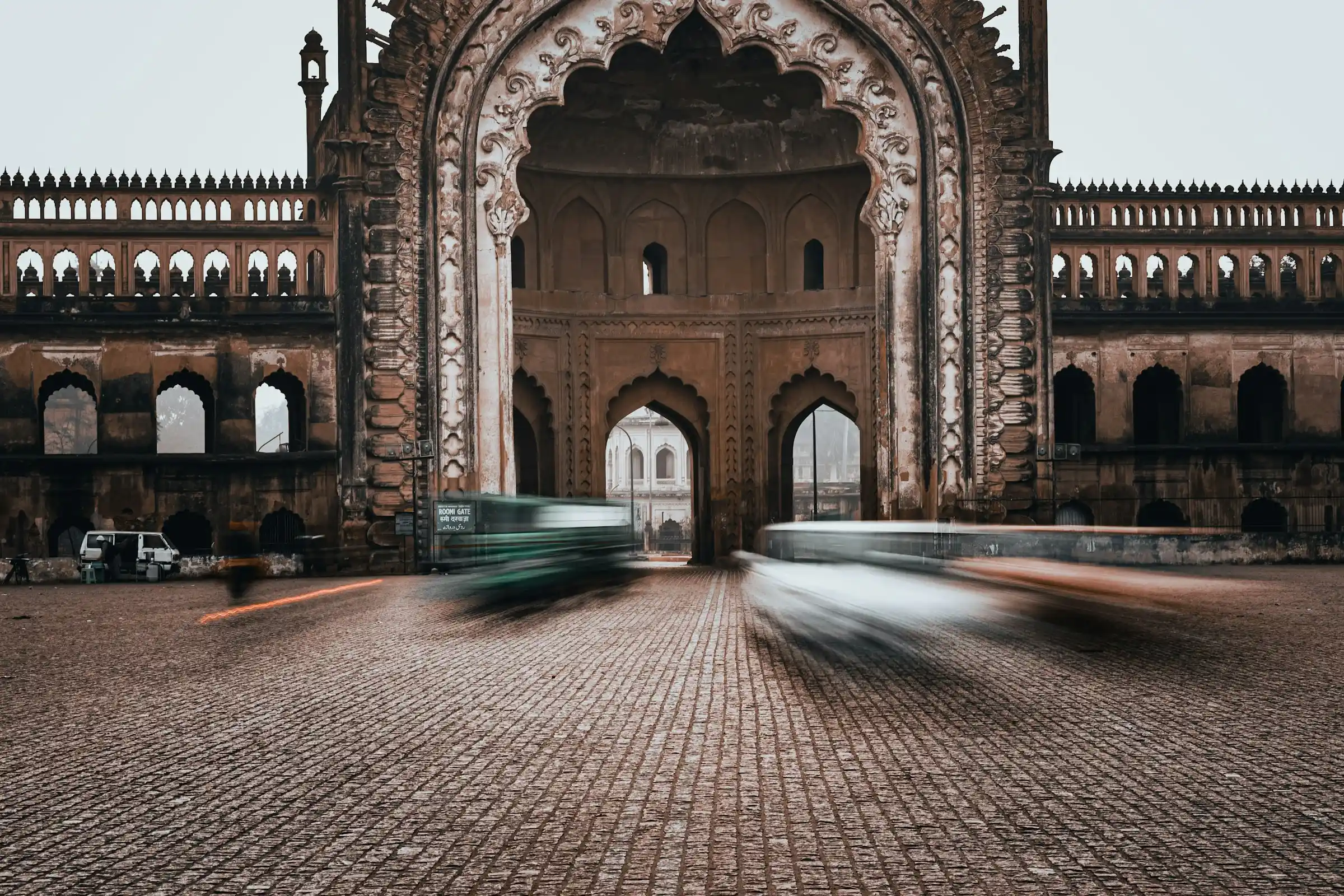
Kaiser Bagh, an elegantly planned city commissioned by Wazid Ali Shah, survives as a beauty ravaged by cruel time. Majestic landmarks like Bada and Chota Imambada, the ornate Rumi Darwaza, and the pockmarked Residency (even pockmarked by cannonballs) lost in the bustling city resonate with echoes of a haunting past.
The cultural legacy of Lucknow arguably owes more to the cosmopolitan immigrant faculty of Lucknow University in the 1920s and other ‘outsiders’ who headed institutions like the Marris College of Music and the Lucknow School of Arts than to flamboyant, blue-blooded descent.
The powerful mystique of the city conjured by legend and lore continues to encourage natives and newcomers alike to identify as Lakhnawi. Adopting the costume and its excessively polite cultural mores, they lounge and stroll wearing seasonally appropriate perfumes – khus, mitti, gulab, and musk.