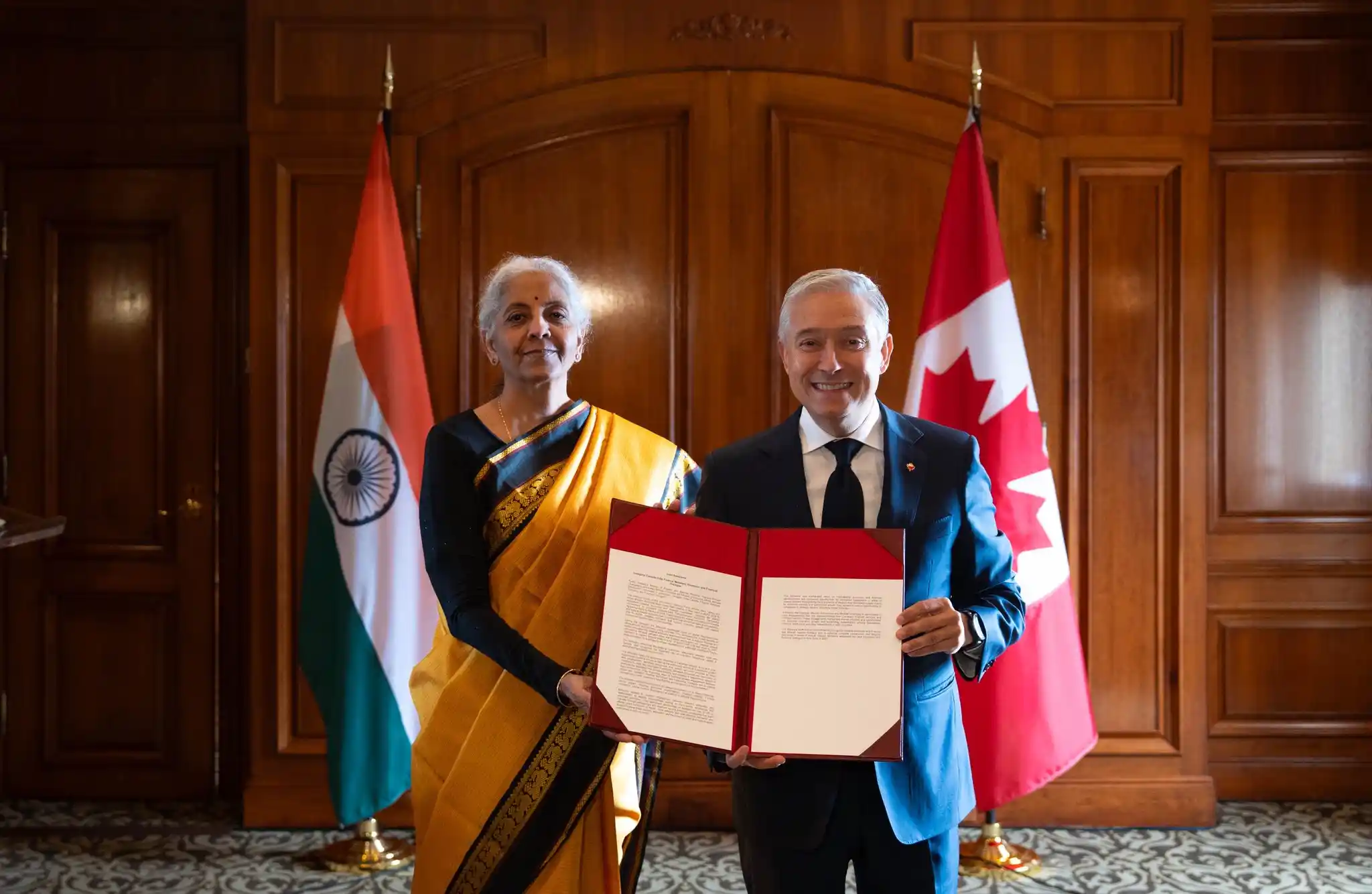
For years, the India-Canada relationship has been described in diplomatic shorthand as “underperforming its potential.” Two G20 economies, deep people-to-people links through one of the world’s largest Indian diasporas, and a natural complementarity of resources and markets — yet the economic relationship rarely matched the promise. This week’s inaugural Economic and Financial Dialogue between Finance Minister Nirmala Sitharaman and her Canadian counterpart François-Philippe Champagne in Toronto suggests that dynamic may finally be shifting, and for the better.
What makes this moment significant is what they’re talking about. The conversation has moved decisively beyond the old vocabulary of tariffs and trade balances into a far more ambitious register: investment flows, capital markets integration, fintech cooperation, cross-border payments, and critical minerals. This is the language of two economies trying to become structurally intertwined, not just occasional trading partners.
Consider the numbers that frame this shift. India is now the world’s fourth-largest economy and its fastest-growing major one. That single fact changes the nature of any bilateral conversation — India is no longer approaching these talks as a supplicant seeking market access, but as a scale player offering a platform for global growth. Champagne’s own framing captured this inversion neatly: he spoke of India as a “partner of choice” for energy security, not merely a market to be served.
Canada, meanwhile, brings something India needs badly as it builds toward its stated 2047 development goals: patient, long-horizon capital. Canadian pension funds — the CPPIB, the Ontario Teachers’ Pension Plan, and others — are already the largest institutional investors in Indian infrastructure. This is not incidental. Pension capital is exactly the kind of money that large infrastructure buildouts require: it doesn’t need to exit in three years, it can absorb the slower payback curves of highways, transmission lines, and urban transit systems. The fact that OTPP’s partnership with India’s National Investment and Infrastructure Fund came up specifically in these talks, alongside discussion of expanding into transmission, transport, urban infrastructure and renewable energy, signals that both sides see room to deepen an already-working model rather than invent one from scratch.
The financial sector cooperation track deserves particular attention. Discussions around cross-border payments, financial stability and capital markets integration are not glamorous headline material, but they are the plumbing through which everything else flows. Easier remittance corridors, deeper capital market linkages, and coordinated approaches to fintech regulation would matter enormously to the millions of Indian-origin residents in Canada and to the businesses on both sides trying to move money, not just goods, across the Pacific and the Atlantic. If this dialogue succeeds in making those channels more efficient, its impact will be felt far beyond boardrooms.
Then there is the critical minerals dimension — arguably the most geopolitically consequential thread in this whole conversation. As countries worldwide scramble to diversify supply chains away from overconcentration in any single source, a Canada-India axis on critical minerals and energy security offers both sides a hedge and an opportunity. Canada has the resources and processing ambitions; India has the manufacturing base and the demand growth to make such a partnership economically rational rather than merely symbolic.
Most importantly, the direction of travel here is genuinely encouraging. Sitharaman’s outreach to Canadian CEOs — inviting them to see India not as a destination but as a partner and platform — reflects a maturing pitch, one that assumes long-term, deeply embedded partnerships rather than transactional deals. Champagne’s enthusiasm about being “part of the journey” of India’s growth suggests Ottawa sees the same opportunity.
If both governments can translate this week’s dialogue into sustained institutional cooperation — in capital markets, fintech, infrastructure financing and critical minerals — the India-Canada relationship could finally start living up to the potential everyone has always claimed it had. That would be worth celebrating, not just as a diplomatic win, but as a genuine template for how two democracies with complementary strengths can build an economic partnership fit for the next several decades.