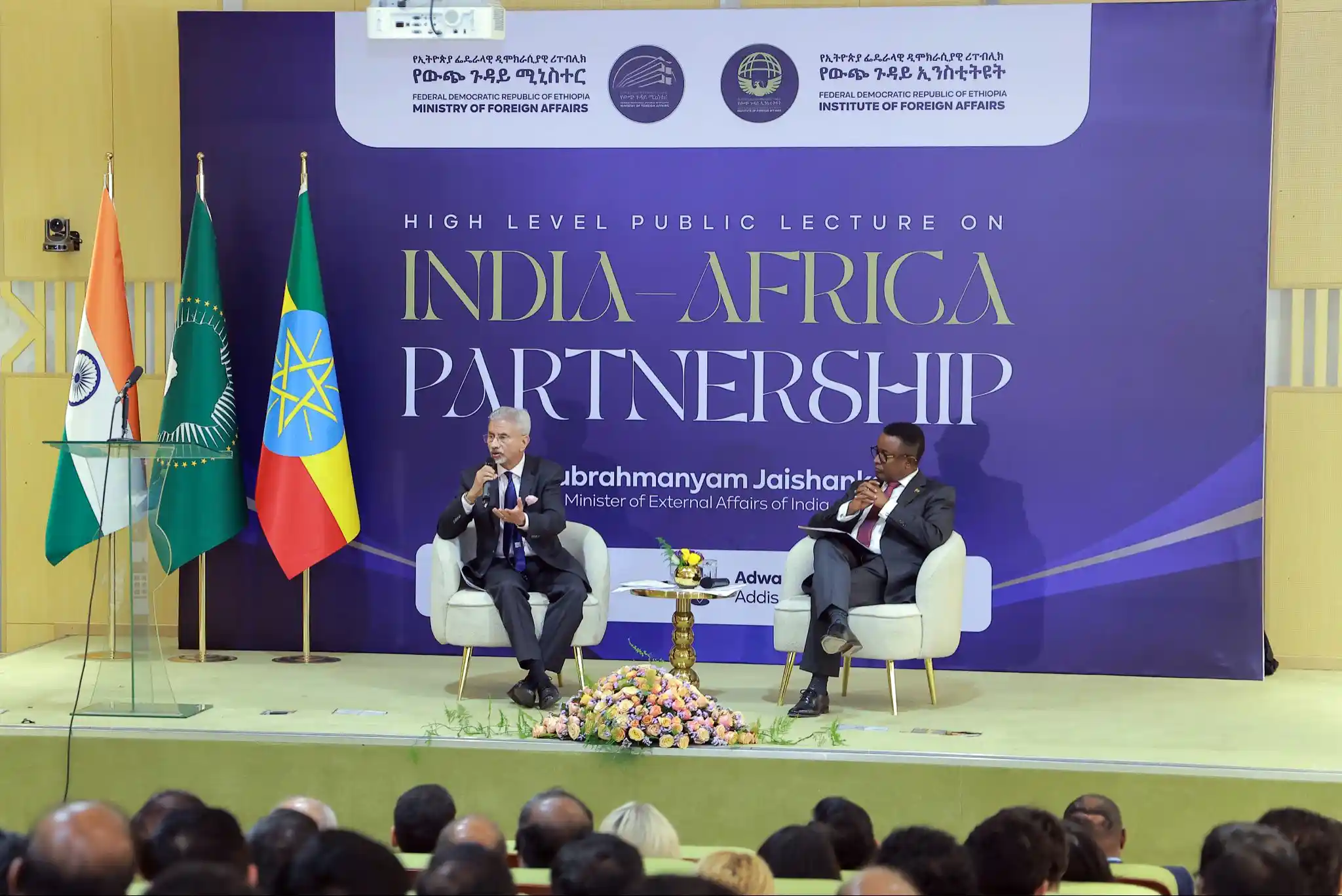
The Indian External Affairs Minister S. Jaishankar’s recent visit to Ghana, Côte d’Ivoire and Ethiopia was more than protocol. It reflected a relationship increasingly defined by concrete trade numbers, investment on the ground, and African priorities in health, agriculture, industrialisation and skills. For African economies seeking diversified partners, capital and technology without new dependencies, the visit offered clear signals of momentum.
Ghana: Trade surge and industrial ambition
In Accra, Jaishankar met President John Dramani Mahama and Foreign Minister Samuel Okudzeto Ablakwa. Bilateral trade has risen sharply: Ghana’s Investment Promotion Authority reported growth from roughly $3 billion in 2024 to about $6.5 billion in 2025, with Ghanaian exports (driven largely by gold, plus petroleum oils, cashews, oilseeds and wood) reaching around $5.2 billion. President Mahama noted exports climbing toward nearly $7 billion. Indian exports of machinery, vehicles, pharmaceuticals, plastics and chemicals move the other way, creating a relationship in which Ghana runs a substantial surplus.
Investment is substantial. Authorities have recorded more than 1,000 Indian-related projects between 1994 and 2026, valued at approximately $12.07 billion across manufacturing, agriculture, services, construction and trading. Earlier official tallies cited hundreds of projects worth nearly $2 billion by late 2024. The relationship was elevated to a Comprehensive Partnership during Prime Minister Narendra Modi’s July 2025 visit.
Tangible outcomes included two memoranda: one linking India’s Council of Agricultural Research with Ghana’s CSIR-Crops Research Institute for research, education, technology transfer and commercialisation (starting with high-yielding tomatoes and extending to cassava, yam and post-harvest systems), and another on biodiversity cooperation. Ghana formally joined the India-led International Big Cat Alliance for conservation of major species and habitats. Cabinet also approved a bid for BRICS membership; Jaishankar indicated India’s long-standing supportive stance, subject to collective decision.
Discussions focused on Ghana’s Accra Reset agenda: local pharmaceutical and vaccine production (building on the Atlantic Life Sciences–KinaPharma partnership), agricultural mechanisation and value addition, industrialisation and job creation, scholarships, IT partnerships, railways (including the Tema–Mpakadan line), defence and digital cooperation. Mahama explicitly invited further Indian pharmaceutical investment to advance health sovereignty and reduce import dependence. These priorities align with Ghana’s industrialisation goals and the African Continental Free Trade Area’s push for regional value chains.
Côte d’Ivoire: Expanding commercial and defence links
In Abidjan, Jaishankar held talks with Minister of State for Foreign Affairs and International Cooperation Nialé Kaba and Vice Prime Minister and Defence Minister Téné Birahima Ouattara. Bilateral trade reached $1.54 billion in fiscal 2024–25, up from $1.07 billion the previous year, with further growth evident in subsequent months. India imports natural rubber, cashews, cotton and teak; it exports rice (a major item supporting food security), vehicles, medicines and machinery. Indian firms have invested in cashew processing and rubber plants.
Talks covered trade, investment, infrastructure, agriculture, healthcare, people-to-people ties, defence and anti-terrorism cooperation, and multilateral engagement. India has extended lines of credit and support via the ECOWAS Bank for Investment and Development. Capacity-building remains a pillar: scholarships, technical training and institutional support address Côte d’Ivoire’s priorities under its National Development Plan. The relationship positions the country as a key West African partner for deeper value-chain cooperation beyond commodity exchange.
Ethiopia: Strategic partnership and investment depth
The final leg in Addis Ababa advanced the Strategic Partnership elevated during Modi’s December 2025 visit. Jaishankar met Foreign Minister Gedion Timothewos and Ethiopian Investments Holdings CEO Brook Taye, discussing trade, investment, development projects, infrastructure, maritime issues, security, technology, culture and deeper private-sector partnerships. He also chaired a conference of India’s Heads of Mission across Africa, reviewing trade, investment, connectivity, development cooperation and capacity building.
Bilateral trade stood at $550.19 million in 2024–25 (Indian exports $476.81 million, imports $73.38 million). More than 650–675 Indian companies are registered, with investments estimated between $5 billion and $6.5 billion-plus, concentrated in manufacturing, pharmaceuticals, textiles, agriculture and related sectors, creating over 75,000 local jobs. Eight agreements from the 2025 visit covered a data centre at the Foreign Ministry, G20 Common Framework debt restructuring, customs cooperation, UN peacekeeping training, AI short courses, increased scholarships and maternal/neonatal health support at the Mahatma Gandhi Hospital. Defence cooperation has expanded into training, exercises, military medicine and industry linkages. Critical minerals, digital public infrastructure, renewables and AI feature in forward plans.
Continent-wide foundation and forward potential
| Fiscal Year | Total Trade ($ bn) | India’s Exports ($ bn) | India’s Imports ($ bn) | Notes |
|---|---|---|---|---|
| 2012–13 | 70.3 | 29.2 | 41.1 | Pre-surge baseline |
| 2015 | ~59.4 | ~25.6 | — | Calendar-year reference (Exim Bank) |
| 2019–20 | ~56–67 | ~29 | ~38 | Pre-COVID level (sources vary slightly) |
| 2020–21 | ~56 | ~28 | ~28 | COVID-related dip |
| 2021–22 | ~89.6 | ~40.3 | ~49.3 | Strong post-COVID rebound |
| 2022–23 | ~98 | ~51.2 | ~46.7 | Near $100 bn peak |
| 2023–24 | ~82–90 | ~45–46 | — | Moderation after peak |
| 2024–25 | >100 (minister statement); some compilations ~82 | ~43–45 | ~39–40 | Crossed $100 bn mark per official remarks |
| 2025–26 | 93.69 | 45.42 | 48.27 | +14.39% y-o-y; India net importer by ~$2.85 bn |
These three stops sit within a larger frame. India–Africa merchandise trade reached $93.69 billion in 2025–26, up 14.39 percent, with India importing $48.27 billion and exporting $45.42 billion—making India a net buyer and Africa a significant supplier of energy, gold, minerals and agricultural commodities. The stated aim is to double trade by 2030. India has extended lines of credit worth about $12 billion to 42 African countries, supporting power, railways, water, healthcare, manufacturing and public infrastructure projects. Indian Technical and Economic Cooperation programmes provide thousands of fully funded training slots annually.
The potential lies in moving beyond raw-material trade. African priorities—local pharmaceutical and vaccine manufacturing, agro-processing and value addition, critical minerals beneficiation, digital public infrastructure, renewable energy, rail and industrial capacity, and skills—align with Indian strengths in generics, machinery, digital systems, pharmaceuticals and engineering. Ghana’s BRICS aspiration, Ethiopia’s strategic partnership and Côte d’Ivoire’s defence and agro links illustrate how individual African states are shaping the terms. Combined with the African Continental Free Trade Area’s $3.4 trillion market, this creates scope for Indian firms to locate production inside African economies, generating jobs, technology transfer and regional supply chains.
Jaishankar’s itinerary demonstrated that the partnership is operational, not rhetorical. For African policymakers and businesses, the task is to convert the meetings, memoranda and investment pipelines into factories, processing plants, trained technicians and diversified export baskets that serve domestic and regional demand. The numbers and projects already on the ground show the trajectory is favourable.