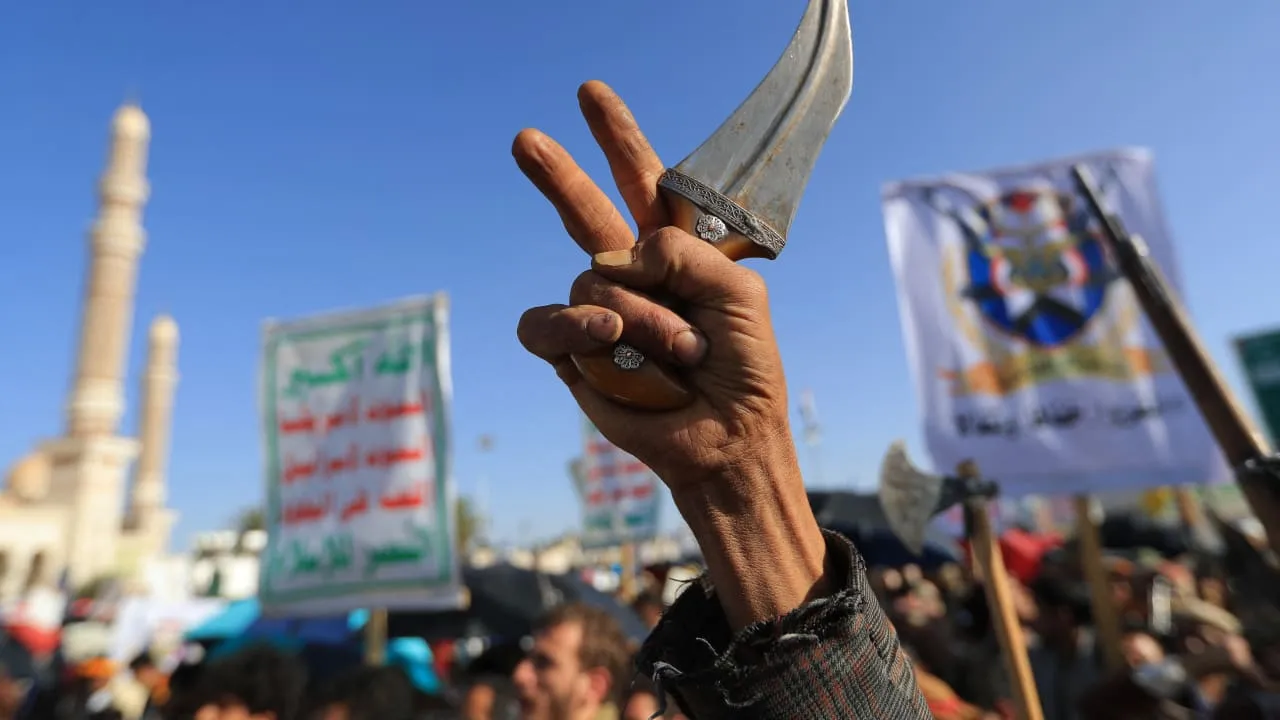
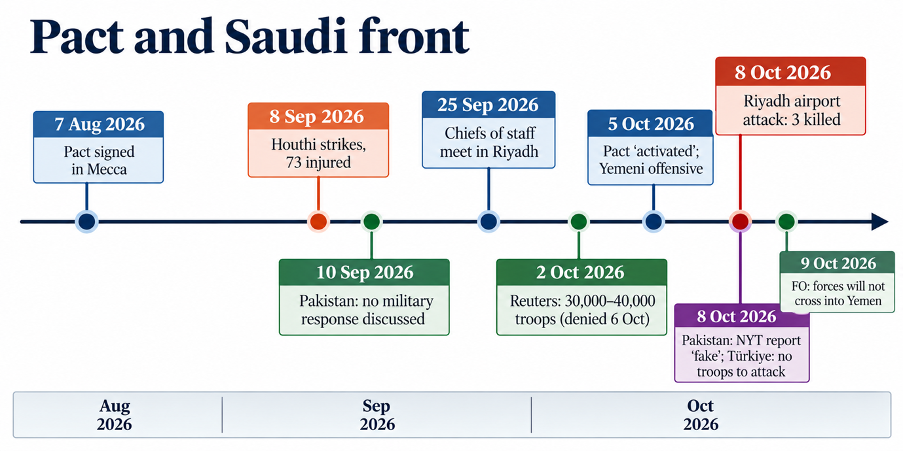
Four weeks after the first Houthi barrage on Saudi cities, the Mecca Pact’s committee announced on 5 October that it would activate collective deterrence and ensure the “rapid deployment” of “agreed” forces (Al Jazeera 2026c; ANI 2026). Within five days Pakistan’s Information Ministry had called a New York Times report of Pakistani air strikes on the Houthis “fake and fabricated”, its Foreign Office had ruled out crossing into Yemen, and Türkiye’s foreign minister had ruled out troops for attacks on another country (Yousaf 2026a, 2026b; Defense News 2026). Houthi-claimed attacks killed three Saudis at Riyadh’s airport (Abou Aljoud and Anna 2026; Al Jazeera 2026b). The pact was activated and disowned in the same week. That contradiction is the argument: a collective-defence promise whose content its authors will not state cannot deter.
The pact and its assumptions
The Mecca Joint Defence Agreement, signed on 7 August, treats an armed attack on one member as an attack on all three (Al Jazeera 2026d). Its text is unpublished; reporting finds no joint command or trigger (Arab Center Washington DC 2026a). Two months after Erdoğan signed it, Ankara has still not put it to parliament, and until ratification Turkish help is, in one reading, bilateral (Defense News 2026; The National 2026). Pakistan’s Foreign Office said on 10 September the pact was “not operational yet”, and on 2 October its foreign minister said full operation could take a year (Dawn 2026a; Shahid 2026). The pact assumed what it had not secured: that threats would follow the machinery, that members define the threat alike, and that Riyadh would ask for help partners could give.
Munir’s miscalculation of tempo
Pakistan signed with the Houthi blockade of Saudi shipping already declared (Arab Center Washington DC 2026b). The National Assembly Speaker and Bilawal Bhutto Zardari both named Field Marshal Asim Munir as central to the pact (National Assembly of Pakistan 2026; Express Tribune 2026a), and he sat in the Riyadh meeting of 5 October (Yousaf 2026a). Responsibility follows credit. The record shows signature before machinery: Defence Minister Khawaja Asif said in early September there was “no ambiguity”, Islamabad said on 10 September that no military response was under discussion, and activation took until 5 October (The New Arab 2026; Reuters 2026a; Al Jazeera 2026c). Munir’s private calculations are unknowable; observable decisions imply a miscalculation of tempo. Deterrence was announced before its operating rules existed, so the first barrage tested a text, not a capability.
Pakistan’s economic constraint
Pakistan can field a limited deployment; it cannot easily fund a long war. The FY27 budget sets defence at Rs3.0 trillion (2.1 per cent of projected GDP) against Rs8.05 trillion for debt service (5.6 per cent) and promises the IMF an underlying primary surplus of 2 per cent of GDP, Rs2.83 trillion (The News 2026a; ProPakistani 2026; IMF 2026b). Each extra 10 per cent of defence spending therefore costs Rs300 billion: 0.21 per cent of GDP, 10.6 per cent of that surplus, about US$1.1 billion, close to the US$1.21 billion IMF tranche awaiting Board approval (Tables 1 and 2). Reserves have risen from US$14.5 billion in June 2025 to US$21.45 billion, yet Saudi deposits of US$8 billion equal 37 per cent of that figure, and FY27 external financing needs are about US$21 billion (IMF 2026a; Business Recorder 2026; Express Tribune 2026b, 2026d). Pakistan is squeezed from both sides: Riyadh’s money makes failing to deliver costly, while an IMF that wants any fuel support limited and inside the budget makes overdelivering costly (IMF 2026b).
Table 1. Pakistan: economic evidence for the sustained-conflict constraint. Budget figures are targets; IMF figures are estimates or projections; reserves and debt stock are actuals. Rupee amounts convert at the implied Rs279 per US dollar (Rs83.285tn = US$298.5bn; The News 2026a).
| Indicator | Latest verified figure (period; status) | Source | Strategic implication |
| Public debt | General government debt 70.1% of GDP in FY26 and 67.2% in FY27 (IMF projections, May 2026). Federal public debt Rs83.285tn (US$298.5bn) at end-March 2026 (actual) | (IMF 2026a; The News 2026a) | Still high; little room for unbudgeted spending |
| Debt servicing | Rs8.054tn in the FY27 budget: 42.9% of federal outlay; 5.6% of GDP (author’s calculation); Rs6.98tn domestic, Rs1.07tn foreign (budget estimate) | (The News 2026a; ProPakistani 2026) | Interest is 2.7 times the defence allocation |
| Foreign-exchange reserves | SBP US$21.454bn; total liquid US$26.797bn (week to 2 Oct 2026, actual); press quotes 3.0 to 3.5 months of imports; US$14.5bn at end-June 2025 (IMF) | (Business Recorder 2026; IMF 2026a) | Rebuilt, but more than a third equals Saudi deposits |
| Fiscal deficit | FY27 budget target 3.6% of GDP (federal deficit Rs7.02tn); IMF projects a general government balance of -3.4% of GDP for FY27 (May 2026) | (ProPakistani 2026; IMF 2026a) | No slack for war costs |
| Government revenue | FBR target Rs15.264tn for FY27, over 8% above Rs14.13tn (budget target); general government revenue and grants 15.3% of GDP in FY26 (IMF projection) | (Aaj News 2026; IMF 2026a) | Narrow base to finance sustained operations |
| Defence expenditure | Rs3.0tn in FY27 (about 2.1% of GDP), up 17% from Rs2.56tn in FY26 (budget) | (Aaj News 2026; The News 2026a) | Baseline already raised; each +10% is Rs300bn |
| IMF programme | Staff-level agreement of 7 Oct 2026 for about US$1.21bn (EFF US$1.0bn, RSF US$0.21bn), total US$5.7bn, subject to Board approval; FY27 budget anchored by a 2% underlying primary surplus; IMF urges phasing out the fuel support scheme | (IMF 2026b) | Programme fixes the fiscal envelope |
| GDP growth and inflation | Real GDP growth 3.6% in FY26 (IMF estimate); FY27 target 4.0% (budget) against IMF 3.5% (May); CPI about 10.3% in September 2026 against a FY27 budget target of 8.2% | (IMF 2026a, 2026b; Aaj News 2026) | Inflation above target limits tolerance for subsidies |
| External financing needs | Gross needs for FY27 about US$21.5bn (SBP governor) and US$21.2bn (IMF projection, as reported); FY26 inflows US$27.2bn including US$5bn Saudi and US$4bn Chinese rollovers; Saudi deposits US$8bn at 4 to 4.5% | (Express Tribune 2026b, 2026d) | Dependent on rollovers by the pact’s own anchor |
The Saudi-Iran dilemma
Geography and diplomacy pull the other way. On 2 October Foreign Minister Ishaq Dar relayed an Iranian suggestion of political engagement with the Houthis as an alternative to “kinetic action” and said he had briefed Tehran on how Pakistan would honour the pact (Shahid 2026). Three days later Pakistan signed up to rapid deployment. The New York Times quoted a former US defence attaché saying Pakistani soldiers were unlikely to fight the Houthis directly because Islamabad is protecting its Iran relationship (Siddiqui and Iftekhar 2026). Iran now questions Pakistan’s role as mediator, one lawmaker calling Islamabad “a regional intervenor” (Iran International 2026); Riyadh appears to be urging Washington not to reinstate the Islamabad memorandum that Pakistan brokered (Arab Center Washington DC 2026b). Türkiye’s parliament speaker hopes Iran will join the pact (Arab News Pakistan 2026), and Pakistan assured Tehran in March that Saudi soil would not be used against it (Al Jazeera 2026a). Pakistan has in effect promised Riyadh protection and Tehran restraint at once (inference). Hedging is prudent only while the hedges do not cancel.
The credibility gap
Against its own words, the pact has delivered activation without disclosure. The 5 October statement commits “agreed” forces and “rapid” deployment but names neither, and Pakistan calls operational details confidential (Express Tribune 2026c; Yousaf 2026a). Troop estimates run from about 8,000 (AP) to 30,000-40,000 (a Pakistani official quoted by Reuters), the higher figure officially disowned, while Brookings counted over 1,500 training and advisory personnel in 2025 (Associated Press 2026; Express Tribune 2026c; Brookings Institution 2025). Anonymous officials brief; the Information Ministry rebuts. That leaves Riyadh, Tehran and the Houthis equally uncertain, the opposite of deterrence (inference). A regional diplomat said in September that troops would not enter Yemen (The New Arab 2026); the activation statement omits the limit. Türkiye is clearer and smaller: air defence and technical help, no combat role (Defense News 2026). Asked about civilian consultation, Pakistan’s Foreign Office cited ministers’ attendance in Riyadh; in 2015 parliament voted (Yousaf 2026a; Al Jazeera 2026e). On four tests, clarity, will, capability and economic capacity, Pakistan is strong only on capability and Türkiye is clearest but least committed (Table 3).
Table 3. Alliance credibility framework. Ratings are the author’s assessment of the public record to 10 October 2026.
| Dimension | Pakistan | Türkiye |
| Clarity of commitments | Low. Text unpublished; numbers and tasks “confidential”; accounts of a Yemen role shift between a denied strike report, a “will not cross” line and 30,000-40,000 reported troops (Express Tribune 2026c; Yousaf 2026a, 2026b) | Medium. Defensive only; air defence, electronic warfare and technical support named; ratification pending (Defense News 2026) |
| Political willingness | Conditional. Activation agreed; offensive role ruled out; Iran channel kept open (Yousaf 2026a; Shahid 2026) | Limited. No troops for attacks on another country; speaker hopes Iran joins (Defense News 2026; Arab News Pakistan 2026) |
| Military and logistical capability | High in the kingdom. Troops “for decades”; estimates 8,000 to 40,000, disputed (Express Tribune 2026c; Associated Press 2026) | Medium. Technical and air-defence support under assessment (Defense News 2026) |
| Economic capacity | Low to medium. Rs3.0tn defence against Rs8.05tn interest; US$21.5bn financing need; 2% primary-surplus rule (Table 1) | Not assessed. No data gathered for this paper |
Why the pact may fail
Three outcomes should be kept apart: formal collapse, operational failure, and survival as a diplomatic framework with limited military meaning. The evidence favours the third, with the second a live risk; nothing has been repudiated, and defence pacts were honoured in wartime only 41 per cent of the time since 1816 (Berkemeier and Fuhrmann 2018). The counterarguments deserve weight. The pact is defensive by design (Defense News 2026); Riyadh may prefer air defence, money and logistics to combat troops (Arab Center Washington DC 2026b); limited deployment may be partly Saudi-funded, and the finance minister says the defence sector now earns foreign exchange (Aaj News 2026); mediation and deployment can coexist if forces stay inside Saudi territory, as the Foreign Office insists (Yousaf 2026a). None answers the central point: an alliance whose operational content is concealed cannot deter, and one whose finance and politics do not match its promises cannot be sustained. Failure becomes likelier if Riyadh asks for offensive support, if Tehran retaliates against Pakistan’s role, or if IMF limits bind (inference).
Conclusion
The Mecca Pact has not failed; it was announced before it was built. Its first test exposed a promise of “rapid deployment” whose authors deny deploying, rule out fighting and hope Iran will join. Erdoğan signed it and Munir is credited with making it possible; both now own a commitment that Pakistan cannot disclose, afford or reconcile with its Iran diplomacy, and that cannot take full effect in Türkiye until parliament ratifies it (Arab News Pakistan 2026). For India, an overstretched Pakistan, dependent on Riyadh and the IMF, is a less predictable neighbour, not a weaker one (inference).