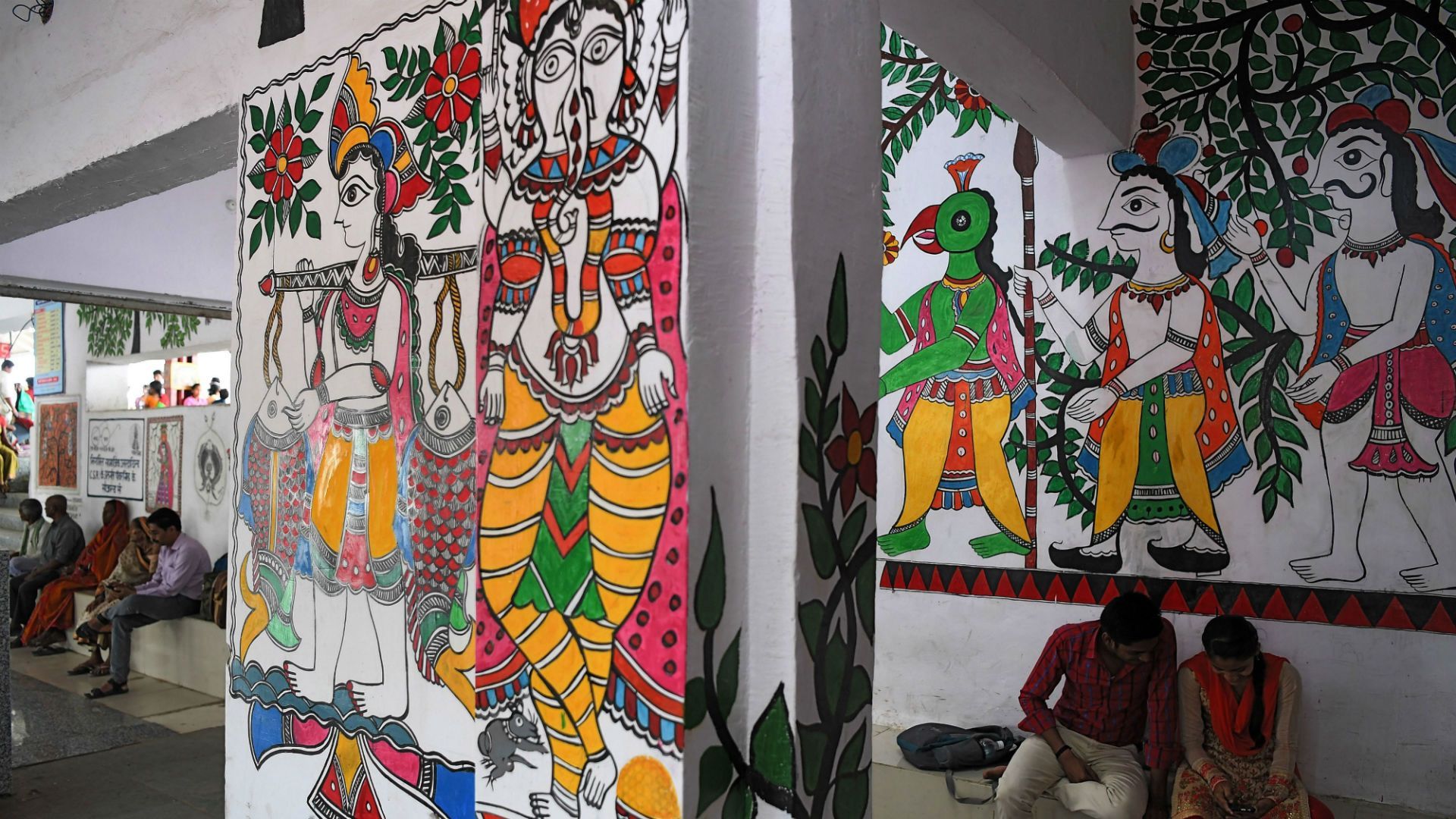
The world knows the Mithila region in the state of Bihar as home to radiant Madhubani paintings that traditionally adorned walls in village homes. The images recreated scenes of Sita’s marriage with Rama and were considered auspicious. The colors were made with vegetable dyes or available minerals. The community of women in the village shared the task when a family prepared for a forthcoming marriage. The nuptial chamber for the newly wed is called kohber and is adorned with symbols of fertility, prosperity and joy. Some time in the 1980s, this folk art was discovered by talent scouts of the patron of humble, poor artistes, Kamala Devi Chattopadhyaya. Since then, the paintings have traveled from mud walls of thatched huts to paper and cloth, even wearable hand-painted fabrics such as exotic saris, scarves, and stoles. Guided by designers, self-taught artistes today use acrylic paints on glass to render inspired fusion creations. Old Wine in New Bottles. New avenues for gainful employment have emerged for unlettered women.
Lore and legends preserved in Hindu epics tell us that this is also the birthplace of Sita, daughter of the sage, likewise King Janak, who was married to Sri Rama, the crown prince of Ayodhya.
This tract of land has a unique cultural footprint extending from Purvanchal in eastern Uttar Pradesh to Bengal, embracing Bhagalpur that lies in between. Maithili is a language spoken across the international border in Nepal, where Janakpur is a major pilgrimage site for devout Hindus.
During British rule, the place was under the charge of Darbhanga Raj. This wasn’t a principality like the domain of quasi-sovereign native rulers who had accepted British paramountcy, but a grand zamindari richer than many rajahs and nawabs. The ‘royals’ of Darbhanga were generous patrons of poets and musicians. Khandharvani style of dhrupad has been preserved in Mithila. The Malik family and Pandit Siyaram Tewari of Betia are renowned exponents of this genre of classical music distinct from the better-known dagarvani. For many lovers of light classical music, nothing is comparable to Vidyapathi Giti. Vidyapati a medieval poet sang of the celestial romance of Radha and Sri Krishna. Famous for his komal kaant padavali (soft and sweet ‘voice’ and mesmerizing musical cadence), he didn’t shy away from evocative eroticism. One of the sonorous verses depicts Radha complaining about her innocent boy lover. Overwhelmed with what has fallen into his lap, he is impatient like a monkey, not knowing what to do- selfishly biting, pinching, licking without any thought of providing some pleasure to the partner.
Foods and flavors in Mithilanchal- the province of Mithila- provide irresistible temptations for both the gourmands and gourmets. A traditional marriage feast here is a many-hours-long, seemingly unending affair. The hosts and guests engage in a friendly competition, with those serving insisting on tempting the guests with seconds and thirds of mouthwatering delicacies, bhaja (deep-fried fritters) or chhenna (cottage cheese) sweets like rasgulla, and the diners declining politely but leaving a gap expertly created by hand covering their leaf platter. How can one say no to the melt-in-the-mouth parwal (wax gourd) filled with mildly sweet chenna appearing in a translucent garb to tickle the sweet tooth?
Maithils (including Brahmins) are enthusiastic meat eaters famous for their fondness for maachh (fish), makhan (fox nuts), and paan (betel leaves).
Makhan is called phool makhana, taal makhana, kamal gutta, and is commonly translated as lotus seeds or lotus puffs. In fact it I has no relationship with our National flower. It is a child of a different water Lilly. Prized as a tonic with unspoken aphrodisiac properties, it was a snack of the affluent, enjoyed dry roasted or lightly stir-fried in ghee. In recent years, it has been rediscovered as a superfood that can decisively vanquish puffed-up, false-pride popcorn. Not very long ago, it emerged from hiding on days of ritual fasting as a substitute for tabooed cereals. Considered satvik (pure and free from pollution) it was used to prepare kheer or rich vegetables paired with khoya ( milk fudge), dried fruits and nuts.
Mithila claims almost 60 percent of the annual production of makhana in India. Harvesting and processing involves backbreaking hard labor. Those who collect the nut or the seed stand day long in waist-deep water in ponds infested by snakes, not always venomous. Grading and drying in stages takes days. It’s not surprising that the stuff is expensive.
Sandalwood is the most preferred fragrance here, with the whiff of kapur (camphor) wafting out of puja rooms. Perfumes worn follow seasonal cycles- khus and gulab. Lemongrass grows wild in this region, both in India and Nepal. Take a deep breath and inhale its refreshing aroma.