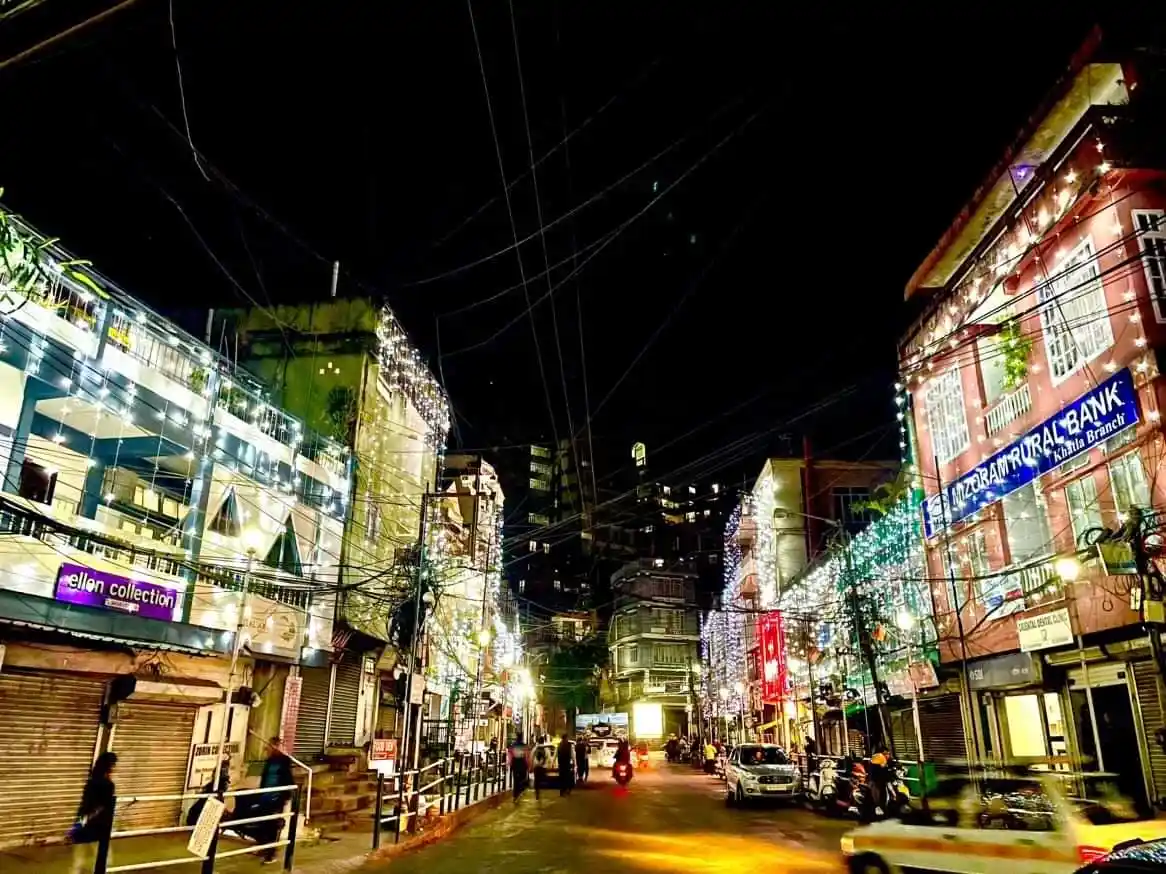
Aizawl, Kohima and Mokokchung sit within a distinctive Northeast Indian landscape where faith, community life and seasonal celebration are closely interwoven. Their inclusion in the national PRASHAD programme places Christian-majority regions within a wider public investment framework for pilgrimage, heritage and visitor infrastructure—one that also covers sacred places of many traditions across India.
Christmas in Mizoram and Nagaland is not merely a date on a travel calendar. In towns and villages alike, it is a period of worship, music, family reunion, communal meals and renewed ties among churches, neighbourhoods and people returning home from elsewhere in India. For visitors, the attraction is therefore less a single monument than an opportunity to encounter living traditions with care and on local terms.
The setting is especially significant. Christianity is the majority religion in both states: the 2011 Census recorded Christians as 87.16% of Mizoram’s population and 87.93% of Nagaland’s. The scale of church-centred civic and cultural life makes the Christmas season a natural period for thoughtfully managed cultural and faith tourism.
Aizawl, Mizoram’s hillside capital, has the urban services, transport links and accommodation base that can support a wider visitor circuit. Kohima offers the state-capital gateway and a strong December travel window, while Mokokchung brings visitors closer to the cultural landscape of the Ao Naga community. Together, they can enable an itinerary in which formal celebrations, choir music, local food, village visits and landscapes are treated as connected experiences rather than isolated attractions.
What PRASHAD identified
PRASHAD—short for Pilgrimage Rejuvenation and Spiritual, Heritage Augmentation Drive—is a Ministry of Tourism programme that provides financial assistance to state and Union Territory governments for tourism infrastructure at identified religious and heritage destinations. Projects are implemented by the respective state or UT governments, while the Union Ministry monitors progress.
In 2018, the Ministry’s published list of 41 identified religious destinations included Aizawl, as well as Kohima and Mokokchung districts. This is important historically: it records these Christian-majority destinations within the same national pilgrimage-development roster as Hindu temples, Sikh gurdwaras, Muslim shrines, Buddhist-associated sites and Christian locations elsewhere in India, including Kerala’s St. Thomas International Shrine and Tamil Nadu’s Velankanni.
Subsequent sanctioned projects gave that identification a more concrete form:
| State | PRASHAD project | Approved cost | Current reported position |
|---|---|---|---|
| Mizoram | Development of Infrastructure for Pilgrimage and Heritage Tourism in the state | Rs. 44.89 crore | Rs. 26.37 crore released in the August 2025 central statement |
| Nagaland | Development of Pilgrimage Infrastructure in Nagaland | Rs. 25.20 crore | Rs. 23.56 crore released; listed as physically completed |
| Nagaland | Development of Pilgrimage Tourism Infrastructure at Zunheboto | Rs. 18.18 crore | Rs. 15.45 crore released |
The March 2025 Ministry project listing specifies Mizoram’s scheme footprint as Chite Vang, Zuangtai, Reiek and Aizawl. In Nagaland, the earlier project formulation covered Molungkimong, Noksen Church, Aizuto, Wokha and Kohima; Molungkimong is in Mokokchung district, linking the later project geography back to the original Kohima–Mokokchung identification.
The policy documents describe pilgrimage and heritage infrastructure; they do not label these projects as a dedicated Christmas-tourism scheme. That distinction matters. It avoids overstating the programme’s stated purpose while still showing how improved access, visitor amenities and destination management can make seasonal Christian celebrations easier to experience responsibly.
A viable Christmas-season proposition could have three layers:
- Aizawl: a city-based introduction to Mizo worship, music, food and hill-town life, linked with nearby heritage and scenic destinations named in the PRASHAD project.
- Kohima: a capital-centred stay that can combine church-centred Christmas observance, local hospitality and the December visitor ecosystem around the Hornbill Festival at Kisama.
- Mokokchung: a slower, community-oriented extension into the Ao cultural region, where visitors can place Christmas observance in the longer rhythm of Naga social and cultural life.
December already carries tourism momentum in Kohima. Nagaland Tourism schedules the Hornbill Festival at Kisama, Kohima, from 1–10 December, alongside the People’s Festival at Khezhakeno from 2–10 December. The same official calendar identifies Mokokchung as the home of the Ao festivals Moatsu in May and Tsüngremong in August—useful context for presenting the district as a year-round cultural destination rather than a one-season stop.
The opportunity is to extend the visitor economy beyond major event days: homestays, locally owned transport, guides, craft producers, musicians, cafés and small food businesses can all benefit when travellers stay longer and move beyond a capital-city checklist.
Development with local stewardship
Faith tourism succeeds when it strengthens, rather than stages, the community that hosts it. In Aizawl, Kohima and Mokokchung, that means treating churches first as places of worship, not as backdrops. Visitors should be guided toward services and programmes open to guests, observe photography rules, dress respectfully, avoid disrupting prayer or choir practice, and follow local guidance on alcohol, noise and Sunday customs.
Infrastructure also needs to be useful after a festive travel peak has passed. The Ministry says project selection is undertaken with state governments and with attention to India’s regional and cultural diversity; its wider tourism approach also includes training and certification for small operators, artisans and homestay providers. In practical terms, that points toward investments such as:
- Clean public facilities, accessible pathways, signage and safe pedestrian movement.
- Visitor information in locally appropriate languages and English.
- Waste collection and sanitation systems able to handle seasonal surges.
- Training for local guides and host communities in interpretation, safety and hospitality.
- Digital booking and reliable travel information that directs spending to local enterprises.
- Community approval processes for any route involving worship spaces or village celebrations.
Such measures turn a pilgrimage project into durable public infrastructure: useful to residents and congregations throughout the year, while making guests more likely to travel responsibly.
A wider national canvas
The significance of these Northeast destinations lies partly in their place within the full PRASHAD map. The programme’s project list includes sites associated with diverse religions and spiritual traditions, from the Bom Jesus Basilica in Goa and Velankanni in Tamil Nadu to Hazratbal in Jammu and Kashmir, Nada Saheb Gurdwara in Haryana, Kamakhya in Assam and many temple destinations.
For Aizawl, Kohima and Mokokchung, the practical implication is clear: local Christian traditions, Christmas observance and indigenous cultural identities can be represented as integral parts of India’s tourism story, with public infrastructure and state-led implementation helping communities welcome visitors without flattening what makes these places distinctive.
The strongest version of Christmas and Christian-festival tourism in the Northeast will not imitate a commercial festive spectacle. It will offer well-managed access to an authentic season of worship, music, hospitality and belonging—while ensuring that the enduring value remains with the people and places that create it.