Legend has it that Indradyumna, the King of Kalinga, dreamed one night that Lord Vishnu was telling him to build a temple dedicated to Sri Krishna. The next morning, strolling by the seashore, he spotted a casket deposited on the beach by the dancing waves. Inside it, he discovered relics of Dwarka- the Capital of Sri Krishna on the western coast. The once prosperous city was reclaimed by the sea after Krishna’s death. The contents included a piece of wood from which the idols to be installed in the Jagannath temple at Puri were carved by Vishwakarma, the divine sculptor. The maestro laid down the condition that Indradyumna would not disturb him till the work was completed. Years passed; the king lost his patience and couldn’t resist the temptation to peep in. Angered, Vishwakarma left in a huff, and this is why the statues remain incomplete. These half-finished idols are carried out ceremonially on giant chariots during the Rathayatra every year.
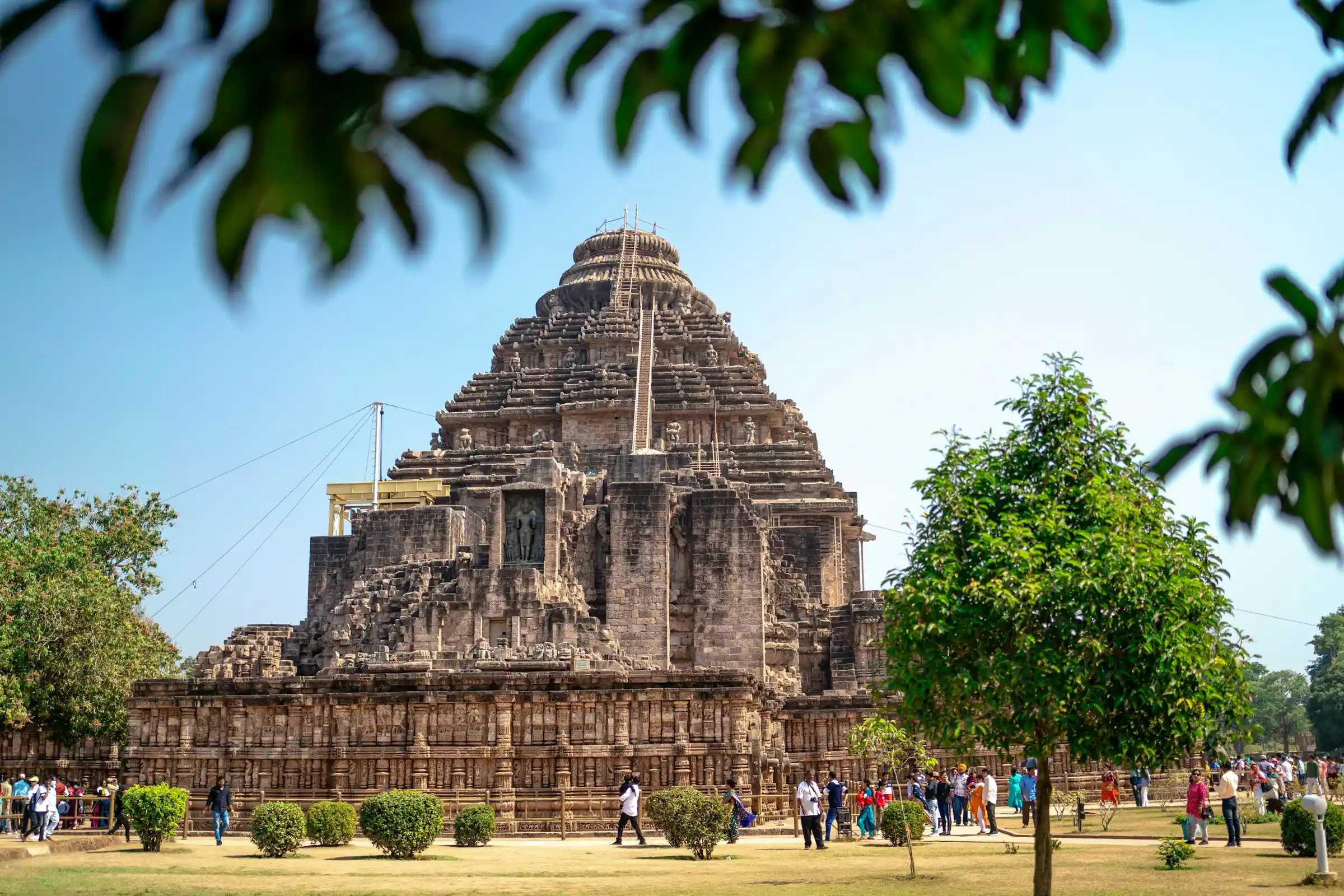
Orissa is inheritor to an exceptionally rich legacy of architecture, dreamlike dances and blessed foods. Besides the Vaishnav shrine at Puri, the towering Lingaraj temple dedicated to Shiva in Bhubaneshwar and the remains of the magnificent Sun Temple at Konark bear testimony to the glory of the Ganga dynasty that commissioned these marvels more than a thousand years ago. Konark, also called the Black Pagoda, is a stunning observatory wrought in stone that effortlessly blends scientific concepts and precise calculations with intriguing erotic carvings that lend themselves to multilayered symbolic interpretations.
These temples were not only places of worship but also centers of learning, conservatories of dance and music.
Odissi is one of the most popular classical dance forms of India. It is performed to evocative verses composed by poet Jaideva. Lesser known is the genre of semi-classical Chhau from Mayurbhanj. Chhau is also performed in Purulia (Bengal) and Jharkhand with colourful masks. Dancers in Mayurbhanj, bordering Chhattisgarh, dispense with masks and bring alive episodes from the Ramayana and Mahabharata with expressive movements of facial muscles, eyes and measured steps and fluid hand gestures.
Moving from myths to history, what the world remembers is the invasion of the ancient Kingdom of Kalinga by Ashok the Maurya ruler of Magadha. The bloodshed revolted the victor and filled him with guilt and remorse. He renounced war forever, converted to Buddhism a creed that preaches non-violence. It is not his military conquests, but pursuit of peace that bestowed greatness on him.
Situated on the shores of the Bay of Bengal, Kalinga in the past had explored distant lands. Seafarers embarked on voyages that took them to the farthest edges of the Indonesian archipelago. The Sinhala people in Sri Lanka trace their ancestral roots to Kalinga. These ancient memories are stirred every year when the festival of Bali Yatra is celebrated, and leaf boats with earthen lamps are launched on the waves.
Chhappan Bhog – 56 exquisite delicacies offered to Lord Jagannath at Puri and many other Krishna temples are prepared ritually from ingredients indigenous to the subcontinent. No grain, vegetable, fruit, spice or condiment that is part of the Columbian exchange finds its way to this sacred kitchen. The celebration of naivedya-prasad (blessed foods) makes us overlook the rich diversity of Odisha’s cuisines. Contact with foreign lands resulted in a confluence of flavours and foods. Delicacies like Malai (Malay)Curry remind us of this interaction.
In the past, Kalinga spanned much of present-day Andhra Pradesh, Telangana, Chhattisgarh and Jharkhand. Much of the forest in this tract has been home to a tribal population. Meat, fish, and seafood have always been relished here. The princely states in the hinterland, away from the coast, have many an heirloom recipe based on game. Chilika, the large saltwater lake, is renowned for its crabs, prawns and more. Chhennapooda, the wonderful local cheesecake, challenges the view that cheesemaking was taught to Indians by the Portuguese and the Dutch.
Crafts of Orissa are no less enchanting than its foods- be it the delicate filigree work in silver or an exciting burst of colours in appliqué, soapstone carving and handloom textiles in Sambalpuri silk; all have an irresistible appeal.
As the great river Mahanadi winds its way from its source to the sea, the boat-rider gliding gently down the river can soak in unforgettable experiences.
The land is fragrant with heady aromas. Ninety percent of all the kewra (screw pine) produced in India is from Orissa. This is what makes a number of sweets and savouries all over India fragrant. The state’s share in the delicately fragrant Khus (vetiver) is considerable. Citronella and lemongrass grow wild. Swarnchampa is a sacred flower whose distilled essence, preserved in sandalwood oil, is greatly prized as it is very rare.