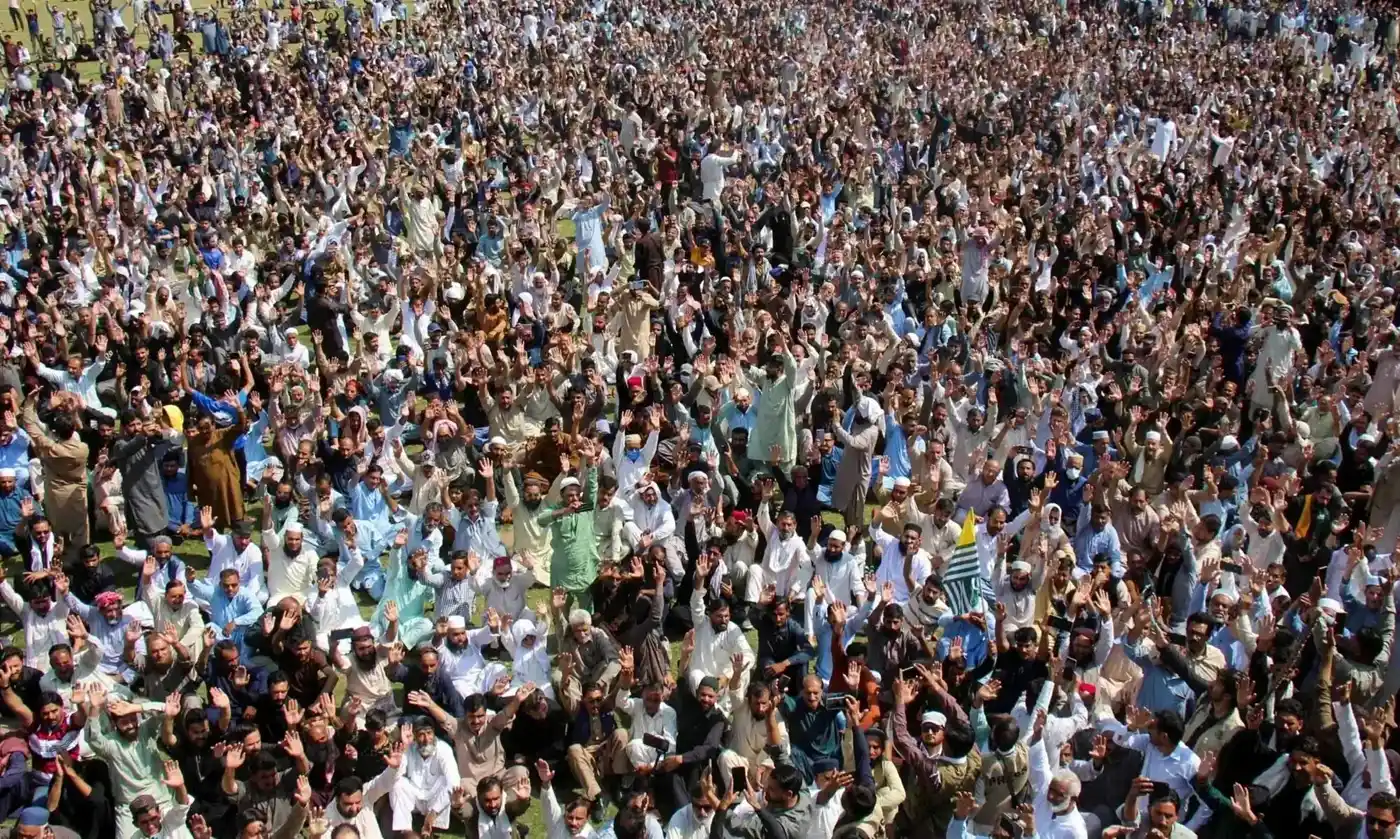
For three years, a quiet but powerful storm has been building in Azad Jammu and Kashmir (AJK), a mountainous territory of roughly four million people governed by Pakistan. What started as anger over the price of flour has grown into one of the most significant civil unrest movements in the region’s recent history. Streets have been shut down, troops have been deployed, and a major civic alliance has been branded a terrorist organisation.
In mid-2023, Pakistan was experiencing some of the worst inflation in its history, and AJK felt the pinch acutely. The price of subsidised wheat flour shot up, and electricity bills became unaffordable for ordinary households. For many residents, these were not abstract economic statistics; they were daily, crushing realities.
The frustration was made sharper by a particular irony. AJK is home to the Mangla Dam and several other hydroelectric projects that generate large amounts of cheap, clean electricity for Pakistan’s national grid. Yet locals were paying bills loaded with federal taxes, seeing little benefit from the power produced on their own land.
In response, a broad coalition of traders, lawyers, students, and transporters came together under the banner of the Joint Awami Action Committee (JAAC). Their first act of defiance was simple but striking: an organised, mass refusal to pay electricity bills across entire districts.
The movement did not remain peaceful throughout. A six-day wave of protests in May 2024, involving sit-ins, shutdowns, and wheel-jam strikes, swept across major towns, resulting in the deaths of at least three protesters and one police officer. The federal government ultimately accepted all the protesters’ core demands, allocating a 23-billion-rupee grant and agreeing to subsidise flour and electricity prices. A judicial commission was also promised to review the perks enjoyed by top officials.
Then, in September–October 2025, the JAAC launched another region-wide shutdown after the government failed to deliver on its promises. After days of confrontation and further loss of life, another agreement was reached and, once again, largely left unimplemented.
For the JAAC and many residents of AJK, these concessions felt hollow. The underlying problems—how resources are distributed, how taxes are levied, and how decisions about AJK are made—remained entirely unchanged. Protest leaders described the government’s approach as offering plasters for wounds that needed surgery.
As the movement matured, its demands expanded well beyond electricity tariffs. The JAAC published a 38-point charter aimed at what it described as shameless excess among the ruling class. In a region where families struggle to put food on the table, local politicians and senior bureaucrats were seen enjoying government-funded luxury vehicles, free fuel, and generous allowances paid for by the public. The visual contrast—an elite living comfortably while ordinary people protested in the streets—became a powerful rallying point.
Following the 2025 unrest, the government again promised reform. But protest leaders say little has changed. Committees have been formed and papers have been signed, but the allowances are still being paid.
The most politically sensitive issue at the heart of the current crisis involves how AJK’s own legislature is composed. AJK is scheduled to hold elections on 27 July 2026. At the top of the JAAC’s agenda is a demand to abolish 12 reserved seats in the AJK Legislative Assembly, designated for descendants of Kashmiri refugees who migrated to mainland Pakistan during the 1947 Partition. These voters now live in Punjab, Sindh, and other provinces, not in AJK itself.
Because they are spread across Pakistan, mainstream national parties such as the PML-N, PPP, and PTI can effectively control these 12 seats and use them to tip the balance of power in Muzaffarabad. The JAAC argues that this allows Islamabad to install governments that answer to the centre rather than to local people. The committee has also alleged that some seats are filled using fraudulent State Subject certificates to benefit well-connected individuals rather than genuine stakeholders.
The political establishment strongly disagrees, defending these seats as an important historical link to the broader Kashmiri cause.
The most volatile phase of the unrest has unfolded rapidly in the weeks leading up to the July elections. Throughout May 2026, six rounds of negotiations between federal ministers and the JAAC leadership took place. The government claimed that most points from a previous 37-point agreement had already been implemented. The JAAC flatly rejected this, insisting that the 9 June strike would proceed unless its demands—particularly the abolition of refugee seats—were met by the end of May. On 31 May, marathon nine-hour talks ended without a breakthrough.
The government’s response was not more dialogue but a sweeping crackdown. On 5 June, the AJK Home Department formally banned the JAAC under the Anti-Terrorism Act, overnight turning a civil society coalition into a designated terrorist group. Within 18 hours, police announced that 72 individuals had been arrested, with authorities claiming that weapons and documents had been recovered. The JAAC denied the allegations and vowed to continue peacefully.
Simultaneously, a travel advisory was issued ordering tourists to leave the region immediately. The University of AJK postponed its Spring 2026 examinations until further notice. Some 1,505 Islamabad Police personnel were deployed alongside requests for more than 14,000 federal paramilitary troops. Internet services were cut across large parts of AJK, as confirmed by the monitoring group NetBlocks, crippling businesses, freelancers, and students.
The ban drew sharp condemnation across the political spectrum. Both PTI and the Tehreek Tahafuz Aeen Pakistan (TTAP) questioned how an organisation that the government had been negotiating with for months could suddenly be labelled a terrorist group. Defence Minister Khawaja Asif, meanwhile, argued that the refugee-seat issue should be settled at the ballot box on 27 July, warning that forcing it beforehand amounted to blackmail.
Not everyone in AJK sides with the JAAC. A significant section of local opinion, including traders, professionals, and ordinary residents, has grown frustrated with the repeated cycle of strikes and shutdowns. Critics argue that every wheel-jam strike hits the poorest people hardest: daily-wage workers lose income, patients struggle to reach hospitals, schoolchildren miss exams, and small businesses suffer losses they cannot recover. Critics also point out that the movement’s leadership does not itself suffer when a strike is called, while the costs fall on everyone else.
An All-Parties Conference in Muzaffarabad, which ran for more than six hours, unanimously rejected the JAAC’s demand to abolish refugee seats, stating that any such change could only come through the elected house. The AJK Prime Minister noted that the JAAC had refused to postpone its protest even by a single day to allow legal discussions to proceed, raising questions about whether the movement was genuinely open to dialogue at all.
The revolving door of subsidies, agreements, and crackdowns has clearly not worked. Lasting stability requires addressing root causes, not merely managing symptoms.
1. Electricity: A formal legal arrangement, rather than ministerial discretion, should guarantee that AJK residents benefit from the hydroelectric power generated on their own land through permanently reduced tariffs.
2. Elite perks: The promised judicial commission needs to produce visible, public results. A government that asks citizens to pay electricity bills while ministers drive on state-funded fuel has little moral authority to demand patience.
3. Refugee seats: The issue cannot be indefinitely parked. Whether through a constitutional amendment, a Supreme Court ruling, or a credible consultative process, a transparent path forward is needed before the next election cycle inflames the issue all over again.
4. Civil society: Banning organisations and cutting the internet is not governance. A permanent standing dialogue mechanism—one that meets regularly rather than only when a strike is 48 hours away—is essential. As PTI itself has argued, political problems require political solutions; the use of force has never produced lasting outcomes.
The unrest in AJK does not occur in a diplomatic vacuum. The territory sits at the heart of one of the world’s most contested disputes. As Pakistani commentators have themselves acknowledged, every strike in AJK hands New Delhi further evidence that the people of Pakistani-administered Kashmir are unhappy and that the region is unstable. India’s broader strategy on Kashmir has long involved directing international attention to governance failures and the plight of local residents on Pakistan’s side of the Line of Control.
The heaviest damage to Pakistan, however, comes not from the protesters themselves but from the way the state responds to them. Arresting 72 activists overnight, cutting internet access across an entire territory, and designating a coalition of traders and lawyers as a terrorist organisation—all just weeks before a general election—is precisely the kind of imagery that media machinery is equipped to amplify globally.
The most effective counter to AJK’s unrest is not more troops or more bans. It is demonstrably better governance: reduced elite privileges, transparent resource management, and elections that locals genuinely trust.
What began as a protest over the price of a bag of flour has become something far more significant: a direct challenge to how Azad Jammu and Kashmir is governed, and by whom. The immediate test is the 9 June strike and the 27 July election. If the strike turns violent, the damage—to lives, to the local economy, and to Pakistan’s standing on Kashmir—will be severe. If it is suppressed by force alone, the underlying anger will simply go underground, ready to resurface once the votes are counted.
More than 3.8 million voters are registered for the 27 July election, half a million more than in 2021, when turnout reached 61 %. That is not the picture of a population that has given up on the system. It wants its voice to count within it.
The people of AJK are not simply asking for cheaper electricity. They are asking to be heard, to have governments that represent them, institutions that serve them, and resources that benefit them. The challenge for both Islamabad and Muzaffarabad is to make that possible before the next eruption makes it harder.