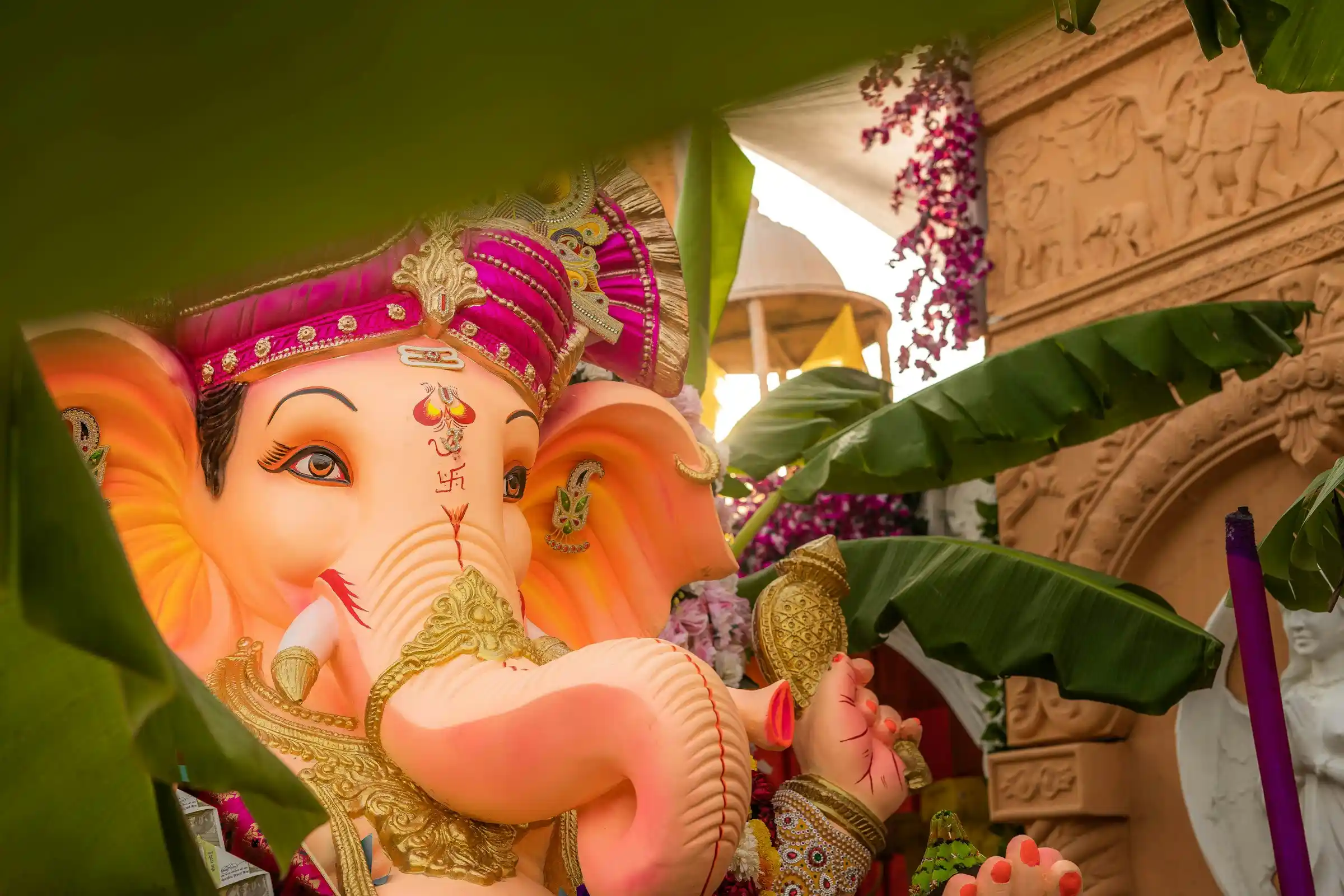
Ganeshotsav is celebrated on a grand scale in Mumbai in July. Gigantic Ganesh idols are fabricated and displayed in public spaces. Smaller ones are installed at home, worshipped for ten days, and finally immersed in water. The shouts of Ganapati Bappa morya rent the sky, clouds of coloured powder rise. There is frenzied dancing to the pulsating beats of music as the procession carrying Ganesh for visarjan (immersion) winds its way. The scale may be less spectacular, but the enthusiasm is no less in other cities and towns in Maharashtra, Karnataka, and other parts of the Deccan. In the last few years it has emerged as a pan-Indian festival.
The delicacy associated with Ganesh is modak, a steamed, pouch-shaped sweetmeat prepared with rice flour, packed with grated coconut, jaggery, and flavored with cardamom seeds. In northern India modak is confused with laddoo. Both are mentioned in ancient Sanskrit texts but are not the same. Other delectable edibles shared are puranpoli and sheera.
The elephant-faced god, pot-bellied with a broken tusk held in his hand, astride a tiny mouse, occupies a very special place in the Hindu pantheon. He is worshiped before all other deities as vighnaharta (the remover of obstacles) and bestower of wealth and wisdom. He is the commander of the ganas Shiva’s unruly hordes. He is also called Gajanan, Vinayak, Vakratunda and Mahakaya.
Ganesh is the son of Shiva, whom he didn’t sire. Once in his absence Parvati, his consort, moulded a lovable boy from unguents while preparing to bathe and gave him the breath of life. She then asked the child to guard the door and let no one in while she was bathing. When Shiva returned, he was surprised and angered to find an intruder blocking his way. He lost no time in beheading him with his trident. Parvati was inconsolable when she saw this. She asked Shiva to bring her child back to life. Shiva moved by her wailing, ordered his attendants to search a new head for the lifeless torso. The first creature they encountered was a majestic elephant. It was his head that was transplanted on the lifeless torso to bring it back to life. The boy was blessed with the boon of precedence in ritual worship. Ever since, all auspicious ceremonies begin with salutations to him: Om! Shri Ganeshay Namah!
The Iconography of Ganesh idols has come to be charged with symbolic meaning. Elephant is the wisest of animal, gifted not only with great power but unfailing memory, his trunk can move heavy loads and at the same time is extremely sensitive signifying compassion. The large stomach suggests an insatiable appetite for knowledge, and the mount he rides reminds us that creatures mighty and tiny complement each other in the cosmic scheme. The mouse can easily scurry where the elephant can’t tread, and with its sharp teeth cut through the strong net (of ignorance) that condemns us to captivity.
Mythological accounts tell us that when sage Ved Vyas urgently required a scribe to help him compile the Mahabharat, he requested Ganesh to take up the task, who agreed, subject to a condition that he would stop and leave if the dictation paused for a moment. Not to be outwitted, Vyas agreed with the caveat that the scribe must understand perfectly what was dictated before writing it down. In the event, the partnership worked wonderfully and 100,000 verses of the epic were preserved for posterity.
Shivaji, the great Maratha warrior who took on the mighty Moguls, was a devotee of Ganesh and celebrated Ganesh Chaturthi with great fanfare. It was the famous freedom fighter Bal Gangadhar Tilak who coined the slogan ‘Freedom is My Birthright’ during the freedom struggle against the British and who revived the Ganeshotsava in Pune in the last decade of the 19th century.
It’s ironic that the festival is at times associated with the demonstration of divisive majoritarianism. In fact, Ganesha is a deity that predates the Vedik canon and has been accessible to all- rich and poor, building bridges between castes and communities
Ganesh Vandana forms an important part of the Indian musical repertoire. The Dhrupad singers, mostly Muslims, reverentially use a variety of compositions after the wordless aalap. Legendary Khayal singing greats Faiyyaz Khan and Bade Ghulam Ali Khan have sung lovely bandishes, both traditional and their own poetic creations, in myriad ragas. A sarod maestro once rendered Ganesh Kalyan at a Pune festival in honor of Ganesh. In Carnatic music, the enchanting Vatapi Ganpatim Bhaje in Hansdwani is credited to Muthu Swami Dikshitar, one of the semi-Divine Trinity in Carnatic music.
Fragrances with floral and sweet fruity notes of honey and a purifying whiff of camphor are offered to Ganesh, who loves japakusum (hibiscus), lotus, marigold, and bananas.