
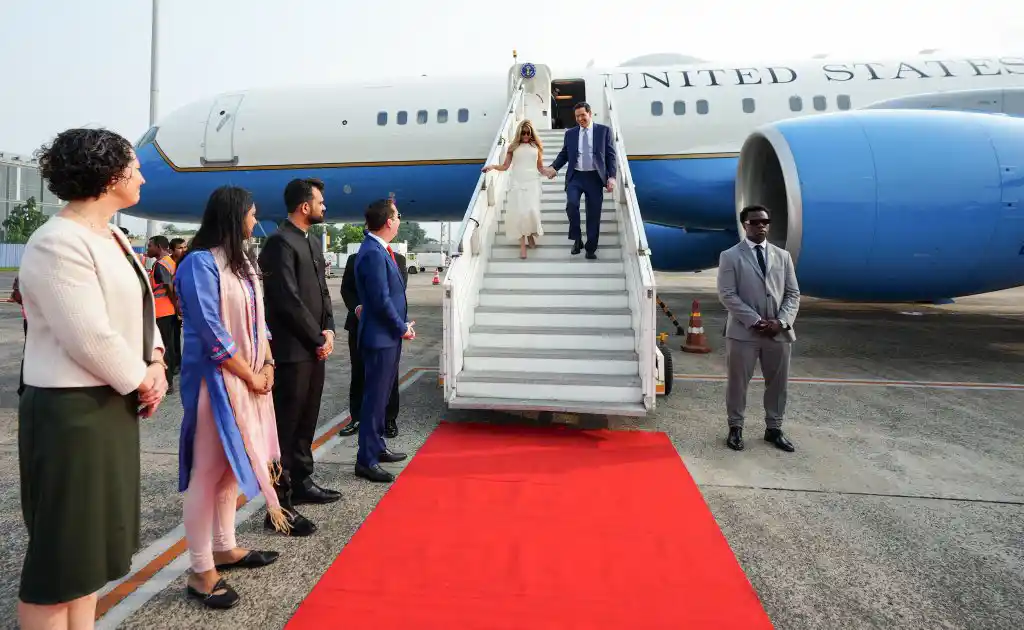
U.S. Secretary of State Marco Rubio’s maiden official visit to India comes at a delicate moment for New Delhi–Washington ties, which have been buffeted by trade disputes, tariff wars, and disagreements over energy and geopolitics. Spread over four days with stops in Kolkata, Agra, Jaipur and New Delhi, the trip is being widely seen as an attempt to “repair” trust and set the relationship on a more stable, forward-looking footing.
This explainer walks through the key developments around the visit: why it is happening now, what is on the agenda, what has already happened on the ground, and what it could mean for India.
The backdrop: strained but strategic ties
Rubio is arriving at a time when India–U.S. relations are simultaneously strategic and strained. On the one hand, Washington sees India as a critical partner in balancing China’s rise and securing the broader Indo-Pacific. On the other, a series of policy moves has produced friction:
- President Donald Trump’s tariffs sharply raised duties on several Indian exports, hurting sectors like steel, aluminium and certain manufactured goods.
- The U.S. also expressed unease over India’s earlier purchases of Russian oil and defence equipment, linking some tariff measures to these choices.
- India, for its part, has been wary of renewed U.S. outreach to Pakistan and Beijing, fearing a dilution of Washington’s commitment to New Delhi’s security concerns.
Although some of the harshest tariffs were rolled back under a “framework for an interim agreement,” a comprehensive trade deal remains elusive, creating a sense of unfinished business as Rubio lands in India.
Why now? The timing and symbolism
Rubio’s visit is not just another routine diplomatic engagement; it is carefully timed and symbolically loaded.
- It is his first official trip to India as Secretary of State, signalling that the Trump administration’s second term wants to re‑invest in this relationship after a turbulent period.
- The four-day, multi-city itinerary—Kolkata, Agra, Jaipur and New Delhi—indicates an effort to go beyond just “Delhi durbar” politics and speak to broader Indian opinion.
- The visit comes days before a meeting of foreign ministers of the Quadrilateral Security Dialogue (Quad) in New Delhi, underlining India’s centrality to Washington’s Indo-Pacific strategy.
Analysts quoted in policy and media reports describe Rubio as coming in “repair mode,” suggesting that the U.S. side recognises a trust deficit and wants to halt further drift.
What’s on the agenda?
Trade and tariffs
Trade is arguably the most politically sensitive issue on the table.
- Rubio is expected to push for finalising a broader trade understanding that builds on the earlier interim framework that had lowered Trump-era tariffs on Indian goods from around 50% to about 18% in many cases.
- India will likely press for more predictable access for its exports and for clarity on future U.S. measures, especially after a recent U.S. Supreme Court ruling struck down some of Trump’s tariff actions, injecting legal uncertainty into trade policy.
For Indian policymakers, a key question is whether this visit yields a path toward more stable, mutually beneficial trade rules rather than episodic, tweet-driven decisions.
Energy security and the post-Russia landscape
Energy is the second big pillar of the visit.
- U.S. officials have signalled that Washington wants to expand its share of India’s energy market, especially in oil and liquefied natural gas, to compensate for disruptions related to Russia and regional conflicts.
- This ties into wider U.S. efforts to curb Russian revenues while reassuring partners like India that they will not be left without affordable, reliable supplies.
For India, which is heavily import-dependent in energy, the discussion is about price, long-term contracts, and ensuring that strategic autonomy is preserved even while diversifying suppliers.
Defence, technology and the Indo-Pacific
The third major set of issues involves defence and strategic technology.
- The two sides are expected to discuss expanding defence cooperation, including co‑development and co‑production initiatives already underway or under negotiation.
- Critical minerals, digital technologies, and supply chains for semiconductors and advanced electronics are also on the radar, as both countries look to reduce dependence on China.
All of this is nested within the Indo-Pacific conversation, where the Quad remains an important but somewhat under-delivering platform. Rubio’s presence at the upcoming Quad foreign ministers’ meeting signals continuity in U.S. engagement, even as the grouping has not yet moved up to regular leader-level summits.
What has Rubio actually done in India so far?
Reports from the ground indicate that Rubio’s visit has blended symbolic outreach with hard-nosed diplomacy.
- He landed first in Kolkata, where he visited the headquarters and memorial associated with Mother Teresa’s Missionaries of Charity, a move that emphasises humanitarian and cultural ties.
- From there, he is travelling to Agra and Jaipur, stops that provide both optics—think Taj Mahal—and opportunities for regional outreach beyond the national capital.
- In New Delhi, Rubio is holding talks with External Affairs Minister S. Jaishankar and meeting Prime Minister Narendra Modi, with sessions devoted to trade, energy, defence, and the broader strategic partnership.
A gala reception in New Delhi, tied to celebrations around the 250th anniversary of U.S. independence, adds a ceremonial layer meant to underscore the “people-to-people” dimension of the partnership.
What’s at stake for India?
For India, the stakes span economics, security, and diplomacy.
- Economically, India wants relief from unpredictable tariffs, greater access to the U.S. market, and more investment in manufacturing and technology sectors aligned with “Make in India” and “Atmanirbhar Bharat” goals.
- On security, New Delhi seeks clearer U.S. commitments in the Indo-Pacific and reassurance that Washington’s ties with Pakistan and China will not come at India’s expense.
- Diplomatically, India aims to preserve its strategic autonomy—maintaining ties with Russia and others—while still deepening cooperation with the U.S. in areas like defence, critical technologies and regional security.
Rubio’s visit will be judged in Delhi not just by joint statements but by whether it signals a more predictable, respectful approach from Washington, especially after a year of sharp rhetoric and policy zigzags.

