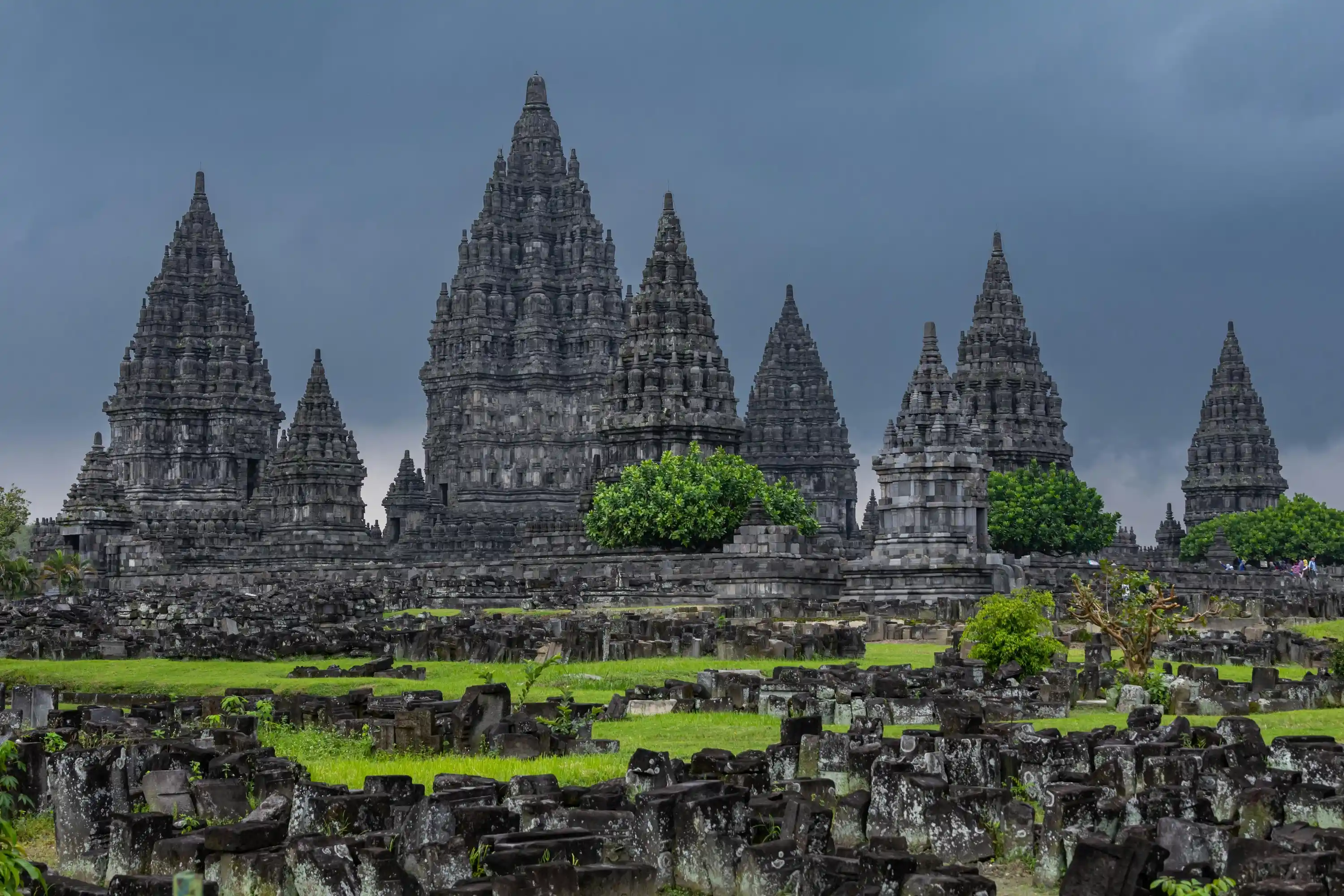
Through the centuries, India has been a source of inspiration for art and architecture in Indonesia as it has been to the entire Southeast Asia. Today, a myriad of cultural vestiges of the Indian connect in the form of landmarks, milestones, rituals and social mores of Indonesia serve as a constant reminder of India’s age-old cultural influence in this part of the world.
Due to such linkages with Indian civilization, the ancient epics of Ramayana and Mahabharata are deeply embedded in the cultural matrix of Indonesia and other parts of Southeast Asia.
It is generally believed that Hinduism came to Indonesia in the first century through traders, sailors, scholars, and priests. It soon integrated into the preexisting Javanese traditions. Hinduism also adapted to Buddhism, which arrived in Sumatra in the sixth century, and this adaptation evolved into an Indonesian version of Hinduism.
Indonesian version of Ramayana: Kakawin Ramayana
These early Indian visitors brought the epic of Ramayana to Indonesia. The innate values of Ramayana soon found a deep connection with the Indonesians at that time. Written in the old Javanese language, the Indonesian version of Ramayana became known as the Kakawin Ramayana. It was used to revive Hinduism at a time when Buddhism was well established in Sumatra, West and Central Java through shadow puppetry (Wayang Kulit and Wayang Purwa). It is believed that the Kakawin Ramayana was written in the 11th century during the Medang Kingdom in Central Java in the old Javanese language. The other Indonesian version of Ramayana is the Balinese Ramakavaca, which is a variant of the Kakawin Ramayana.
The Javanese consider the Kakawin Ramayana, derived from an array of Sanskrit-based metrical patterns, as the pinnacle of artistic expression. It remains the lengthiest of all old Javanese texts. A large number of preserved palm leaf manuscripts of Java and Bali attest to its popularity and adaptation.
The earliest portrayal of Ramayana on stone was seen in Central Java, carved on the courtyards of Chandi Shiva and Brahma temples.
Divergences
But the Kakawin Ramayana differs from the original Indian version in some ways. According to several literary scholars, the source of the old Javanese Kakawin Ramayana was possibly the Sanskrit poem Bhattikavya written by Indian poet Bhatti around the 7th century AD as the first half is almost identical to the rendering of Bhattikavya. But Indian scholars find the latter half almost unrecognizable from the original.
Though the characters of Rama, Sita, Lakshman, Hanuman, Ravan, etc remain fundamental to its narrative, the Kakawin Ramayana also has several Javanese indigenous deities like Dhayana, (regarded as the Guardian God of Java Semar or ‘Twalen’ in Balinese literature) and four of his sons called the four Punokawan or “clown servants”.
However, these characters are most popular and figure prominently in all Wayang performances. A significant difference is how Sita and Ravana are depicted. While the Indian Ramayana paints her as a soft, beautiful, demure, loyal, and patient woman, Kakawin Ramayana portrays her as bold, strong, and is seen fighting with the Asuras in Ravana’s Lanka, instead of waiting for Rama to rescue her.
It is not uncommon in Indonesian Wayang performances to see Sita’s character being played with her chin and head up in a defiant position. At other times, she is also portrayed as a bit weak for desiring the golden deer.
Lord Rama is shown as somewhat imperfect since he trusted the people over Sita after she was rescued from Lanka. Ravana is portrayed as a wise, but highly complex personality with superhuman capabilities.
Hanuman is a much-revered character in Indonesia as he figures in many of the historic dance and drama artworks such as Wayang Wong found in Javanese culture and Odalan celebrations and other festivals in Bali.
Reliving Ramayana through dance and puppetry
Ramayana is such an ingrained aspect of Indonesian culture, especially among Javanese, Balinese and Sundanese people, that it has represented a source of moral and spiritual guidance. It is also an aesthetic expression, especially through puppetry shows and traditional temple dances.
The prominent puppet theatres in Indonesia – Wayang Golek (wooden rod-puppet play) of the Sundanese and the Wayang Kulit (leather shadow-puppet play) of the Javanese and Balinese—draw much of their repertoire from indigenized versions of Ramayana and Mahabharata. Although the vast majority of Javanese are Muslims, these art forms still survive and are a great source of entertainment.
The Balinese Kecak dance delineates the Ramayana saga, with dancers donning the roles of Rama, Sita, Laxmana, Jatayu, Hanuman, Ravana, and other characters. The performance also has a fire show depicting the burning of Lanka by Hanuman. Similarly in Yogyakarta, the Wayang Wong Javanese dance retells Ramayana through the famous Ramayana Ballet performed on the Trimurti open-air stage, with the renowned and majestic Prambanan temple as the backdrop.
Over the years, these temple dances have proved to be mega touristic attractions.
Bali is the quintessential example of the living legend of Ramayana in Indonesia. One can see ornate and exquisite statues of Arjuna with his bow, Rama, Hanuman, Sita, Shiva, Jatayu and Vishnu at every corner and roundabouts in Bali city.
So why is Ramayana still relevant in Indonesia?
For many Indonesians, the legend of Ramayana is part of their culture and goes beyond the barriers of religion and ethnicity. They have not merely romanticized the idea of Ramayana but also approached it as a philosophy of life that is integral to daily living. To them Rama and Sita are not just heroes but torchbearers of good values, bringing relevance to modern-day living.
Former President of United States Barack Obama once famously mentioned that he had a special place for India in his imagination and the reason he cited was that while living in Indonesia, he was often told the story of Ramayana and Mahabharata, which seems to somewhat reinforce the connect these tales have to daily Indonesian life.
Indonesia has issued many postage stamps on Rama, Sita, and Hanuman.
The older generation still reminds the new generation that before they get charmed by western superheroes, they should not forget Rama, Sita, and Hanuman. Younger generation Indonesians are now learning that they too are a part of a rich and ancient Hindu culture which gave them Ramayana and Mahabharata.