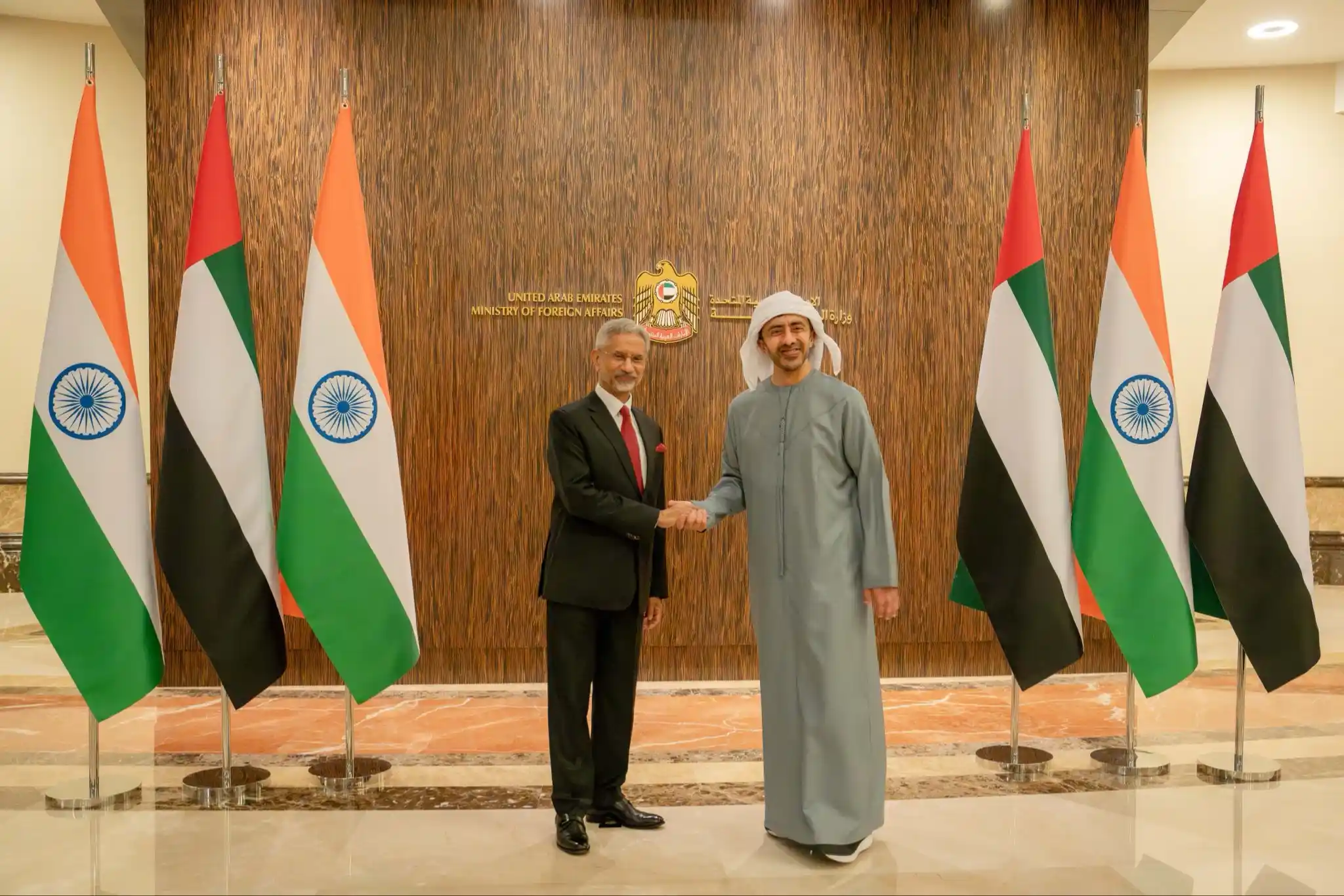
External Affairs Minister S. Jaishankar’s visit to the United Arab Emirates (UAE) at a time of heightened instability, a fragile ceasefire, and the reopening of the Strait of Hormuz in the West Asian region is both strategically timed and diplomatically layered. The visit must be understood not as a routine bilateral engagement but as a calibrated geopolitical intervention reflecting India’s role as a stabilizing actor in a turbulent region. This visit is also significant in the context of India’s energy security imperatives, diaspora concerns, and recalibration of its broader West Asia policy. Further, the timing of the visit is also critical. The recent escalation in conflict in the West Asian region has raised significant concerns about maritime security, energy flows, and the safety of expatriate populations. The temporary closure—and now reopening—of the Strait of Hormuz underscored the vulnerability of one of the world’s most critical energy transit routes. Nearly one-fifth of global oil supply passes through this narrow waterway, making any disruption not merely a regional concern but also a global economic shock. For India, which imports a substantial proportion of its crude oil from the Gulf, the stability of the Strait of Hormuz is important for its economic functioning. In this context, S. Jaishankar’s visit signals India’s proactive diplomatic engagement in ensuring that such disruptions are transient and do not escalate into systemic crises.
The UAE, in this context, emerges as India’s pivotal partner. Over the past decade, India-UAE relations have undergone a qualitative transformation, evolving from transactional economic ties to a comprehensive strategic partnership. The UAE’s role as a regional stabilizer, mediator, and economic hub makes it a critical interlocutor for India. EAM Jaishankar’s visit during a period of ceasefire indicates India’s intent to leverage its strong bilateral ties with Abu Dhabi to both assess the ground realities and coordinate responses to emerging geopolitical risks. It also reflects a recognition of the UAE by New Delhi as part of its diversified diplomatic outreach.
The reopening of the Strait of Hormuz has significant strategic consequences. It suggests that despite the volatility, there remains a mutual understanding amongst the regional actors about the catastrophic consequences of prolonged disruption. For India, this development provides immediate relief in terms of energy supply continuity, maritime security and respite for rising insurance costs. At the same time, EAM Jaishankar’s visit also indicates that New Delhi is not merely reacting to events but is seeking to institutionalize mechanisms that can mitigate future risks. This includes discussions on maritime security cooperation, intelligence sharing, and possibly coordinated naval presence in critical sea lanes. India’s increasing naval engagements in the Indian Ocean region are also part of a broader strategy to secure free and open sea lines of communication, and the Gulf region is key to this calculus.
Another critical dimension of this visit is the Indian diaspora in the UAE, which constitutes one of the largest expatriate communities globally. During periods of conflict, the safety and probable evacuation of Indian national—if required—was of paramount concerns. Jaishankar’s presence in the UAE during this sensitive period serves both as reassurance to the diaspora and as a signal to host governments of India’s commitment to its citizens abroad.
Economically, the visit must be seen in the context of the deepening India-UAE economic partnership, particularly following the Comprehensive Economic Partnership Agreement (CEPA). The stability of the Gulf region directly impacts trade flows, investment pipelines, and joint ventures. The recent conflict has demonstrated that the uncertainties can disrupt all these ventures. EAM Jaishankar’s engagement aimed at reaffirming commitments, addressing investor concerns, and exploring ways to insulate bilateral economic cooperation from geopolitical shocks. This includes discussions on supply chain resilience, energy investments, and renewable energy collaboration.
The broader geopolitical significance of the visit lies in India’s evolving West Asia policy. Traditionally characterized by a balancing act between competing regional actors, India’s approach has become more nuanced and proactive. It seeks to maintain strategic autonomy while engaging deeply with multiple stakeholders. The current crisis provides an opportunity for India to demonstrate its diplomatic agility, i.e., engaging with Gulf partners like the UAE while also maintaining channels with other regional powers like Iran and Israel. So, EAM Jaishankar’s visit can also be interpreted as part of a larger effort to position India as a credible and constructive actor and supporter of regional stability.
Furthermore, this visit highlights the intersection of energy security and geopolitics. The disruption of the Strait of Hormuz due this conflict serves as a reminder of the risks associated with overdependence on specific routes and regions. While India has been diversifying its energy sources and investing in strategic reserves, the Gulf region remains indispensable. EAM Jaishankar’s discussions are likely to include long-term energy security arrangements, including strategic petroleum reserves, joint investments in upstream and downstream sectors, and collaboration on alternative energy sources. The UAE’s own transition towards a diversified energy portfolio, including renewables, aligns with India’s interests in sustainable energy cooperation.
Diplomatically, the visit also sends a message beyond the immediate region. It underscores India’s willingness to engage actively in crisis management and its recognition of the connection between regional and global security. In an era where major powers are increasingly focused on great power competition, India’s approach in West Asia clearly emphasizes stability, connectivity, and economic cooperation. This further positions India as a distinct actor whose engagement is not driven by ideological alignments but by pragmatic considerations.
The outcomes of the visit, while not immediately visible, are likely to manifest in several areas. First, there will be enhanced coordination on maritime security, particularly in ensuring the uninterrupted flow of energy supplies. Second, the visit will likely lead to reaffirmed commitments on economic cooperation, including investments and trade facilitation. Third, there may be progress in institutional mechanisms for crisis management for the Indian expatriate population. So, the visit reinforced the strategic partnership between India and the UAE, ensuring that it remains resilient in the face of external shocks.
EAM S. Jaishankar’s visit to the UAE amidst ongoing conflict and a tentative ceasefire in West Asia, coupled with the reopening of the Strait of Hormuz, is emblematic of India’s proactive and multidimensional engagement with this region. It also signifies a shift from reactive diplomacy to anticipatory and balanced statecraft, where New Delhi seeks not only to safeguard its immediate interests but also to contribute to regional stability. The visit underscores the centrality of the Gulf states, like the UAE, in India’s strategic calculus, underlining its significant partnerships in navigating an increasingly volatile geopolitical landscape.
The views expressed are those of the author and do not represent the institution.