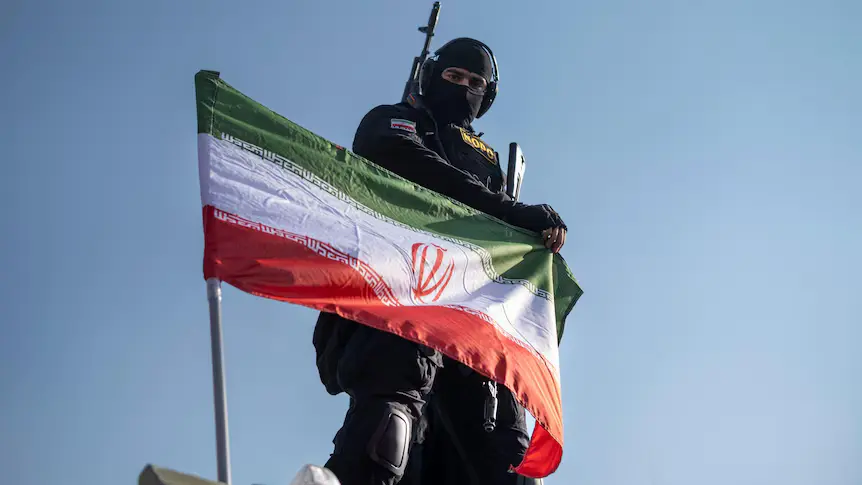
With the recent US and Israeli attacks on, or expedition into, as some seem to call it, the two attackers of Iran have taken some serious risks. One of the risks of such an expedition is that it may lead to a destabilised Iran. At present, it seems that risk is somehow avoided. Even though the jury is still out. Before such interventions take place, it is important to consider all the resulting developments. What may happen if Iran turns unstable? We may want to have a closer look at the potential consequences.
To examine such potential consequences, we also need to look at recent history. After all, it would not be the first time that an adventurous expedition of this kind leads to long-lasting instability. Such instability has far-reaching implications for the country and its population. But beyond that, also for the larger region and sometimes even for a full continent or even globally.
We all remember that the US invasion of Iraq back in 2003 led to the emergence of Daesh. Not `one on one`, directly or immediately but with some intermediate steps. The Sunni driven opposition to the shift in internal power-relations in Iraq was felt all across the region and provoked an influx of so called Foreign terrorist Fighters from all corners of the globe. The aftermath of this experimental Caliphate is history. Even though it is not completely finished business. Traces are still with us. Both within the region and in parts of Africa and Asia.
Although the NATO-led intervention in Libya in 2011 was of a fundamentally different nature and could even be understood under the R.t.P[1]. banner, the impact was no less disastrous. The present day situation in Mali and Burkina is in a certain sense a long term effect of the regime change in Libya. The proliferation of weapons from Libya’s battlefield and the efflux of Tuaregs that served as combatants for the Khaddaffi regime are the source of today’s terrorist related problems in West Africa. Again with some in between steps. The former Tuareg combatants became jobless after the ousting of Khaddafi and decided to join and reenforce the militants that sought independence of Azawad in Northern Mali. This served as a starting point for the group that calls itself JNIM[2]. This terrorist group is presently at the outskirts of Bamako, threatening to take the city.
These are just two examples where local instability, after an intervention, led to a large-scale terrorist threat. The question then is whether today’s intervention in Iran may lead us into the follow-up of Daesh or JNIM. Are we looking at a plausible scenario?
The proliferation of weapons is one of the conditions for the emergence of a threatening terrorist outfit. Ungoverned or under-governed spaces is another one. Disenchantment is a third one. Human rights violations and suppression is number four. Opportunity is number five. Under-governed spaces often create a vacuum where `bad apples` can start to recruit and mobilize anger. Mix that with sufficient weapons and violence may be the outcome.
Now let`s explore the specifics of the Iranian situation. It is unclear at present to what extend the attacks already have or still will weaken the local position of the regime. Resilience seems higher than anticipated. At least in military terms. Whether the focus on national defense will have an impact on the relationship between the population and the leaders is difficult to judge. The fact is that the anti-government demonstrations in early 2026 were severe and nationwide. These protests were heavily driven by economic crisis, inflation and the devaluation of the rial. Since then, the humanitarian situation has only deteriorated. The human suffering may eventually give rise to increased opposition and more violent protests.
Several regional organizations may find an opportunity in this mix. Because as ICCT indicated in their recent publication[3] both ISIS and AQ cannot wait until their moment has come. They both want to grow and expand their influence and presence in the region. Neither of them is befriended with the revolutionary forces in Tehran. Especially, ISIS is an obvious opponent. And it is an opponent that has several motives to strike when the window opens. As a Sunni force, it will be a great pleasure for ISKP[4] to occupy space in a Shia revolutionary country. They will do everything to elevate the sectarian tensions in the region. An agenda that they are clearly dedicated to in other parts of Asia. ISKP is already active in Pakistan, Afghanistan, and Central Asia. And, most importantly, the Khorasan Province is partly located in Iran. ISKP defines north-eastern Iran as part of its territory. The Sunni population of Iran has been complaining about discrimination for a long time. This adds a supplementary ingredient to the conditions to potentially create rebellion.
All in all, it means that spicing up tensions and creating an `us and them` identity-based rebellion in Iran is potentially possible and a once-in-a-lifetime opportunity for the ISKP leadership. It would mean targeted attacks on Shia interests, symbols and representatives. To what extend such sectarian violence would be actively or passively supported by other Sunni dominated forces in the region is hard to predict. But it is not totally unthinkable.
Fact is that further destabilisation of Iran by ISKP in the post intervention phase will not sadden the leaders of the nations that initiated these attacks. The non-interventionist approach[5] that Israel took in the earlier case of confronting the emerging Daesh Caliphate may serve as an indication from the past of how the Israeli government will respond.
All in all, if this scenario turns into reality, it means that the combined US and Israeli expedition may become the stepping stone to a long term terrorist expansion with consequences far beyond the national territory of Iran. A presence of ISKP in Iran will have consequences for the whole region. But for now the regime in Tehran seems more resilient than the adversaries expected. So far there is no sign of large scale collapse of governance structures. The regime is stronger than expected, the people stand together and feel nationalistic pride under foreign pressure and the structures seems more solid than some had expected. As shown in the earlier cases of Iraq and Libya, it is not about a simple `good` or `bad`. It never is. The world is more complex than that. Those who thought that Iranian structures would be destroyed in a matter of days made a major miscalculation. And, in terms of security and counter terrorism that may be more of a blessing in disguise than some had foreseen.
[1] Responsability to Protect
[2] Jamaat Nusrat Ul-Islam wal-Muslim
[3] https://icct.nl/publication/tehran-europe-terrorism-risks-after-killing-irans-ayatollah
[4] Islamic State in the Khorasan Province
[5] The global coalition to defeat ISIS is a combination of 90 States, 14 of these member states are located in the Middle East. Israel is not a member.