
In 2025, India’s scientific and technological landscape is not simply evolving, it is sprinting toward global leadership. The pace, depth, and breadth of change are staggering. In a world increasingly defined by technological sovereignty, India is no longer content to be a peripheral player. From quantum computing to agri-tech, and from space research to clean energy, the nation is leveraging policy, capital, and talent to build a future where innovation is both the engine and the export. The question is no longer whether India will lead in science and technology, but how quickly it will consolidate its position.
The Technology & Innovation Surge
India’s National Supercomputing Mission (NSM) reaching 32 PetaFlops is not just a headline—it’s a statement of intent. For a country whose research ecosystem once struggled with computational bottlenecks, the leap of 5 PetaFlops in a single year is an unambiguous signal that India wants to play in the premier league of global HPC (High Performance Computing). The IUAC’s 3-PetaFlop system is particularly significant, not just for the raw processing power, but for the kinds of problems it can now realistically address—from climate modeling to genome sequencing.
Even more transformative is the National Quantum Mission (NQM), with a budget of ₹6,003.65 crore. Unlike in the past, where India often imported critical high-tech solutions, the NQM is aimed squarely at indigenous hardware and algorithms. This is an ideological shift: instead of merely adopting global technology, India is creating it, and in a field—quantum computing—where even the most advanced economies are still experimenting.
Artificial intelligence is following a similar trajectory. The BharatGen LLM project is particularly notable because it addresses India’s unique linguistic diversity—something most Western AI models fail to capture effectively. The projected 23.1% CAGR for the AI market through 2025 isn’t just about revenue growth; it’s about AI becoming embedded in agriculture, healthcare, and governance. This is AI not as a Silicon Valley export, but as a tailored domestic tool.
Perhaps the most underappreciated metric is India’s climb in the Global Innovation Index (now 39th) and its ranking as 6th in global IP filings. This isn’t a vanity score—it reflects the health of the innovation ecosystem: the patent culture, R&D intensity, and investor confidence. The jump in the Network Readiness Index (from 79th in 2019 to 49th in 2024) tells a parallel story—connectivity and ICT access are no longer barriers but enablers.
With semiconductor partnerships (such as with Nvidia) and 6G research underway at IIT Madras, India is showing that it understands the strategic importance of owning the next wave of computational infrastructure. This is not a case of technological mimicry—it’s about ensuring long-term self-reliance.
Space: From Pragmatism to Ambition
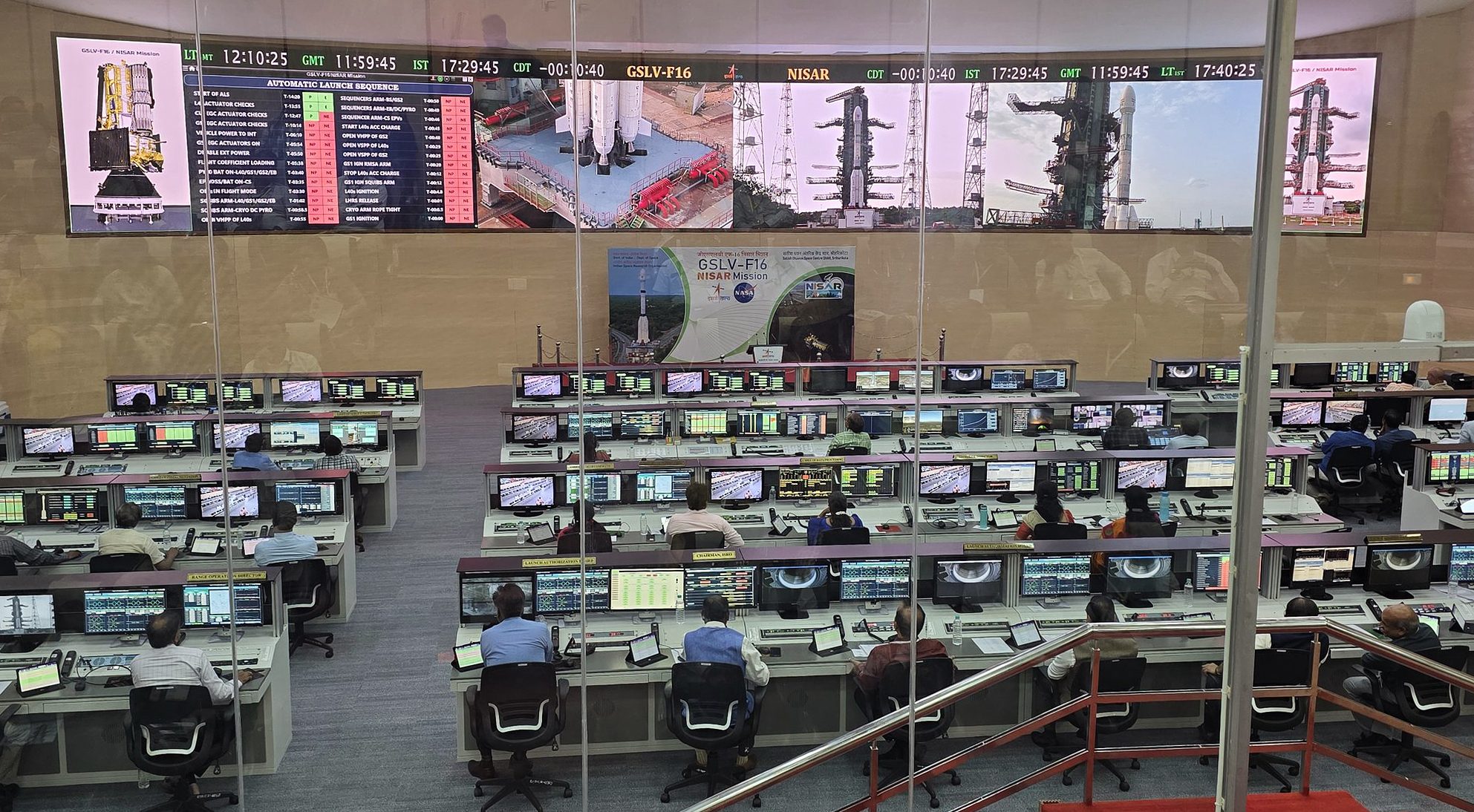
The Gaganyaan human spaceflight program, with its ₹20,193 crore budget, may be the most visible sign of India’s ambitions, but it’s the less glamorous milestones that impress me most. The NISAR satellite’s high-resolution Earth scans, developed jointly with NASA, exemplify the fusion of global collaboration with local capability. GSLV missions are now routine enough to be unremarkable, which is perhaps the clearest measure of maturity in any space program.
The Aditya-L1 solar observatory represents a new frontier—space weather monitoring—which has downstream benefits for communications, power grids, and satellite safety. ISRO’s retention of the world record for launching 104 satellites in one mission reinforces its reputation for cost-efficient, high-reliability launches. This is not just a scientific triumph but an economic one, drawing international clients who value affordability without compromising on quality.
Looking forward, the planned Bharatiya Antariksh Station by 2035 and the stated goal of lunar landings by 2040 suggest that India’s space strategy is no longer reactive but generational. If the last decade was about proving capability, the next will be about shaping the architecture of global space governance.
Agriculture’s Quiet Tech Revolution
In global conversations about innovation, agriculture often gets relegated to the background. But India’s 2025 agri-tech story is arguably as transformative as its quantum computing push. The fact that over 70% of Indian farms are projected to use bio-enhanced seeds is a game-changer for food security and climate resilience. Precision agriculture—already adopted by 40% of farms—has shown measurable gains: up to 25% higher yields, with 20–30% lower water and fertilizer use. This isn’t just efficiency; it’s survival in an era of climate volatility.
IoT-based soil sensors crossing 49% adoption rates may sound like a statistic, but it signals a profound behavioral change in rural India. Farmers are now data-driven decision-makers. The expansion of AI-powered advisory systems to 35% of the farming population is equally critical—technology is finally bridging the gap between knowledge and practice.
Investments in agritech, expected to hit $24 billion this year, are focusing on sustainability—climate-resilient seeds, vertical farming, and blockchain-enabled supply chains. Here, India’s approach is subtly radical: rather than simply chasing yield, it’s building systems resilient to a world where weather unpredictability is the new normal.
The Broader Ecosystem: Geospatial, Health, and Energy
India’s expansion into geospatial science—training over 6,000 students in spatial thinking across seven states—might seem modest, but it’s laying the groundwork for a generation that sees mapping, data visualization, and environmental modeling as everyday skills. This could have profound long-term effects on disaster planning and urban development.
In health, the combination of vaccine innovation, genetic diagnostics, and affordable medical devices points toward a healthcare model that is both high-tech and accessible. In clean energy, the diversification into solar and green hydrogen underscores the understanding that energy independence is inseparable from technological sovereignty.
The Policy Backbone
None of these advances would have been possible without the policy frameworks and funding streams that have matured over the past decade. The Anusandhan National Research Foundation (ANRF) represents a decisive move to consolidate and scale research funding. INSPIRE continues to feed the talent pipeline, and the Technology Development Board’s ₹220.73 crore in project funding demonstrates the state’s willingness to de-risk innovation.
Here, India’s strength lies in the convergence of top-down vision and bottom-up adoption. Government programs are not sitting in policy documents—they are translating into deployed infrastructure, working prototypes, and measurable KPIs.
The Road Ahead: Opportunities and Caveats
If I have a critique, it’s this: India’s rapid ascent in science and technology risks creating “islands of excellence” amid uneven distribution of benefits. The urban-rural digital divide, though shrinking, still poses a threat to inclusive innovation. Similarly, while global partnerships like NISAR are vital, India must guard against overdependence on foreign technology in strategic domains.
There’s also the question of ethical governance. AI, quantum, and biotech all carry risks that require anticipatory regulation. India’s challenge will be to balance innovation speed with robust ethical and legal frameworks—without stifling the very dynamism that is driving its ascent.
A Nation Rewiring Its Future
In 2025, India’s science and technology ecosystem has reached a point of inflection. The data tell a clear story: rising in global rankings, commanding IP leadership, achieving double-digit yield improvements in agriculture, building indigenous quantum systems, and planning multi-decade space programs. But the deeper truth is philosophical—India is no longer content to adapt global technology; it is intent on defining it.
The next decade will test whether India can translate its technological muscle into sustained socio-economic transformation. If it succeeds, the India of 2035 will not merely be a beneficiary of global science and technology—it will be one of its principal architects.

