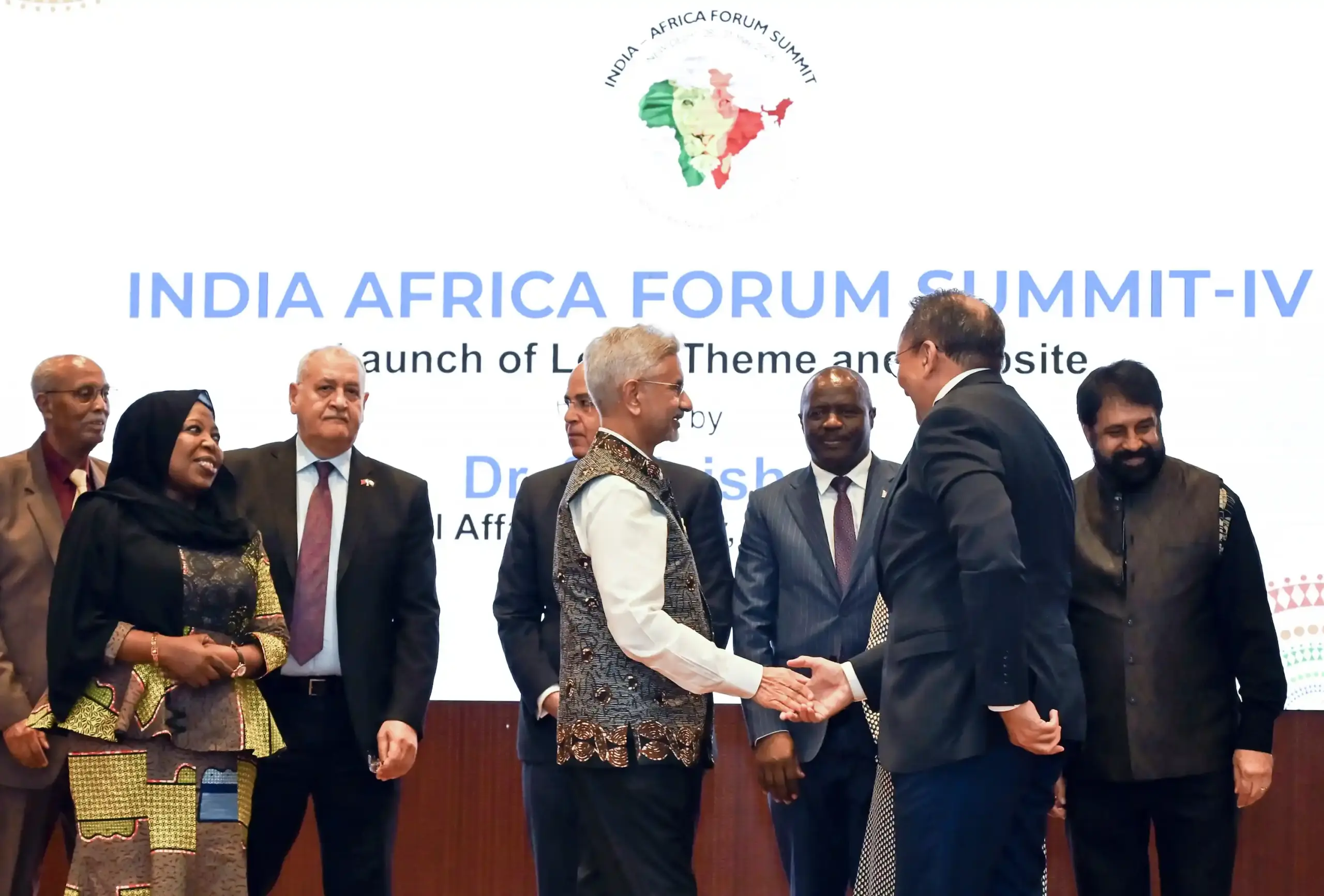
The India–Africa Forum Summit in 2026 cannot afford to be only ceremonial. The last two decades of India–Africa engagement were shaped by development partnership and energy security. The next phase must be shaped by corridor resilience, industrial integration, and supply chain alignment. If IAFS 2026 is to be consequential, it must anchor India’s Africa policy in areas of modern geopolitics including trade architecture and maritime stability. In that framework, Kenya and Egypt are not simply bilateral partners. They are strategic gateways.
Africa’s economic geography is organised around corridors. Ports, logistics chains, customs regimes, and industrial zones determine whether trade flows expand or stall. For India, whose economy is deeply dependent on maritime and whose exports increasingly target emerging markets, corridor stability is not peripheral to foreign policy. It is central to it. Kenya anchors the eastern corridor of Africa’s Indian Ocean littoral. Egypt commands the northern maritime hinge connecting Asia to Europe through the Suez Canal. Together they frame India’s westward and southward trade horizons. In an era of fragmented globalisation, corridor stability has become a precondition for strategic autonomy.
The agenda for IAFS 2026 should therefore move beyond development assistance and articulate a coherent corridor strategy. With Kenya, the objective is integration with East Africa’s growth arc. Bilateral trade between India and Kenya has consistently ranged in the vicinity of USD 3 to 4 billion annually. India is among Kenya’s leading trade partners. Pharmaceuticals, machinery, petroleum products, and manufactured goods flow from Indian ports to Mombasa. Tea and agricultural products flow back. The trade basket reflects complementarity, not rivalry.
Yet trade volumes alone are not the metric of strategic success. The question is whether India is embedded in the logistical and regulatory ecosystems that shape East Africa’s commerce. The Port of Mombasa serves as a gateway to landlocked economies such as Uganda and Rwanda. Infrastructure corridors radiating inland determine whether Indian goods reach regional markets efficiently. If IAFS 2026 is to expand and strengthen India’s economic footprint, it must prioritise logistics cooperation, standards harmonisation, and digital customs facilitation with Kenya and its regional partners.
Kenya’s relevance is amplified by its membership in the East African Community, whose customs union and common external tariff framework bind together a regional market that now stretches well beyond the Kenyan coastline. For India, engagement with Kenya is therefore not confined to a single national economy but provides structured access to a wider integrated space linking Uganda, Tanzania, Rwanda, Burundi, South Sudan, the Democratic Republic of the Congo and Somalia. The harmonisation of tariffs and customs procedures within the Community reduces transaction friction and enhances predictability for Indian exporters. If IAFS 2026 seeks to deepen trade integration, structured dialogue with the East African Community as a bloc should complement bilateral engagement with Nairobi. Corridor diplomacy, in this sense, must recognise regional institutions as multipliers of access and stability.
The significance of the East African Community, however, extends beyond its internal tariff regime. It is also a building block of the African Continental Free Trade Area, which seeks to progressively knit together Africa’s sub-regional markets into a single trading framework. For India, this layering of integration matters. Engagement with Kenya and the Community offers not only regional access but a vantage point into a continent that is attempting to reduce internal barriers and expand intra-African trade. As AfCFTA implementation deepens, supply chains that begin in Mombasa may increasingly connect to markets across West and Central Africa under harmonised rules of origin and dispute resolution mechanisms. If IAFS 2026 is to align India’s Africa policy with long term economic transformation on the continent, it must view the East African Community not as an isolated bloc but as a gateway into a progressively integrating African market.
Indian investment in Kenya reinforces this imperative. More than a hundred Indian companies operate in sectors ranging from manufacturing to finance. The presence of a long established Indian origin community, numbering over eighty thousand, provides social depth to the relationship. These linkages should be leveraged strategically. IAFS 2026 must frame diaspora networks not merely as historical residue but as channels for industrial collaboration and technology diffusion.
Maritime security forms the second layer of engagement. Nearly ninety per cent of India’s trade by volume moves by sea. The sea lanes connecting Indian ports to Mombasa are arteries of commerce. Piracy in the Western Indian Ocean may have declined from its peak, but maritime insecurity has not disappeared. Illegal fishing, trafficking, and the risk of spillovers from regional conflicts remain persistent concerns. A disruption in these waters would reverberate through freight rates and domestic inflation in India. Corridor diplomacy therefore demands sustained maritime cooperation. Naval exercises, hydrographic surveys, and maritime domain awareness initiatives with Kenya are not symbolic gestures. They are instruments of economic security.
If Kenya represents India’s eastern gateway into Africa’s interior, Egypt represents the northern hinge of India’s global trade architecture. The Suez Canal is not merely an Egyptian asset. It is a global chokepoint through which a substantial share of India’s westward trade transits. Recent disruptions in the Red Sea have demonstrated how quickly instability can translate into higher shipping costs and supply chain delays. For India, the stability of this corridor is directly linked to economic predictability. A prolonged disruption in this passage does not merely delay shipments; it raises freight costs, tightens supply chains, and feeds directly into domestic price pressures.
Bilateral trade between India and Egypt has expanded significantly, crossing the USD 7 billion mark in recent years. India exports petroleum products, cereals, chemicals, and engineering goods, while importing fertilisers and hydrocarbons. But the more significant shift lies in industrial cooperation. Indian firms have invested in Egypt’s special economic zones, including the Suez Canal Economic Zone. These investments allow Indian manufacturers to leverage Egypt’s trade agreements with Europe and Africa, integrating production networks rather than merely exporting finished goods.
The summit would do well to recognise this shift from trade to co-production. Industrial partnerships in Egypt provide India with manufacturing footholds closer to European markets. They diversify supply chains and reduce overdependence on any single geography. In an era of fragmented globalisation, such diversification is strategic insurance.
Energy collaboration adds another dimension. Egypt’s emerging role as a regional gas hub and its ambitions in renewable energy, including green hydrogen, align with India’s own transition priorities. Structured dialogue under the IAFS framework can align regulatory standards and investment flows in these sectors. The objective should not be transactional energy exchange, but coordinated participation in new energy ecosystems.
Political coordination reinforces economic logic. Both India and Egypt have advocated reform of global governance institutions and have sought greater voice for developing economies. Kenya, as a regional anchor in East Africa, similarly engages actively in continental institutions. IAFS 2026 must therefore articulate a shared agenda that links trade facilitation with multilateral reform. Corridor stability and fairer trade rules are mutually reinforcing objectives.
The pairing of Kenya and Egypt under the IAFS agenda illustrates a broader principle. Africa policy cannot be reduced to a single narrative of solidarity. It must differentiate between corridors and functions. Kenya offers access to East Africa’s consumer markets and inland corridors. Egypt secures maritime passage to Europe and anchors industrial integration. One strengthens India’s southbound trade expansion. The other safeguards and diversifies its westward commerce.
These partnerships are not without risk. Kenya faces fiscal constraints and currency pressures that can affect import demand. Egypt’s strategic location exposes it to regional volatility. Shipping disruptions in the Red Sea have shown how geopolitical turbulence can disrupt trade flows overnight. Risk management must therefore be embedded within the corridor strategy advanced at IAFS 2026. Diversification of routes, coordination on maritime security, and sustained diplomatic engagement with littoral states are not optional extras. They are prerequisites for trade resilience.
India’s total trade with Africa has crossed the USD 100 billion mark in recent years. This aggregate figure signals the continent’s growing importance. However, scale alone does not confer strategic comfort. What matters is whether trade routes are secure, industrial partnerships are durable, and regulatory frameworks are aligned. Kenya and Egypt offer platforms to advance each of these objectives.
Digital cooperation presents an additional frontier. India’s experience in building digital public infrastructure can support trade facilitation and financial inclusion in partner economies. Collaboration with Kenya in fintech and with Egypt in digital governance can reduce transaction costs and enhance transparency. Such initiatives align with IAFS objectives of capacity building while directly strengthening trade ecosystems.
Ultimately, the success of IAFS 2026 will depend on whether it can translate broad declarations into corridor specific outcomes. With Kenya, this means deepening logistical integration and maritime coordination. With Egypt, it means safeguarding the Suez passage and expanding industrial co-production. These are not abstract ambitions. They are operational necessities for an economy as outward oriented as India’s.
India does not seek dominance in Africa. It seeks dependable gateways and resilient corridors. Kenya and Egypt, situated at opposite ends of the continent’s maritime arc, provide precisely that opportunity. If IAFS 2026 can anchor these relationships within a coherent trade and connectivity strategy, India’s engagement with Africa will enter a new phase. It will move from presence to positioning, from outreach to integration, and from episodic diplomacy to sustained economic statecraft.