I. Introduction
No religion appears anywhere in India’s Foreign Contribution (Regulation) Amendment Bill, 2026. That has not stopped five months of claims that it amounts to one: a US congressman called it “a clear attack against Christians,” a federal commission renewed its case for sanctions against India’s largest Hindu volunteer organisation, the Rashtriya Swayamsevak Sangh, and Canadian civil society split into open argument over whether the RSS’s chief, Mohan Bhagwat, should even be allowed to address the crowd waiting for him in New York. Read the calendar closely enough, though, and the tidiest version of this story — a coordinated campaign, timed to a funding law New Delhi had every right to pass — falls apart on its own dates. What survives is smaller, stranger, and considerably harder for USCIRF to explain away.
Coincidence, coordination, or the internationalisation of an argument India has been having with itself for a century? Not one source in this paper settles that question by simply asserting an answer. The dates do more work than the rhetoric does.
II. The Law Behind the Outrage
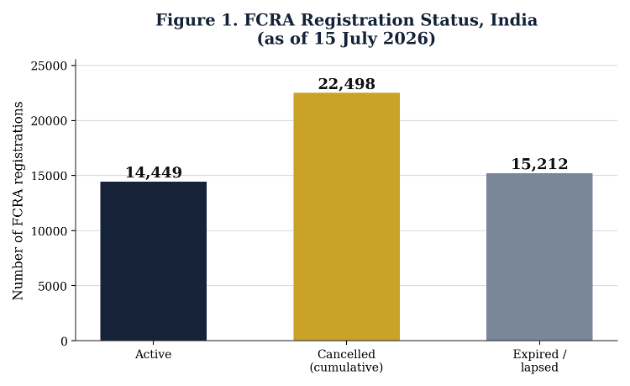
The bill, introduced in the Lok Sabha on 25 March 2026 and referred to a Joint Parliamentary Committee in August after sustained domestic opposition, does not change who may receive foreign funds. It creates a “Designated Authority” empowered to take provisional, and eventually permanent, custody of the assets of any organisation whose FCRA registration lapses, is surrendered, or is cancelled. The stock under management is already substantial: 14,449 active certificates against 22,498 cancellations and roughly 15,000 further lapses since 2019 (Figure 1).
Its harshest domestic critics were not American. Kerala civil-society groups and church councils objected within weeks of introduction; Mizoram’s congregations marched in Aizawl; Nagaland’s chief minister sought a formal review; and the Tamil Nadu Assembly passed a resolution against the bill in early August — pressure substantial enough, on its own, to push the Lok Sabha toward committee referral before Washington had said a word that month. That sequencing matters: it is difficult to sustain the claim that New Delhi was reacting to American pressure when its own Parliament was already responding to Indian citizens first.
Comparatively, the underlying principle is unremarkable: the United States has required foreign-funding disclosure since 1938 under FARA; Australia since 2018; the United Kingdom since 2025 (Table 1). A hardcore case for India does not need to pretend the comparison is perfect, and is stronger, not weaker, for admitting where it isn’t: none of those three regimes lets the state absorb an organisation’s property outright, and FCRA’s remedy is genuinely more intrusive on that single dimension. What India’s bill does simultaneously do, and what the regimes it is compared to do not, is cut the maximum prison term for a compliance violation from five years to one — more custodial control over assets, markedly less criminal exposure for the people who ran the organisation. That asymmetry, not any religious language in the statute’s text, is the one objection worth taking seriously on its own terms, and the case for India’s sovereignty claim survives it: a state may legitimately choose administrative remedies over criminal ones and still be exercising an ordinary, internationally unremarkable power.
Table 1. Foreign-Influence Registration Regimes Compared
| Jurisdiction | Core mechanism | Can the state absorb assets? | Max. criminal penalty |
| India — FCRA (2010; 2026 Amendment Bill pending) | Registration; “Designated Authority” absorbs assets on cancellation, surrender, or lapse | Yes | 1 year (reduced from 5) |
| United States — FARA (1938) | Registration and public disclosure of foreign-directed activity and funding | No | Criminal prosecution, case-by-case |
| United Kingdom — FIRS (2023; in force 2025) | Two-tier registration of arrangements with a foreign power | No | Up to 5 years’ imprisonment |
| Australia — FITS (2018) | Registration of activity on behalf of a foreign principal | No | Up to 5 years’ imprisonment |
III. The Timeline USCIRF’s Critics Skip
The chain usually offered runs in a straight line: FCRA angered American Christians, American Christians moved USCIRF, and USCIRF then targeted the RSS. Start with the arithmetic that gets skipped: USCIRF’s call for “targeted sanctions” against entities including the RSS and India’s Research and Analysis Wing, for their “tolerance of severe violations of religious freedom,” was published on 4 March 2026 — three full weeks before the FCRA bill even reached the Lok Sabha. A recommendation cannot be provoked by a law that does not yet exist.
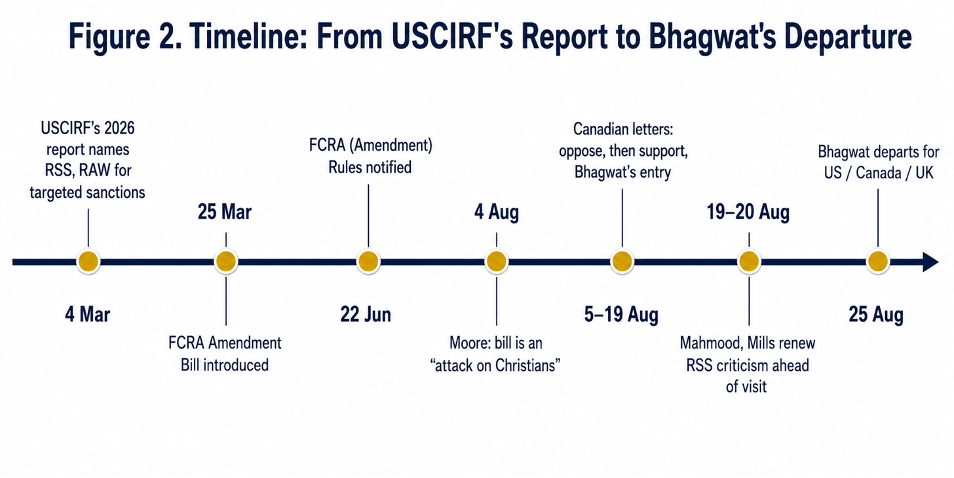
Nor is this Asif Mahmood’s doing, whatever the past fortnight’s headlines imply. USCIRF’s own masthead settles the point: the chair of record on the report’s cover is Vicky Hartzler, with Mahmood then serving as vice chair; he did not take the gavel until 20 July, more than four months later, for the 2026–27 term. An institutional position now popularly blamed on one man predates his chairmanship entirely and survived a change of leadership fully intact — harder to write off as one commissioner’s grudge, and easier to recognise for what USCIRF itself insists it is: an institutional pattern, not a personal one. What can genuinely be dated to the days before Bhagwat’s 25 August departure is a second, separate round: Chair Mahmood’s statement that Modi “is a member of the RSS,” and Commissioner Gene Mills’s call for no high-level meetings with RSS figures “even when affiliated with the Indian gov’t” — both on the record, both timed to the visit, neither new.
If résumés are fair game — and a serious analysis should treat them as fair game consistently, not selectively — two cut both ways. Before USCIRF, Mahmood spent years as a Kashmir-policy advocate in Washington, helping organise the congressional engagement that followed India’s 2019 revocation of Article 370 and testifying before a House Foreign Affairs Subcommittee on the subject himself. Hartzler, the chair who actually presided over the March report, built her congressional career and her post-Congress advocacy around defending persecuted Christians specifically — she sponsored the Combatting the Persecution of Christians in China Act and addressed a “Christian Persecution Summit” the autumn before the report’s release. Neither fact proves bad faith on its own. Together they establish something more useful than an accusation: USCIRF’s leadership, across two consecutive terms, has been staffed by commissioners with pre-existing, specific advocacy records on the exact disputes now before them — a structural feature of how the commission is appointed, not a conspiracy authored by whichever commissioner happens to be quoted this month.
IV. A Century of Being Banned, and Outlasting It
The RSS’s own story starts with a physician, not a soldier: K. B. Hedgewar founded it in Nagpur in 1925, building it around the shakha, a daily gathering that has outlasted three separate governments’ attempts to ban it out of existence — 1948, after Gandhi’s assassination by a former member; 1975, during the Emergency; 1992, after the Babri Masjid demolition — each lifted once specific charges could not be sustained.
“We were banned thrice… if we were not there, whom did they ban?” — Mohan Bhagwat, arguing that prohibition is itself a form of official recognition.
The line only works because the bans were real, and because the organisation survived them without ever being required to register under any statute — predating independence, and never legally obligated to seek registration since, which makes Bhagwat’s larger analogy a real legal argument rather than only a rhetorical one. By its own 2025 centenary count, the network reported 83,129 shakhas and an estimated four million participants, up from 39,823 in 2010, dipping to 55,652 during the pandemic before recovering. A hardcore defence of the RSS should not pretend the historical debate is settled, because independent verification of that figure is difficult — the organisation keeps no membership rolls — and the standard institutional histories, Andersen and Damle’s Brotherhood in Saffron and its 2018 sequel, lean heavily on RSS’s own access and have been criticised for reproducing its preferred narrative. Christophe Jaffrelot’s independent scholarship goes further, treating the same shakha network as an ethnic-nationalist project rather than civic infrastructure. That scholarly fight is real and unresolved, and no amount of enthusiasm on either side changes that — which is exactly why the institutional case against the RSS has to stand or fall on something sturdier than reputation, in either direction.
The pattern of an organisation’s legal status shifting sharply at the border is not unique to the RSS. The Muslim Brotherhood is a banned terrorist organisation in Egypt, the UAE and Saudi Arabia, a legal political party’s lineage in Tunisia, and a registered civil-society presence in Britain — three legal characterisations of one movement, decided by geography rather than by anything the movement itself changed. Turkey’s state-linked Diyanet network has drawn comparable host-country scrutiny across Western Europe for the same underlying reason: a large, organised, transnational movement will be read differently by every jurisdiction it touches. That variance is evidence of how borders work, not proof that any single reading is the correct one — and it cuts against treating USCIRF’s characterisation of the RSS as self-evidently authoritative simply because it is foreign.
V. The Case That Never Sticks
USCIRF can recommend. It cannot compel. On India, recommending is all it has ever managed: the State Department has accepted none of USCIRF’s India CPC recommendations for seven consecutive years, across three administrations of both parties (Table 2) — a pattern of inaction it shares with Washington’s treatment of USCIRF’s Syria and Vietnam recommendations, which undercuts any reading of the India case as singular rather than symptomatic of an advisory body whose bark has consistently outrun its bite.
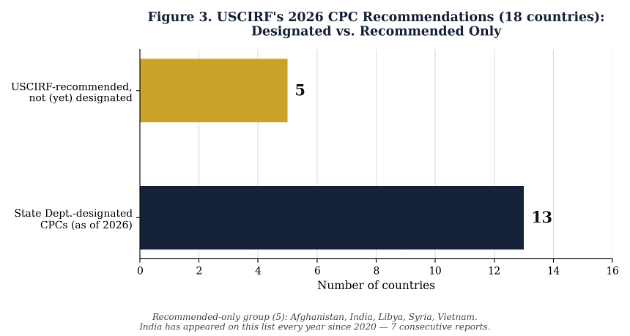
Table 2. USCIRF’s India Recommendation versus State Department Action, 2020–2026
| Year | USCIRF recommendation | Consecutive streak | State Department action |
| 2020 | CPC recommended (1st time since 2004) | 1st | Not accepted |
| 2021 | CPC recommended | 2nd | Not accepted |
| 2022 | CPC recommended | 3rd | Not accepted |
| 2023 | CPC recommended | 4th | Not accepted |
| 2024 | CPC recommended | 5th | Not accepted |
| 2025 | CPC recommended | 6th | Not accepted |
| 2026 | CPC + targeted sanctions on RSS, RAW (under Chair Hartzler) | 7th | Not accepted (as of Aug. 2026) |
The entity-specific case against the RSS is where the evidentiary record is thinnest of all. The organisation has no formal membership rolls or command structure in the conventional sense, and USCIRF’s public characterisation of the alleged violations leans on affiliated groups and self-professed sympathizers rather than demonstrated organisational direction from RSS leadership — a distinction the commission would likely insist on if the organisation under scrutiny were American. Even Justice For All, an advocacy group that welcomed the recommendation, has publicly asked USCIRF to strengthen it by naming specific individuals rather than the organisation as a whole, which itself concedes the original finding does not tie the RSS institutionally to a named act.
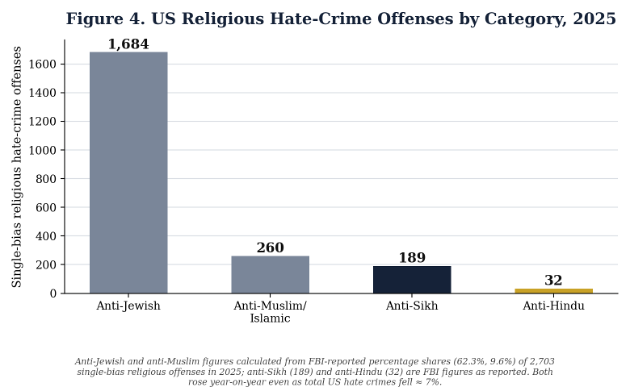
A parallel question applies to USCIRF’s own country, and honesty requires asking it with equal force rather than louder force. FBI data released 14 August 2026 recorded 189 anti-Sikh and 32 anti-Hindu hate-crime offences in the United States in 2025, both up on the previous year even as total US hate-crime offences fell by roughly seven percent nationally (Figure 4). A Carnegie Endowment survey separately found that a substantial share of Indian-Americans reported being called a slur since the start of 2025. Days before Bhagwat’s own address, the Fourth Circuit Court of Appeals upheld an injunction against immigration enforcement at eight houses of worship — Quaker, Sikh, and Cooperative Baptist Fellowship congregations among them — after finding the government’s policy likely violated the Religious Freedom Restoration Act. None of this makes USCIRF’s India findings wrong. A critic with problems of its own is not thereby wrong about someone else, and pretending otherwise would be the same evidentiary sleight of hand this paper has spent four sections rejecting in the opposite direction. What it does mean is that an institution invoking religious-freedom authority abroad is not obviously entitled to a benefit of the doubt it has not yet extended to itself at home.
VI. Canada, and a Second Front With Meta
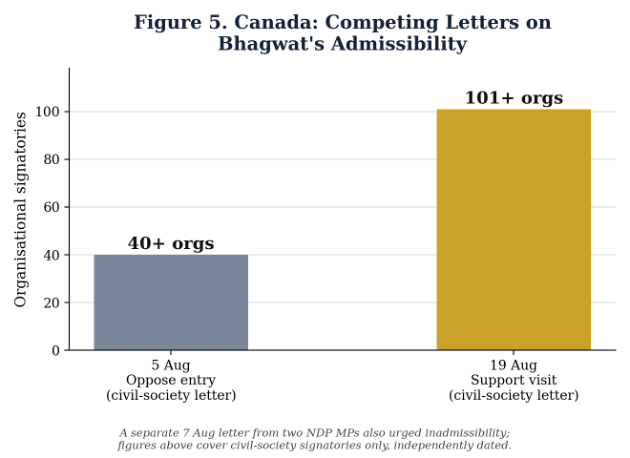
Canada shows the same split in miniature. More than forty Canadian civil-society and rights organisations, joined by two New Democrat MPs, asked Ottawa to bar Bhagwat, citing alleged extremism and unsubstantiated ties to “listed terrorist organisations” — an allegation the letters did not themselves document with named incidents. Twelve days later, more than a hundred Canadian Hindu and civil-liberties organisations countered, warning that excluding a visitor without “credible evidence and due process” would itself look discriminatory (Figure 5). Neither side has produced evidence specific enough to settle the question on its own; both agree on the legal standard and disagree completely about who meets it. A reader hoping to find a clean villain in Ottawa will not find one.
A separate, unrelated dispute makes the same point from another angle. On 23 July, Meta briefly restricted a Facebook video of Modi addressing Gen Z protesters over examination-paper leaks, then called the removal an error; the Ministry of Electronics and Information Technology summoned Meta’s global policy head, a parliamentary committee issued a public ultimatum to Zuckerberg, and Hyderabad police opened a criminal case against Meta India’s chief — all inside two weeks, and all while Meta India was separately apologising for a false Zuckerberg claim about the outcome of India’s 2024 election. Nothing ties this to FCRA, USCIRF, or Bhagwat’s tour, and treating it as part of the same story would be the unearned connection this paper has argued against throughout. What it does show is an Indian state that moves fast and hits hard against a foreign platform when it chooses to — which sits uneasily next to any narrative in which India is a passive target of Big Tech rather than an increasingly assertive regulator of it.
A funding law, a sanctions list and a deleted video: three separate fights, in three separate rooms, or one argument — made without coordination, in the same idiom, by everyone involved — about who gets to govern India’s institutions?
VII. Regulatory and Cultural Sovereignty
None of this required a conspiracy to happen, and that is precisely what USCIRF’s critics and USCIRF itself both keep missing. A sovereign state regulating its own funding, its own platforms, and its own borders does not need a secret hand to explain it. It needs only the thing India has been asserting the entire time: that decisions about who may fund Indian civil society, how an Indian cultural organisation should be characterised, and what a foreign platform may restrict inside India belong, in the first instance, to Indian law and Indian institutions — which have already adjudicated the RSS’s status three times over — not to a foreign commission’s annual report, a Canadian ministry’s discretion, or a platform’s automated systems. Sovereignty is a claim about who gets to decide. It is not, by itself, a verdict on whether India’s underlying conduct toward its religious minorities is beyond criticism; those are different questions, and this paper’s case for the first does not require silence on the second.
VIII. Conclusion
On the three questions this paper set out to test — the FCRA’s legality, the strength of USCIRF’s case against the RSS, and the fairness of the campaign to exclude Bhagwat from Canada — the record assembled here supports India’s and the RSS’s position, not because the paper set out to prove it, but because that is where the verified evidence, followed through its own chronology, actually leads. A domestic regulatory dispute entered the vocabulary of religious freedom and platform accountability, and it stopped being domestic — attracting institutions with their own separate histories and incentives rather than a single hostile one. FCRA’s drafters wrote a bill about lapsed certificates; a commission chaired, at the moment of decision, by a career Christian-persecution advocate; two rival Canadian coalitions; and an unrelated dispute with Meta turned the surrounding season into a referendum on Hindu nationalism and Indian regulatory power, largely without producing a single new fact about the RSS itself. What the record so far will not support is the claim that any of it was engineered — by a congressman, a commissioner, a platform, or a coalition of NGOs. What it will support is India’s oldest and simplest argument: that these are its calls to make.