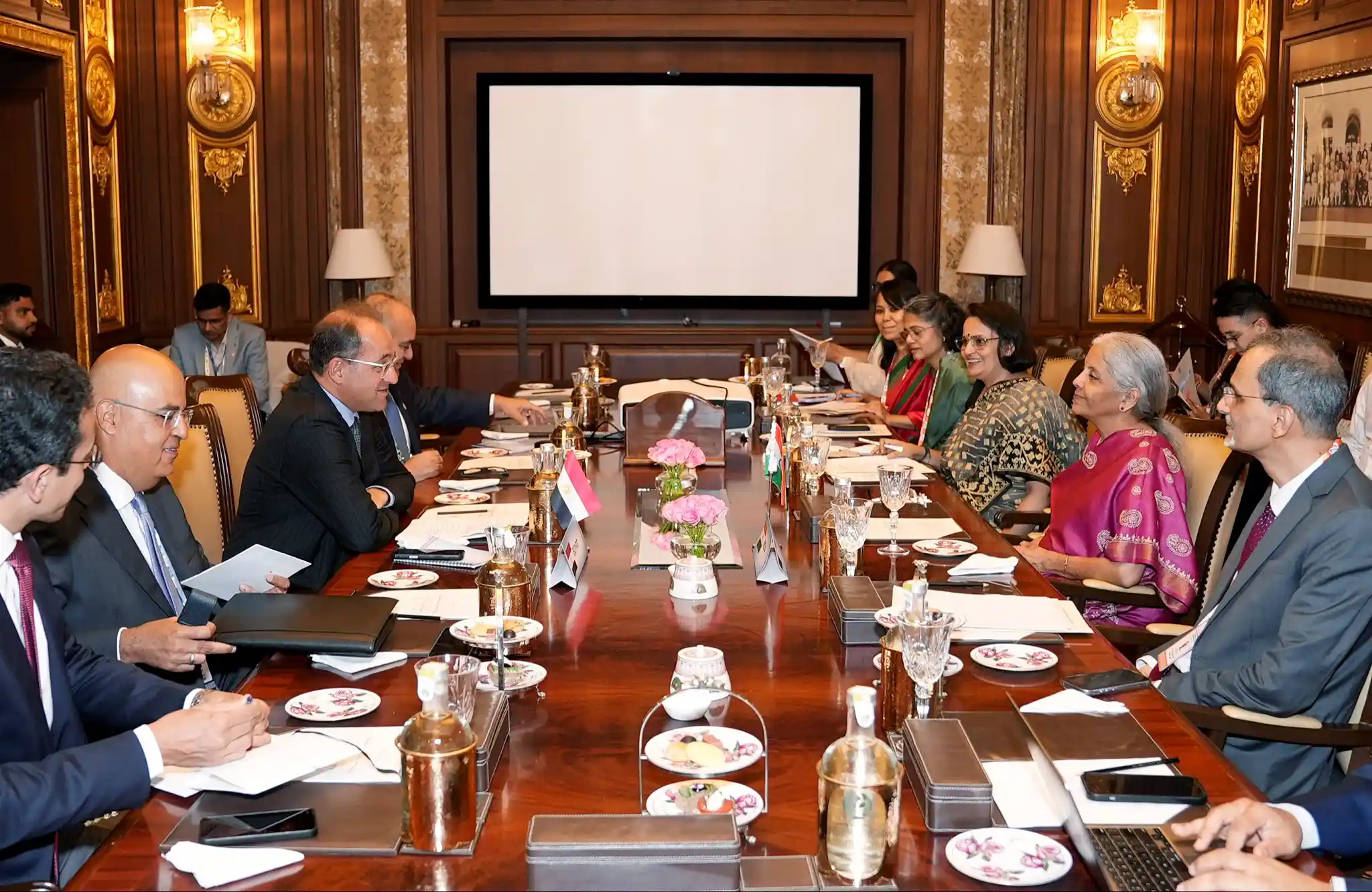
India and Egypt are moving beyond ceremonial friendship toward a consequential strategic alignment. As New Delhi chairs BRICS in 2026, a more purposeful Cairo–Delhi partnership can help turn the Global South from a diplomatic slogan into an agenda for trade resilience, energy access, technology, and a more representative international order.
BRICS has expanded in ambition and membership at precisely the moment the global system is most fragmented: wars disrupt shipping lanes and food markets, debt pressures constrain developing states, and economic security is increasingly shaped by technology, supply chains and access to capital. India’s chairship theme—resilience, innovation, cooperation and sustainability—correctly identifies the shared pressure points. Its energy track explicitly prioritizes energy security, access and equity, and technology-led sustainability.
Egypt is unusually well placed to be India’s partner in this effort. It is an Arab state, an African state and a Mediterranean power; it sits at the junction of major maritime routes and maintains weight in regional diplomacy. India, meanwhile, is a major Indian Ocean power with substantial diplomatic capital across developing countries. Together, they connect the Indo-Pacific, West Asia, Africa and the Mediterranean—not as a formal bloc, but as two countries that understand how quickly global disruptions become domestic economic crises.
That makes their convergence more valuable than the usual language of “South-South cooperation.” It offers a practical bridge between regions that are too often discussed separately in global forums.
From symbolism to strategy
The relationship has acquired an institutional backbone. India and Egypt formally elevated ties to a Strategic Partnership in 2023, covering political, security, defense, energy and economic cooperation. Their leaders also identified the need for stronger food and pharmaceutical supply chains and set an aspiration to lift bilateral trade to $12 billion over five years.pib.gov+1
Since then, the relationship has begun to gain operating mechanisms rather than merely headlines. The first India–Egypt Strategic Dialogue in October 2025 focused on trade, investment, technology and innovation, defense-industrial collaboration, joint training, counterterrorism and intelligence-sharing. In February 2026, the two sides recorded approximately $5 billion in bilateral trade and $5 billion in Indian investment in Egypt, with additional proposals in health care, fertilizers, green energy and hospitality. They also agreed to coordinate in BRICS during India’s presidency.mea+1
This matters because a strategic partnership is not proven by a declaration; it is proven by whether it creates habits of cooperation in a crisis. Defense contacts, intelligence exchanges and high-level dialogues build confidence. But the lasting test will be whether businesses, researchers and institutions find reasons to work together when no summit is taking place.
The economic logic
A more ambitious India–Egypt compact should begin with geography. Egypt’s Suez Canal Economic Zone can be more than a transit point for Indian commerce. It can become a manufacturing, logistics and export platform linking Indian companies to African, Arab and European markets. Egyptian officials have already highlighted Indian investment in the zone, while BRICS-linked investment has been significant: Chinese and Indian investments accounted for 45 percent of recent Suez Canal Economic Zone contracts, according to Egypt’s Ministry of International Cooperation.
The task now is to concentrate on sectors where both countries have clear interests:
- Food and fertilizer security: India needs dependable access to inputs and diversified supply routes; Egypt needs robust food systems and industrial investment. Joint storage, processing, fertilizer and agricultural-technology projects would address a real shared vulnerability.
- Pharmaceuticals and health: Indian manufacturing capacity and Egypt’s location and market access could support regional production of affordable medicines rather than simply bilateral exports.
- Clean energy: Green hydrogen, renewable generation, grid technology and efficient industrial systems align with Egypt’s energy-transition ambitions and India’s BRICS emphasis on equitable energy access.
- Digital public infrastructure: India can offer experience in scalable digital systems, while Egypt brings a large, youthful market and an African-Arab gateway. The goal should be interoperable payments, trusted digital identity where locally appropriate, skills development and support for small businesses—not technology dependence under another name.
- Maritime logistics: The Red Sea, the Gulf of Aden, the Arabian Sea and the Mediterranean have become a single strategic commercial theatre. Cooperation on port security, shipping information and logistics resilience would serve both countries and the wider trading system.
The scale is still modest relative to the ambition. Official Indian data put 2024–25 bilateral trade at $4.8 billion, down from the earlier high of $7.26 billion in 2021–22. That is not a reason for pessimism; it is evidence that the $12 billion goal will not be met through conventional trade promotion alone. It requires investment-led trade, predictable regulation, better banking channels, direct shipping and joint production.
A Global South agenda
India should use BRICS to advance a focused India–Egypt programme rather than pursue grand declarations that fade after the summit. Cairo’s support for India’s 2026 BRICS presidency, coupled with its call for greater economic and financial cooperation, is a useful political foundation.
A credible shared agenda would press for three things.
First, more resilient development finance. Emerging economies do not need lectures on fiscal prudence when external shocks repeatedly raise food, fuel and borrowing costs. They need accessible long-term finance for ports, grids, health systems, water efficiency and climate adaptation.
Second, fairer rules for technology and trade. Global South countries should not be forced to choose between costly dependence on imported technologies and exclusion from green or digital markets. India and Egypt can advocate technology partnerships, local capabilities, and standards that do not become disguised barriers to development.
Third, security for global commons. Maritime routes, food chains, energy supplies and digital networks are not peripheral issues. For countries that import essentials, employ large young populations and depend on open commerce, they are the foundation of economic sovereignty. A joint Indian–Egyptian voice can make this case with unusual credibility.
The Road Ahead
There is a risk in overstating the moment. BRICS itself contains divergent political interests, and neither India nor Egypt can insulate its economy from regional conflict, commodity volatility or financial stress. Egypt’s pivotal geography is also a reminder that connectivity can be fragile: a disruption near the Red Sea can quickly become a factory delay or a food-price problem thousands of kilometres away.
Nor should India treat Egypt merely as a corridor, or Egypt view India only as a market and investor. Durable strategic ties require reciprocity: Egyptian firms and professionals should gain access to Indian opportunities, while Indian projects in Egypt should create local jobs, skills and supply chains. The partnership must be designed with commercial realism and social legitimacy, not only geopolitical vocabulary.
That is why this is a strategic phase—not because every obstacle has disappeared, but because the incentives to solve them have become stronger. India’s BRICS chairship gives New Delhi an opening to show that leadership of the Global South means building useful coalitions across regions. Egypt gives that leadership a vital Arab-African-Mediterranean anchor.
If Delhi and Cairo can turn shared anxieties over food, energy, shipping and development finance into shared institutions and investments, they will do more than deepen a bilateral relationship. They will demonstrate what a multipolar order should deliver: not competing camps, but more routes, more choices and a stronger voice for countries that have too often been asked to absorb the costs of a fractured world.