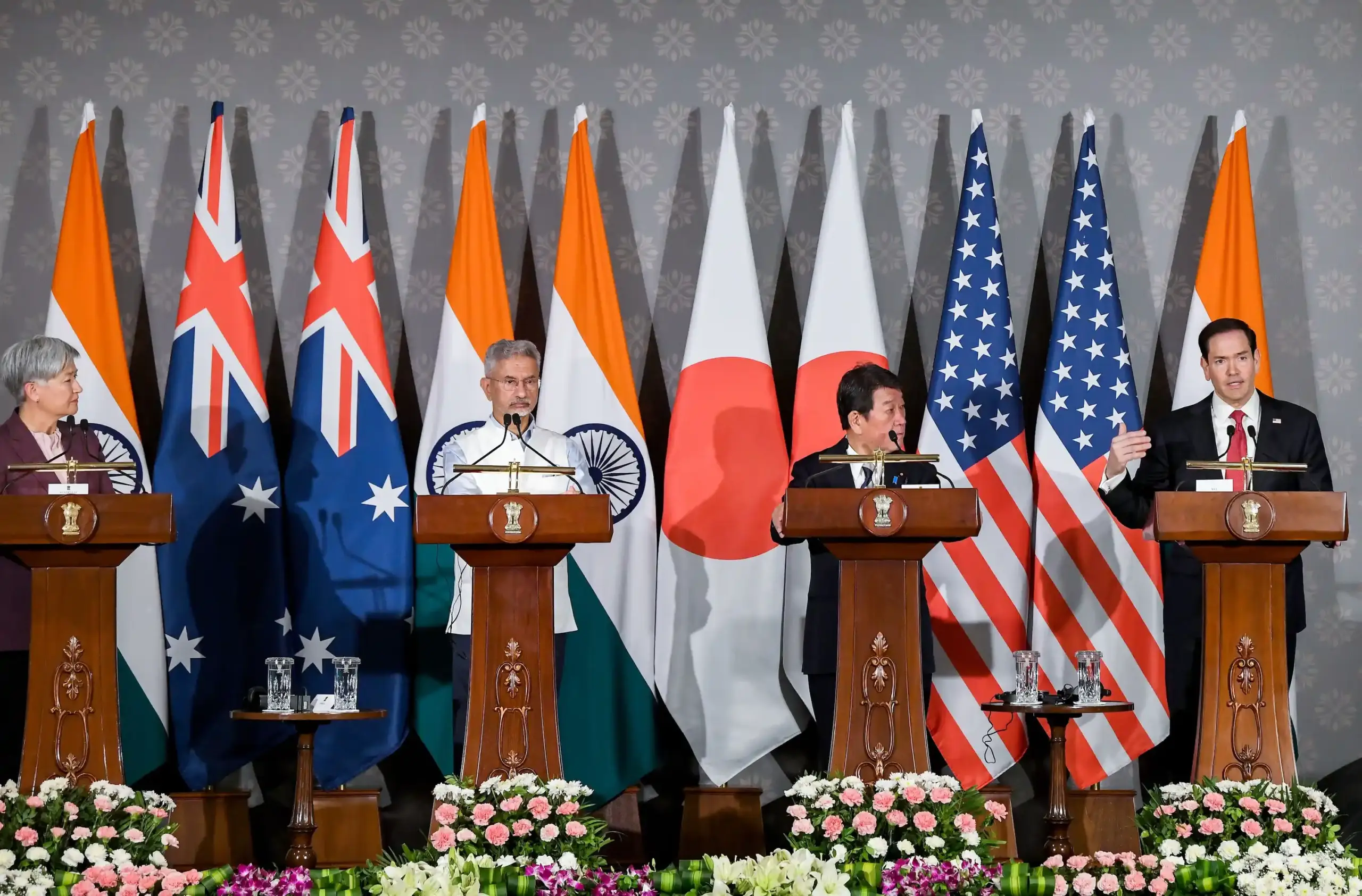
The visit of US Secretary of State Marco Rubio to New Delhi in May 2026 was a restrained affair, but not without its own significance. The visit could well be termed as an exercise in strategic reassurance at a moment of widening geopolitical uncertainty.
In diplomacy, timing matters. Rubio arrived in India just days after President Donald Trump’s summit with Xi Jinping in Beijing, a meeting that produced language about a “constructive relationship of strategic stability” between the U.S. and China. Simultaneously, the continuing conflict involving Iran and the resulting instability in the Gulf and around the Strait of Hormuz has brought energy security and maritime vulnerability to the forefront of global politics.
These developments formed a multi-layered backdrop to Rubio’s Delhi visit and to the Quad Foreign Ministers’ Meeting held on May 26.
The bilateral leg of the visit was plainly designed to reassure New Delhi. Rubio repeatedly described India as central to America’s Indo-Pacific strategy and called the Quad a cornerstone of regional stability. Prime Minister Narendra Modi received an invitation to visit Washington. Rubio and External Affairs Minister Jaishankar reviewed the now-familiar agenda of trade, defence, critical technologies, semiconductors, AI, energy, nuclear cooperation and mobility. The atmospherics were good, although reassurance is not reset.
No major bilateral breakthrough emerged from the visit. The long-discussed trade agreement is still awaited. Tariff disputes linger beneath the rhetoric of strategic convergence. Defence and technology cooperation were reaffirmed rather than dramatically expanded. The relationship today is more candid, more transactional and less turtle dove-like than during the earlier phase of India-US convergence.
That need not dampen spirits. However, the geopolitical environment surrounding the relationship has altered.
Trump’s Beijing summit revived old and perennial anxieties in Indian strategic thinking: the possibility that Washington and Beijing, despite rivalry, may still seek periods of accommodation or managed coexistence that leave other powers adjusting to understandings reached above their heads. One should not exaggerate the emergence of a formal “G-2.” The United States and China remain locked in deep structural competition. Yet the language of “strategic stability” after Trump’s Beijing visit inevitably raises questions in Asia about whether Washington’s priorities are shifting.
Rubio’s Delhi visit therefore had a dual purpose: to reaffirm the importance of the India connect and partnership while simultaneously assuring the broader Indo-Pacific that engagement with China would not come at the expense of regional partnerships.
West Asia complicated this further. The Gulf crisis has demonstrated how deeply interconnected the Indo-Pacific and West Asian theatres have become. For India, the Strait of Hormuz is not an abstract strategic concern. It is a lifeline for energy supplies, shipping routes, diaspora welfare and economic stability. The old compartmentalisation between the Indo-Pacific and West Asia no longer holds. That is the new reality that shaped bilateral discussions during the Rubio visit, and the Quad meeting itself.
The official Quad joint statement issued after the Delhi meeting of the four foreign ministers revealed a grouping that is becoming more operational, more geo-economic and more systemic in its outlook.
The Quad’s agenda is now explicitly organised around four pillars: maritime and transnational security, economic prosperity and security, critical and emerging technologies, and humanitarian assistance and emergency response.
Security today is no longer confined to military deployments or naval manoeuvres. It lies equally in energy corridors, semiconductor ecosystems, critical minerals, undersea cables, resilient ports, logistics networks and technological standards. The Delhi meeting demonstrated that the Quad increasingly understands this.
The launch of the Quad Initiative on Indo-Pacific Energy Security was perhaps the clearest sign of this evolution. The joint statement linked Gulf instability, the Hormuz shipping crisis and Indo-Pacific maritime security by emphasising unimpeded commerce, freedom of navigation, opposition to coercive restrictions on sea lanes and the protection of fuel, food and fertiliser flows across maritime corridors.
Concepts within the Quad are changing. Strategic anxiety about China is not a sole focus although China remains the unmistakable strategic subtext. The Quad as a framework is sensing the crucial need for protecting the wider circulatory systems of the global economy.
For India, this broadening is strategically advantageous. It allows New Delhi to participate in the Quad through the language of resilience, connectivity and maritime stability rather than through overt alliance politics.
At the same time, the joint statement contained some of the sharpest language yet seen from the Quad regarding coercive behaviour in the South and East China Seas. References to dangerous manoeuvres, maritime militia, militarisation of disputed features, water cannons and obstruction of vessels were clearly directed at Beijing’s conduct. The reaffirmation of UNCLOS and the 2016 arbitral award reinforced this signal.
At the same time, the Quad is not becoming an Asian NATO. There are no treaty obligations, no collective defence commitments and no integrated military command structures. India would resist such a transformation. Instead, the Quad is seeking to define itself as a flexible coalition for strategic resilience.
The practical outcomes announced in Delhi underline this. The operationalisation of the Indo-Pacific Partnership for Maritime Domain Awareness through the Information Fusion Centre–Indian Ocean Region in Gurugram; real-time information-sharing through the Indo-Pacific Maritime Security Coordination system; the next Quad-at-Sea mission hosted by India; a new Quad Critical Minerals Framework; cooperation on undersea cable resilience; common approaches to 5G, 6G and AI standards; biomanufacturing initiatives; and expanded humanitarian assistance coordination together suggest that the Quad aims at acquiring operational depth.
This is institution-building. At the same time, it must be kept in mind that President Trump’s foreign policy instinct has never been deeply institutional. His diplomacy is transactional, leader-centric and often improvisational. That creates unease not only in India, but also among U.S. treaty allies such as Japan and partners like Australia. The Indo-Pacific increasingly senses that American strategic attention may fluctuate according to crises elsewhere — whether in the Gulf, Europe or domestic politics.
The Pakistan factor also remained in the background during Rubio’s visit. Pakistan’s renewed diplomatic visibility during the Iran crisis, including its role in facilitating regional contacts and its parallel engagement with both Washington and Beijing, has revived old Indian sensitivities about the periodic rediscovery of Pakistan’s tactical utility by major powers during moments of regional instability. Rubio himself was asked in Delhi to comment on this question and his response that India’s concerns about Pakistan were “different”, and India was “always pointing to the face that there are armed terrorist groups operating from Pakistan territory that target India” was diplomatically careful, but revealing. He emphasised that “I don’t view our relation with any country in the world as coming at the expense of our strategic alliance with India”. The concern in New Delhi is however, less about relationship-reversal than about strategic distraction and fluctuating American bandwidth in Asia.
Indeed, in such a scenario of fluctuating bandwidth, India, Japan and Australia may now have to “own” the Quad more actively. Japan has long provided much of the intellectual architecture behind the Indo-Pacific idea. Australia has become deeply invested in regional resilience and maritime partnerships. India contributes geography, strategic location, scale and growing naval capability. A more decentralised, partner-driven Quad may prove more durable than one excessively dependent on the political cadences of Washington.
India has historically preferred flexible strategic coalitions over rigid alliance systems. A Quad focused on energy security, maritime awareness, critical minerals, infrastructure and technological resilience aligns far more naturally with Indian strategic culture than an overtly militarised bloc would.
The deeper significance of Rubio’s Delhi visit therefore lies not in what it transformed, but in what it revealed. It revealed that the India-US relationship has entered a more adult and less sentimental phase. Strategic convergence remains real, but it now coexists openly with trade friction, differing geopolitical compulsions and uncertainty about American consistency.
It also revealed that the Quad is evolving from a primarily diplomatic signalling mechanism into a practical framework for resilience in an age of fractured globalisation. The challenge for the Quad is how to strengthen sustainability and strategic coherence.
Can the Quad retain coherence if U.S.-China relations oscillate between rivalry and accommodation? Should the Quad be drawn into the game of U.S.-China rivalry and competition? Can the Quad become more operational without collapsing into the rigidities of bloc politics that Asia historically resists? These are no longer theoretical questions. Durability and capability go together.
In a fragmented world, reassurance remains valuable. But resilience — institutional, economic, technological and strategic — matters far more. The Quad inhabits an uncertain world. The Quad meeting in Delhi showed that the architecture of Indo-Pacific cooperation remains alive, but it must become more functional, more partner-owned and less dependent on rhetoric.