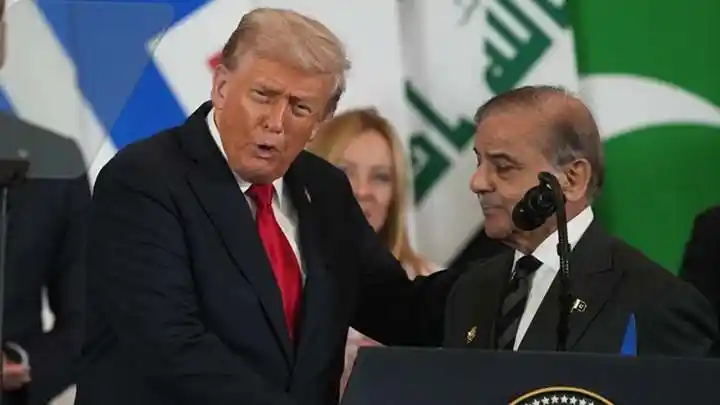
When Donald Trump urged Pakistan, Saudi Arabia, Turkey, Egypt, and Jordan to join the Abraham Accords on a May 2026 conference call, the silence on the line was revealing. Pakistan’s defence minister Khawaja Asif was first to respond: Islamabad could not join any arrangement conflicting with its ‘fundamental ideologies.’ Within days, Foreign Minister Ishaq Dar restated the refusal. Pakistan’s passport—the only one in the world that explicitly excludes Israel—became shorthand for an impasse that is far older and far deeper than Trump’s phone call.
The episode crystallizes a genuine analytical puzzle. Pakistan’s military establishment, under Field Marshal Asim Munir—now Chief of Defence Forces with constitutional tenure through 2030 and lifetime immunity from prosecution—exercises near-total control over foreign and security policy. If the institution is supreme, why does recognition of Israel remain structurally impossible despite American pressure, Saudi financial leverage, and a fundamentally changed regional order? The answer lies not in diplomatic calendars but in four decades of deliberate state policy that fused Islamic ideology with security strategy, cultivated militant proxy networks as geopolitical instruments, and produced a domestic ecosystem that Rawalpindi itself can no longer fully control.
Pakistan’s dilemma is not ultimately about Israel. It is a case study in how states lose strategic flexibility when ideological narratives and proxy networks become instruments of national security policy.
Table 1: The Abraham Accords Were Strategic Transactions, Not Peace Agreements
| Signatory | Concrete US Concession | Primary Strategic Logic |
| UAE (2020) | Prospective $23 bn F-35 / MQ-9 package; US security umbrella | Counter-Iran containment; US defence architecture access |
| Bahrain (2020) | Enhanced US security guarantees; Israeli drone & intelligence cooperation | Existential Iranian threat; regime survival; Fifth Fleet proximity |
| Morocco (2020) | US recognition of sovereignty over Western Sahara; Israeli arms deals | Territorial legitimacy; military modernisation; Israeli intelligence |
| Sudan (2021) | Removal from US state sponsors of terrorism list; debt relief | Economic rehabilitation; Western reintegration |
| Kazakhstan (Nov. 2025) | White House access; strategic visibility | Diversification from Russian/Chinese dependence |
Sources: Carnegie Endowment for International Peace (April 2025); Middle East Institute; Britannica.
The transactional architecture of the Accords exposes why the UAE model cannot simply be imported to Islamabad. Abu Dhabi, Manama, Rabat, and Khartoum each possessed something Pakistan structurally lacks: state control over their domestic religious and civil society ecosystems. The Al-Nahyan family directs Emirati foreign policy insulated from popular accountability; the Al-Khalifa monarchy manages Bahrain’s clerical narrative; Morocco’s palace frames normalization as a royal prerogative. In each case, the regime calculus was a cost-benefit analysis conducted within a controlled political environment. Pakistan is categorically different.
Table 2: Why Pakistan Cannot Follow the Gulf Model
| Variable | UAE / Bahrain / Morocco | Pakistan |
| Regime type | Hereditary monarchies; civil society restricted; no mass electoral pressure | Hybrid civil-military state; competitive elections; mass Islamist mobilization |
| State control over religious institutions | High; clerical establishments subordinate to ruling family | Low; madrassa network expanded under Zia, funded by Gulf donors, now autonomous |
| Street mobilization on Palestine | Limited; protest suppressed or managed | Very high; Islamist parties retain veto-level mobilization capacity |
| Domestic cost of normalization | Manageable within closed political system | Existential; 74% of Pakistanis held unfavorable views of Jewish people (Pew 2019) |
| Military’s relationship to ideology | Military subordinate to ruling family’s pragmatic decisions | GHQ is itself embedded in the ideological ecosystem it constructed |
Sources: INSS Strategic Assessment (2023); Pew Research Center Global Attitudes Survey (2019); Middle East Eye.
The critical variable is not democracy or authoritarianism per se. Egypt and Jordan are not liberal democracies, yet both normalized—Egypt in 1979 at severe cost (Sadat’s assassination; Arab League suspension until 1989), Jordan in 1994 with Oslo Accords providing partial political cover. What enabled both was state management of Al-Azhar in Egypt and the Hashemite monarchy’s claim to custodianship of Jerusalem’s holy sites in Jordan, which paradoxically gave King Hussein the religious authority to frame peace as a royal prerogative. Pakistan’s military possesses no equivalent religious legitimacy. GHQ did not merely fail to control the religious ecosystem—it actively constructed and empowered it.
Pakistan is not waiting for Israel. Pakistan is waiting for Saudi Arabia.
The Saudi financial relationship is the most quantifiable constraint on Pakistan’s strategic flexibility. According to International Organization for Migration data drawn from State Bank of Pakistan records, Saudi Arabia contributed USD 7.4 billion (25 percent) of Pakistan’s total remittances in FY2024; the UAE added USD 5.5 billion (18.7 percent). Together, GCC states account for more than 55 percent of total inflows, which reached a record USD 38.3 billion in FY2025—a 26.6 percent year-on-year rise. Beyond remittances, Riyadh has acted as Pakistan’s lender of last resort: USD 6 billion in 2018, USD 4.2 billion in 2021, USD 3 billion in 2022. Saudi deposits in Pakistani banks are not commercially motivated; they are placed to signal confidence to the IMF, which has extended twenty-three programmes to Pakistan since 1958, including the current USD 7 billion Extended Fund Facility. The political implication is unambiguous: Pakistan cannot financially afford to lead Saudi Arabia on normalization.
Riyadh, for its part, continues to condition normalization on a credible pathway to Palestinian statehood. Saudi Arabia’s position, as articulated through the OIC and bilateral channels, mirrors Pakistan’s official stance and functions as a permissive condition rather than an external pressure: as long as Riyadh does not move, Islamabad has both a reason and a cover not to move. The September 2025 Saudi-Pakistan Strategic Mutual Defence Pact—the first such agreement Pakistan has signed with any foreign state—deepened this structural alignment. For Islamabad to normalize before Riyadh would mean positioning itself ahead of the Keeper of the Two Holy Mosques in the Islamic world’s most sensitive foreign policy question, a reputational cost no Pakistani leader, civilian or military, can absorb.
Table 3: Intended vs. Actual Outcomes of Pakistan’s Ideological Statecraft
| State Policy | Intended Purpose | Actual Constraint Created |
| Islamization under Zia-ul-Haq (1977–1988) | Manufacture regime legitimacy; displace secular opposition; mobilize for Afghan jihad | Deep embedding of Islamist worldview in military culture, judiciary, curriculum, and public opinion |
| Proxy warfare — Lashkar-e-Taiba, Jaish-e-Mohammed, Afghan Taliban | Strategic depth in Afghanistan; deniable pressure on India in Kashmir | Networks institutionalized and politically entrenched; cannot be fully dismantled without triggering domestic crisis |
| Anti-Israel passport policy | Signal Islamic solidarity; earn OIC credibility | Deepest symbolic obstacle to normalization; cited by defence minister as an immovable red line (May 2026) |
| Religious mobilization as foreign policy tool | Channel discontent outward; sustain elite cohesion | Islamist parties retain veto-level influence over foreign policy; TTP exploits same ideological grammar to challenge state authority internally |
Sources: Britannica; Fair, C. Christine, Fighting to the End (OUP, 2014); Hudson Institute; Radical Politics (May 2025).
General Zia-ul-Haq’s Islamization project, accelerated by the Soviet invasion of Afghanistan in December 1979 and the CIA–ISI joint operation to arm the mujahideen, was not merely a domestic political manoeuvre. It was the systematic weaponization of Islamic ideology as a substitute for democratic legitimacy and as an instrument of regional power projection. The organizational ecosystem produced by this period—Lashkar-e-Taiba, Jaish-e-Mohammed, the Afghan Taliban—became what analysts at the Hudson Institute have characterized as the army’s ‘most subservient proxies.’ They were assets to be wielded, not liabilities to be managed. The 2008 Mumbai attacks were not an aberration; they were a demonstration of how deeply these networks had been institutionalized.
The consequences for the Abraham Accords are direct and underanalyzed. Pakistan’s military cannot normalize relations with Israel not merely because public opinion is hostile—it is—but because the institutional networks that would most violently resist normalization are themselves products of GHQ’s own strategic investments. Any move toward Israel would be read by Lashkar-affiliated networks, Deobandi political parties, and the broader jihadist ecosystem as a betrayal of Islam itself—and those networks retain the organizational capacity to translate that narrative into domestic instability. The state that manufactured the constraint now operates within it.
Figure 1: Munir’s Decision Matrix — Recognition vs. Continued Refusal
| Cost Dimension | Normalize with Israel | Maintain Non-Recognition |
| Political | High: Islamist street mobilization; erosion of Munir’s ‘defender of faith’ image; TTP propaganda dividend | Low: domestic legitimacy preserved; principled stance narrative intact |
| Economic | Low-Medium: potential US goodwill; but Gulf remittances unaffected by recognition or refusal | Low: Gulf states impose no penalty for non-recognition; Saudi financial architecture continues |
| Security | High: militant blowback; TTP may cite normalization as casus belli for escalation inside Pakistan | Low-Medium: existing equilibrium maintained |
| Diplomatic | Medium: gains Washington favour; risks OIC credibility without prior Saudi move | Low: Islamic solidarity narrative preserved; useful to both US (as regional mediator) and Gulf |
| Net assessment | Extremely high domestic risk; politically destabilizing absent Saudi cover | Optimal given current constraints; strategic ambiguity preserves all options |
Sources: Carnegie Endowment (May 2026); Modern Diplomacy (December 2025); Atlantic Council — Kugelman.
Munir’s position is genuinely paradoxical. He is by any measure the most powerful individual in Pakistan since Zia himself: promoted to field marshal after the May 2025 India conflict, appointed the first Chief of Defence Forces, constitutionally extended through 2030, and cultivating genuine trust with the Trump administration through counterterrorism cooperation and Iran-US mediation. Yet his structural power does not dissolve structural constraints. His domestic standing rests partly on the ‘defender of faith’ image that his own institution constructed over decades. Recognition of Israel would not merely be a foreign policy decision; it would threaten the ideological compact that legitimizes GHQ’s political dominance. Unlike the UAE’s Al-Nahyan family, which operates in a closed system, Munir governs an ideological ecosystem he cannot fully discipline. His rational calculus is therefore strategic ambiguity: maintain the public refusal, extract US goodwill through counterterrorism and mediation, and wait for Riyadh to move first.
Table 4: Three Scenarios for Pakistan and the Abraham Accords
| Scenario | Probability | Key Conditions & Implications |
| A: Saudi Arabia normalizes first | Medium (25–30%) | Pakistan follows within 12–18 months; Munir frames recognition as ‘Islamic consensus’ behind Riyadh’s lead; September 2025 defence pact creates institutional channel for coordinated movement |
| B: Strategic ambiguity (no recognition, no rupture) | High (50–60%) | Most politically sustainable; Pakistan extracts US goodwill via counterterrorism and mediation; non-recognition insulates against domestic Islamist pressure; no structural change required |
| C: Regional escalation collapses the Accords | Low-Medium (15–25%) | Deepening Iran conflict or Gaza catastrophe derails the Accords framework; Pakistan’s refusal retroactively vindicated; regional architecture reconfigures around new alignments |
Sources: Central Asia Caucasus Institute (January 2026); Author’s scenario analysis.
For Indian policymakers, the Abraham Accords process is not a Middle Eastern curiosity. It is analytically significant for three reasons. First, Munir’s successful repositioning of Pakistan as a US counterterrorism partner and Iran-US interlocutor reconfigures the bilateral US-Pakistan relationship in ways that constrain Indian diplomatic space. A Pakistan that provides irreplaceable mediation value between Washington and Tehran acquires leverage that India cannot easily neutralize. Second, the Saudi-Pakistan Strategic Defence Pact creates a military architecture in the Arabian Peninsula that intersects with India’s own Gulf dependencies—remittances exceeding USD 40 billion annually, energy imports, and I2U2 investments. A more militarily integrated Saudi-Pakistani axis introduces structural uncertainty into a region India has treated as relatively stable. Third, the May 2025 conflict established that Indian use of Israeli missiles, drones, and air-defence systems in Operation Sindoor has made normalization with Israel a harder domestic sell in Pakistan, not easier: Israeli military technology is now directly associated in the Pakistani public imagination with attacks on Pakistani territory.
The policy implications follow from the structural diagnosis. For Pakistan, the prerequisite for any credible foreign policy reorientation is not normalization itself but reform of the ideological ecosystem that forecloses it: madrassa curriculum reform, civilian oversight of religious-political organizations, and a sustained institutional counter-narrative to the jihadist calculus. These are not alternatives to normalization—they are conditions of its possibility. For the United States, Trump’s May 2026 phone call demonstrated that transactional pressure is an inadequate instrument when applied to a state whose constraints are structural rather than preference-based. Washington should condition expanded security cooperation on measurable institutional reform, and should invest diplomatically in the Saudi pathway—because Riyadh’s movement is the only cover that makes Pakistani movement politically viable. For Saudi Arabia, the normalization question ultimately rests with Riyadh: Islamabad will follow, but it cannot lead.
Pakistan’s Abraham Accords dilemma is a case study in how states lose strategic flexibility when ideological narratives and proxy networks are institutionalized as instruments of national security policy. The Gulf monarchies that joined the Accords absorbed normalization costs because they controlled their domestic political and religious ecosystems. Pakistan cannot, because it constructed one it no longer commands. Field Marshal Munir is among the most capable military strategists Pakistan has produced—but strategic brilliance cannot dissolve structural traps. The greatest obstacle to normalization is not Washington, Riyadh, Tehran, or Tel Aviv. It is the legacy of policies that Pakistan itself created, nurtured, and exported as instruments of state power. Until Islamabad reckons seriously with that inheritance, it will remain caught between its geopolitical ambitions and the monsters it manufactured to serve them.
References
Arab News. “Pakistan rules out joining Abraham Accords after Trump call.” May 26, 2026.
Carnegie Endowment for International Peace. “The Abraham Accords After Gaza: A Change of Context.” April 2025.
Carnegie Endowment for International Peace. “Pakistan’s Military Consolidation Under Munir Faces Critical Challenges.” May 2026.
Central Asia Caucasus Institute. “Pakistan and the Abraham Accords: Implications for Central Asia.” January 2026.
Fair, C. Christine. Fighting to the End: The Pakistan Army’s Way of War. Oxford University Press, 2014.
Hudson Institute. “The Milli Muslim League: The Domestic Politics of Pakistan’s Lashkar-e-Taiba.”
International Monetary Fund. Extended Fund Facility, Pakistan Programme, USD 7 billion, 2024.
International Organization for Migration (IOM)/DTM. “Remittance Inflows to Pakistan, January 2020–May 2025.” 2025.
INSS. “Pakistan-Israel Relations: A Chance of Normalization?” Strategic Assessment, May 2023.
INSS. “The Many Faces of Normalization: Models of Arab-Israeli Relations.” Strategic Assessment, August 2023.
Middle East Eye. “Why Pakistan will likely refuse to join the Abraham Accords.” June 2026.
Middle East Institute. “A Mixed Report Card: The Abraham Accords at Three.” November 2023.
Modern Diplomacy. “Pakistan’s Army Chief Asim Munir Faces Defining Test Over Trump’s Gaza Plan.” December 2025.
Pew Research Center. Global Attitudes Survey, 2019.
State Bank of Pakistan. Workers’ Remittances Database, 2025.
Xinhua. “Pakistan’s remittances surge 26.6 pct in fiscal 2025.” July 9, 2025.