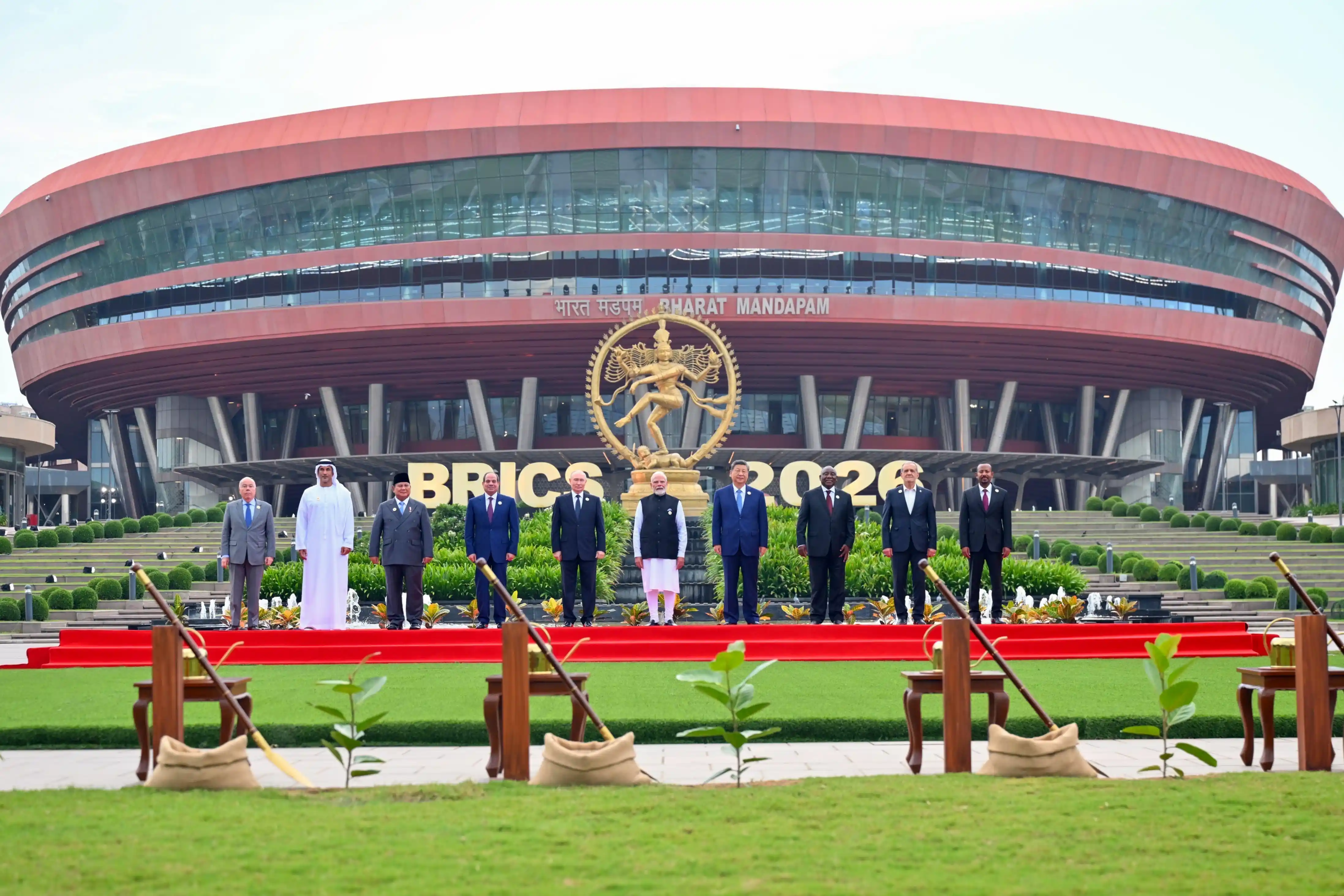
After hectic back-channel negotiations in the shadows of conflict, power rivalry and tensions, India managed to secure consensus for a uniform declaration, a tightrope walk. A close look at the declaration suggests that India’s grand strategy of strategic autonomy secured not only a diplomatic victory but also projected the power and strategic relevance of India’s chairmanship.
The Objective
New Delhi’s strategy in BRICS is a clear push to advance its grand strategy, send a global message, and increase its strategic relevance, rather than letting the summit become a geopolitical showdown or a centre of power games by big powers, especially Russia and China. Three key shifts are essential to ensure its strategic autonomy works on both fronts: national and global interests. First, make multilateralism practical by pushing institutional and structural reforms in global governance rather than echoing bloc politics. Second, India’s BRICS vision, as enshrined in its re-anchored acronym, must be promoted by becoming a strategic enabler to strengthen cooperation and resilience. Third, project India as a global major player, providing strategic and sustainable alternatives to navigate global crises, by concretizing supply chain and economic security through diversification and greater inclusivity.
The Grand Strategy
Hectic backroom negotiations, perhaps a seamless convergence of strategic de-hyphenation and strategic autonomy. India has focused on strategic de-hyphenation to make this multilateral event practical, looking beyond conflict, tensions, and geopolitical contestations, and complemented it with strategic autonomy to ensure convergence of interests that helps not only shift the narrative to economics but also further the goal of BRICS set by New Delhi. Together, these strategic manoeuvres have, to some extent, helped manage political tightness in the event and create room to negotiate and bring everyone to the table, especially the Global South, for consensus-building on a declaration or key statement. The same mix of de-hyphenation and autonomy worked effectively at the G-20 Summit three years back, under the shadow of the Russia-Ukraine War. Apprehension did revolve around the summit, and many feared it would fail to reach a declaration. Still, India shifted the narrative, aligned national and global interests, and ensured the Global South was represented, so the spirit of the agenda and its values prevailed. India’s recent decision to sign the SCO declaration, which toes Iran’s stance, saw the joint declaration strongly condemn military strikes on Iranian territory and criticize unilateral Western economic sanctions.
This is a clear exercise in strategic differentiation and a multilateral-focused diplomatic strategy, carefully crafted by India, which signed it while projecting strategic autonomy by successfully negotiating the language.
The New Delhi Declaration
The grand strategy’s success is evident in the full text of the New Delhi Declaration, where apprehensions about friction over language and fully anti-Western reflections or impressions were well managed. Three key observations show India’s successful attempt to bring practicality and sense to multilateralism while maintaining the essence and spirit of BRICS: first, shaping global issues by separating them from political interests and presenting them as real global concerns; and second, creating common ground for cooperation to strengthen the BRICS agenda. Third, and most important, is maintaining BRICS’ core value: its strategic role as a rising alternative system challenging the US-led West. These strategic messages and impressions also appear in the BRICS New Delhi Declaration. The first key reflection is the shaping of global issues while maintaining the strategic essence or value of BRICS intact, where one of the key emphases was on seeking stability in global finance and trade governance, where the declaration expresses its condemnation of “unilateral coercive measures”, which are contrary to international law and the United Nations Charter, and calls for their elimination.
The grouping acknowledges its role as a collective affected by such “unjustified unilateral protectionist measures”. This language positions BRICS as a collective counterweight to the growing use of trade and financial restrictions by major Western economies.
“We acknowledge that BRICS members represent a broad diversity of societies and civilisations that are affected differently by unjustified unilateral protectionist measures inconsistent with WTO rules, and that BRICS should focus on promoting a just and fair, stable and predictable environment for mutually beneficial sustainable development,” the statement said. However, the language stops short of announcing a retaliatory trade mechanism, maintaining a neutral tone and framing the issue as both global and regionally important.
Similarly, the most talked-about issue of a common currency, which was also seen as a major challenge to the West, was strategically crafted into a multilateral framework, whereby BRICS continued to focus on a more incremental goal: making it easier for members to promote trade settlements and investments in their own currencies to achieve faster, cheaper and safer cross-border payments. The declaration acknowledged discussions on promoting the use of BRICS local currencies while respecting national priorities and recognising that there is “no one-size-fits-all approach”.
The declaration states that the BRICS Payment Task Force, a collaborative grouping of central bank experts from BRICS nations, has been studying how their payment and messaging systems could work more easily with one another. This move, which strengthens local-currency-based geopolitical rivalry and political colouring, rather appears to be a step towards promoting inclusivity and advancing BRICS’s agenda without directly challenging the US.
Another core fiction was getting the UAE and Iran on the same page, as friction between them, against the backdrop of BRICS and the ongoing conflict in West Asia, derailed this year’s statement at the BRICS Foreign Ministers’ Meeting in May. Even so, the statement was strategically crafted to build common ground by de-hyphenating the rivalry and political elements and framing it as a global and regional concern. The declaration expresses “deep concern” over the escalation of tensions across West Asia and calls for maximum restraint and the resolution of disputes through dialogue and diplomacy. Without assigning responsibility to individual countries, it condemns attacks on civilian infrastructure and safeguarded nuclear facilities, while stressing the importance of maintaining uninterrupted trade, supply chains and energy flows.
Carefully crafted strategic de-hyphenation at the multilateral level ensured the crucial objective of strengthened practicality and advanced BRICS’s agenda, keeping its strategic posture intact without overt display or allowing the weaponisation of BRICS to launch targeted attacks on the US-led West.
Another major win for India was the successful project of strategic autonomy in advancing its strategic relevance and interests, and the strong condemnation of terrorism, especially the Pahalgam attack. The declaration expresses its commitment to combating terrorism in “all its forms and manifestations”. In a diplomatic victory for India, the declaration specifically condemns in the “strongest terms” the April 2025 terrorist attack in Pahalgam in Jammu and Kashmir, in which 26 people were killed, and several others were injured.
The declaration also singles out the cross-border movement of terrorists, terrorism financing and safe havens, while expressing zero tolerance for terrorism and rejecting double standards in countering terrorism. In the endeavour to cultivate a strategic role and consolidate its position as a leader of the Global South, the declaration also emphasises the role of the Global South, which Prime Minister Narendra Modi strengthened by calling them rule-shapers and advocating a platform of partnership instead of a pyramid of privilege. The declaration specifically addresses artificial intelligence as an economic and governance opportunity for the Global South. It broadly calls for wider access to AI resources while stressing safety, security, inclusiveness, reliability, energy efficiency and “trustworthy AI”, and emphasising the needs of the Global South.
India also successfully projected its strategic promise and power by detailing the prioritisation of several initiatives by India during its chairmanship, particularly in digital infrastructure, health and development cooperation. In digital public infrastructure, the declaration notes a proposal to create a BRICS repository for digital public infrastructure (DPI) and to undertake pilot projects using DPI solutions across member countries.
In summation, India’s grand strategy worked extensively well in ensuring the smooth convergence of interests, bringing practicality and sense to multilateralism, and this particular win at the BRICS is not only about multilateral management but also sends a loud strategic message about India’s progress in its strategic rise.