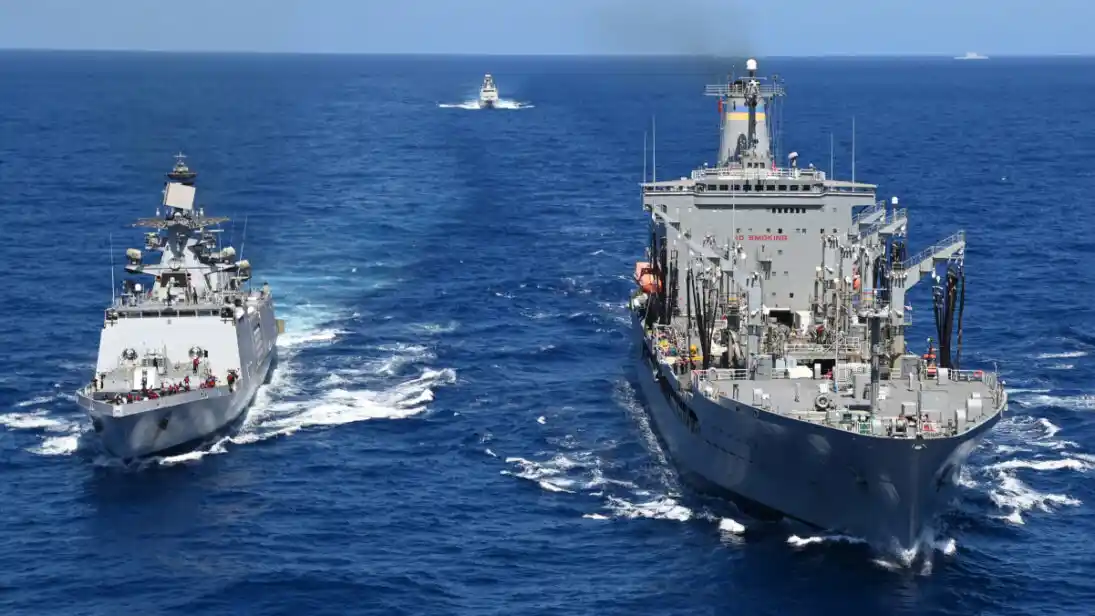
For most of its modern history, India’s strategic imagination has been bound to land. Its anxieties ran along the Himalayan frontier with China and the western border with Pakistan, and its statecraft was shaped accordingly — cautious, insular, reactive. That era is ending. Over the past several weeks, a string of summits and agreements with Japan, South Korea, Indonesia, Australia and New Zealand has revealed something more deliberate than a diplomatic calendar: India is assembling a maritime strategy for the Indo-Pacific, and it is doing so on its own terms.
This is not the familiar story of a rising power joining a bloc. India has not signed a treaty alliance, nor has it adopted the language of containment. Instead, it is building something closer to the old Indian statecraft concept of the mandala — concentric circles of partners, each valued for a different kind of leverage, none subordinate to a single grand design. It is a geometry of interests rather than a hierarchy of loyalty, and it may turn out to be better suited to this moment than any alliance would be.
Japan sits at the center of that geometry. The relationship has moved well past ceremonial summitry into the machinery of economic security — critical minerals, artificial intelligence, clean energy, defense co-development. The 16th India-Japan Annual Summit this July made that shift explicit. Tokyo is no longer a benefactor extending goodwill; it is a partner helping New Delhi build supply chains and industrial capacity that do not run through Beijing. The goal is not confrontation. It is redundancy — enough alternatives that dependence stops being a vulnerability.
South Korea plays a quieter but comparably important role. It lacks Japan’s political symbolism, but it offers something India badly needs: depth in semiconductors, shipbuilding and batteries, the sort of high-end manufacturing capability that could pull India further up the value chain. The new India-Republic of Korea strategic vision for 2026 to 2030 widens cooperation across trade, defense and climate, and Seoul’s appeal lies precisely in its lack of baggage. Like India, South Korea wants insulation from an overreliance on China without adopting a confrontational posture. That shared caution makes it a natural, low-drama partner in a coalition of pragmatists.
If Japan is the anchor and Korea the quiet balancer, Indonesia is the hinge on which the entire strategy turns. No serious Indo-Pacific policy can ignore an archipelago that straddles the sea lanes linking the Indian and Pacific Oceans, and Prime Minister Modi’s visit there this July was built around exactly that fact — maritime security, energy, trade and supply-chain resilience. Indonesia gives India both a foothold near the Malacca Strait, one of the world’s most consequential chokepoints, and a large, nonaligned partner that reduces India’s exposure to single-source risk. In a mandala framework, Indonesia is not a junior partner waiting for instruction. It is a pivot point.
Australia supplies the hard-power dimension that the others largely avoid. The India-Australia Comprehensive Strategic Partnership has thickened steadily, and this month’s summit in Melbourne pushed it further into defense interoperability, critical minerals and maritime domain awareness. Australia’s value lies less in what it announces than in what it enables: naval exercises, intelligence coordination, resource access. It is the partner that lets Indian power move from doctrine into deployment, connecting a continental power’s ambitions to a genuinely oceanic reach.
Then there is New Zealand, the smallest node in the network but in some ways the most revealing. The first Indian prime ministerial visit there in forty years, paired with a new free trade agreement in April, would barely register as strategic news if judged only by New Zealand’s size. But that is the point of a mandala system: value is not proportional to power. Wellington reinforces norms, diversifies trade and adds a democratic voice to the regional order, and New Delhi’s willingness to invest in that relationship signals a strategy built on breadth, not just weight.
None of this can be separated from China, whose assertiveness at sea and grip on critical supply chains have plainly driven India’s recalculation. But India has resisted the temptation to frame its response as containment. That would sit uneasily with its long-standing preference for strategic autonomy, and it would foreclose the flexibility that a networked approach preserves. Call it calibrated balancing: enough external ties to raise the cost of coercion, without foreclosing India’s room to maneuver.
The risk is that this remains more architecture than achievement. Partnerships are only as good as what they deliver — faster trade, real defense interoperability, technology transfer that actually happens rather than merely gets announced. India’s bureaucracy has a long history of promising more than it executes, and the region is already saturated with summits and communiqués that lead nowhere. If New Delhi wants its Indo-Pacific turn to be more than good diplomatic theater, execution, not another joint statement, will have to be the next test.
Still, the shift in orientation is real. India is no longer only defending a border. It is learning to work a sea.