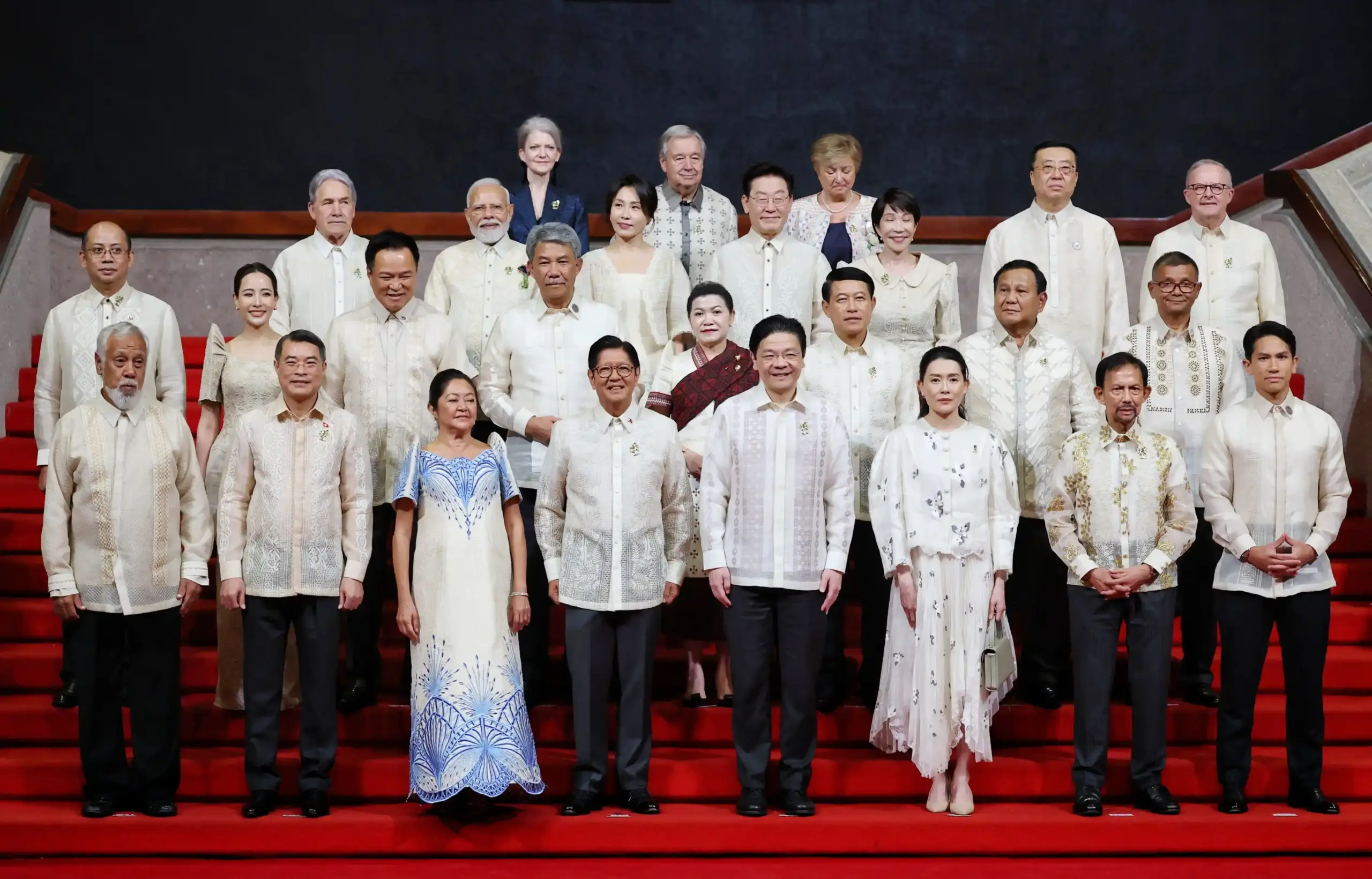
When Prime Minister Narendra Modi sits down with Southeast Asian leaders in Manila on 17 November, his presence will itself carry a message. A year ago he joined the 22nd ASEAN-India Summit virtually, and External Affairs Minister S. Jaishankar represented him at the 20th East Asia Summit in Kuala Lumpur. This time he has travelled to the Philippines for the 23rd ASEAN-India Summit and the 21st East Asia Summit. These meetings close a year of maritime partnership that New Delhi itself proposed. With the strategic foundations firmly laid, the opportunity now is to build an economic partnership of equal ambition, one that Southeast Asia will find well worth having.
India’s maritime and security engagement with ASEAN has matured rapidly. The natural next step is to bring commercial engagement up to the same level. Doing so would further strengthen the ASEAN “centrality” that India has consistently championed.
Begin with what has worked. Announcing the Year of Maritime Cooperation in 2025, Mr Modi said: “India has always fully supported ‘ASEAN centrality’ and ASEAN’s outlook on the Indo-Pacific.” The year has had real substance. The second ASEAN-India Maritime Exercise was held at Subic Bay in September and October. INS Sahyadri and INS Kulish joined humanitarian, disaster-relief and search-and-seizure drills. Under India’s $375-million BrahMos contract with the Philippines, signed in January 2022, deliveries began in 2024. Bilveer Singh of the National University of Singapore calls the relationship “two-way traffic”, with Southeast Asian states keen to engage India amid rapid geopolitical change.
That change explains the demand. ASEAN and China first pledged to pursue a South China Sea Code of Conduct in a non-binding 2002 declaration. The code remains unfinished, and observers say Beijing has resisted making it legally binding. On 15 November the Philippine Foreign Secretary said the parties had provisionally agreed on approximately 80 per cent of the draft, with the code’s binding force still unresolved. Meanwhile, US President Donald Trump arrives for an ASEAN-US Special Summit before travelling on to China for APEC. For states hedging between two great powers, India, a partner with no territorial dispute in the region, has obvious appeal.
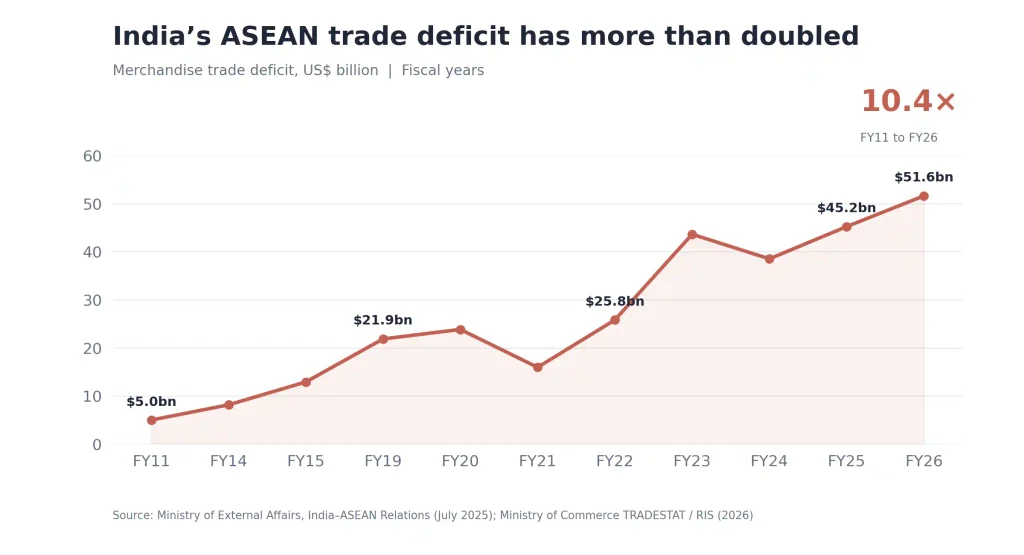
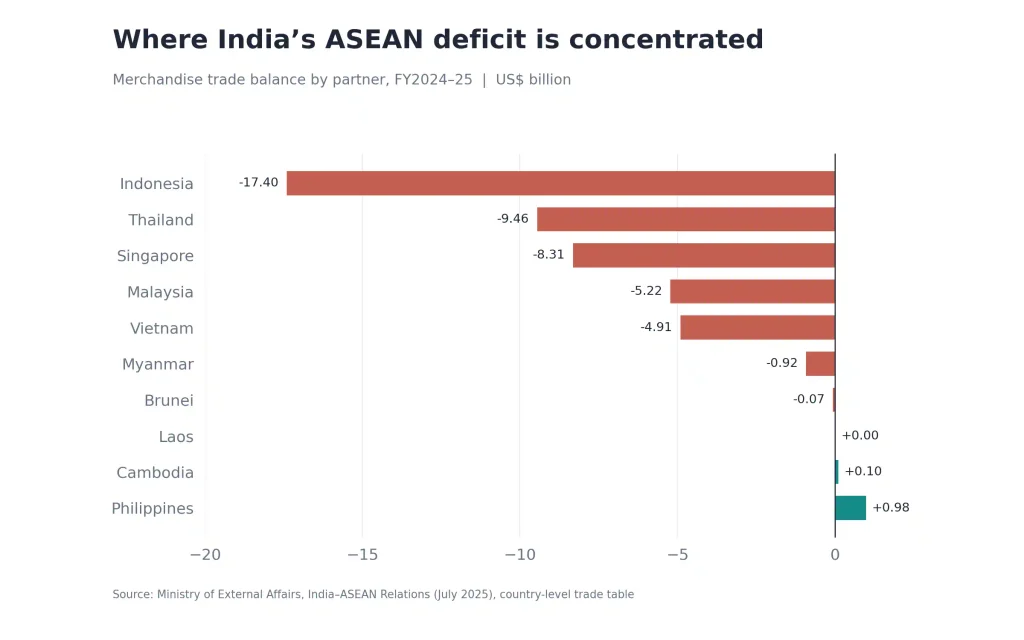
Hedging, however, is as much economic as military, and here there is considerable room to grow. Trade with ASEAN reached $128.38 billion in 2025-26, with India importing $89.96 billion and exporting $38.41 billion. The resulting deficit of $51.55 billion compares with a $7 billion gap when the goods agreement took effect in 2010. Indian exports moved from $42.4 billion to $38.4 billion between 2021-22 and 2025-26, even as imports rose. With ASEAN accounting for around 11 per cent of India’s global trade, getting the balance right matters to both sides.
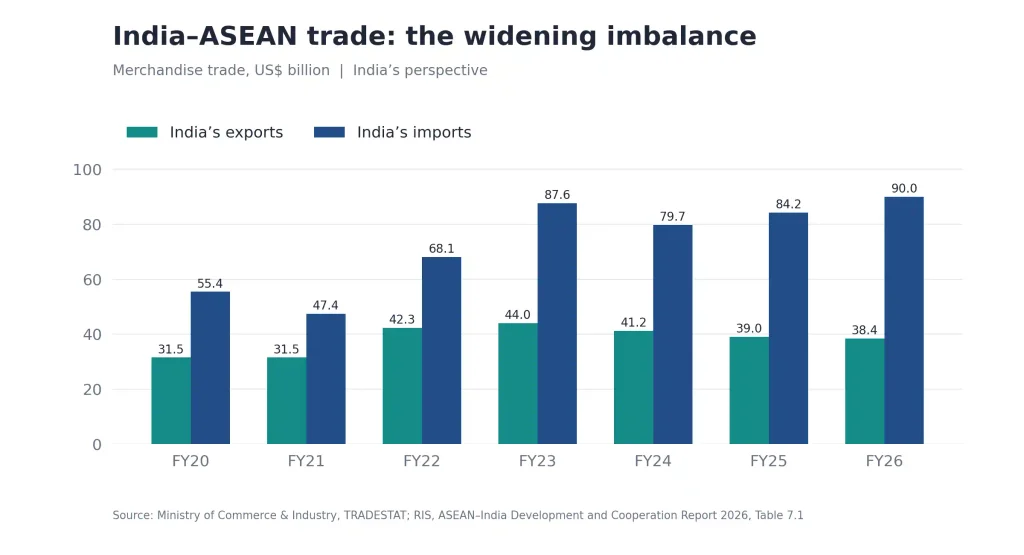
The review of the ASEAN-India Trade in Goods Agreement is the vehicle for this. Leaders launched it in August 2020, and the 15th Joint Committee meeting has since been held in Jakarta. The next round is scheduled for January 2027, and one report suggests a resolution is unlikely until at least early 2027. New Delhi’s case is well founded. India has liberalised roughly 80 per cent of tariff lines for ASEAN members, though the reciprocity it receives is not yet as full. Officials also worry that Chinese goods are being routed through ASEAN states to exploit preferential duties. Tighter rules of origin are a reasonable demand, and one that protects the integrity of the agreement for every party to it.
There is also a good case for patience. On this view, strategic convergence stands on its own merits. An imbalanced agreement should be repaired carefully, and India can protect domestic industry independently if talks take longer. There is force in this. A hurried deal concluded for a summit photograph would serve no one. The deficit also reflects broader questions of manufacturing competitiveness, not treaty text alone.
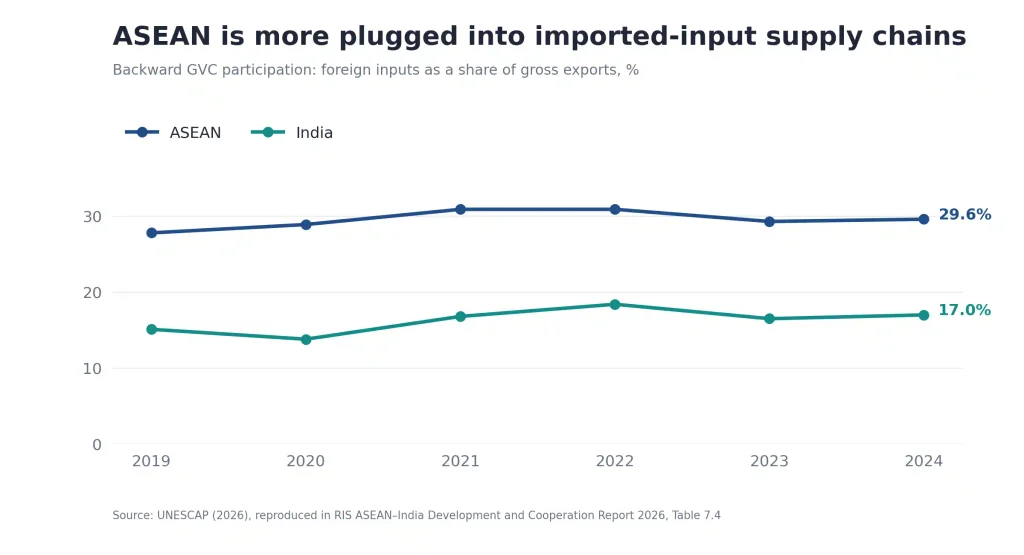
At the same time, momentum matters. Since India’s withdrawal from RCEP in 2019, the review has taken on added weight as a route into regional value chains. India’s strategic credentials in the region are now well established through its naval presence and defence partnerships. A deeper commercial relationship would complete the offer that ASEAN states seek when they hedge. Ajay Sahai of the Federation of Indian Export Organisations argues that the review should be judged by the export opportunities and business partnerships it generates, not by the number of tariff concessions. That is the right test. It points towards simpler customs procedures, regulatory transparency and integration into regional supply chains, rather than tariff arithmetic alone. Connectivity offers a similar opportunity. The Trilateral Highway and the Kaladan project, though slowed by Myanmar’s instability and infrastructure delays, would bring India and Southeast Asia closer still once complete.
Before leaving, Mr Modi said ties with ASEAN occupy “a central place in our MAHASAGAR vision”. In 2027, India and ASEAN will mark 35 years of Dialogue Relations. The maritime year has shown India to be a dependable partner at sea. The anniversary year is a natural moment to bring the same energy to the marketplace. ASEAN centrality, in the end, is best served when member states have more than one serious economic partner to choose from, and India is well placed to be one of them.