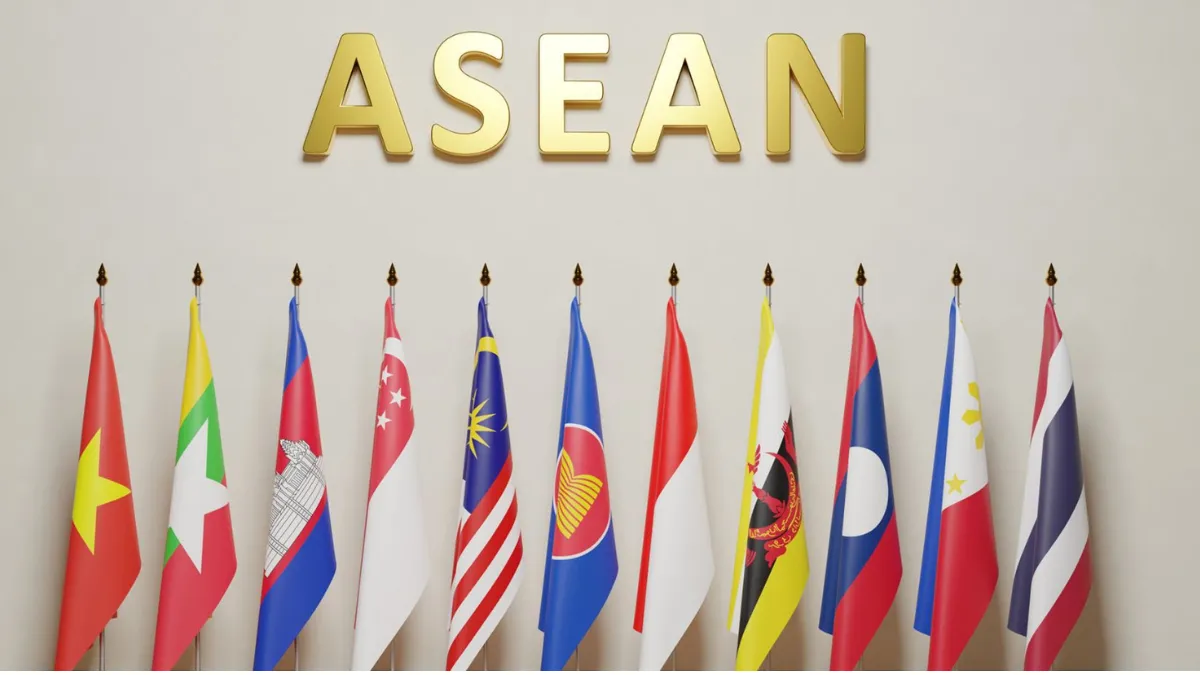
The recent state visit of the Vietnamese President to India reflects the steady consolidation of India’s engagement with Southeast Asia. High-level exchanges with Vietnam, Indonesia and the Phillipines, India’s continued participation in the ASEAN-led summit process, and the expanding defence interactions such as the India–ASEAN Defence Ministers’ engagement in Kuala Lumpur, collectively point to a sustained regional outreach rather than episodic diplomacy.
India’s engagement with ASEAN has also evolved beyond traditional diplomatic outreach into a more institutionalized framework of cooperation. Bilateral trade has expanded significantly over the past decade, while mechanisms such as the ASEAN–India Free Trade Area, the ASEAN–India Plan of Action, and regular summit-level consultations have created a structured basis for long-term engagement. Connectivity initiatives including the India–Myanmar–Thailand Trilateral Highway and broader efforts under India’s Act East Policy seek to integrate India more closely with Southeast Asian production networks and supply chains. Although implementation delays have affected perceptions of reliability, the strategic intent behind these initiatives reflects India’s recognition that sustained relevance in Southeast Asia ultimately depends on deeper economic integration rather than security ties alone.
At the strategic level, India’s engagement increasingly aligns with ASEAN’s preference for inclusive and non-bloc regional architectures. Unlike alliance-driven approaches, India has consistently emphasized ASEAN centrality within the Indo-Pacific and continues to participate actively in ASEAN-led institutions such as the East Asia Summit, ASEAN Regional Forum, and ASEAN Defence Ministers’ Meeting-Plus.
This matters because ASEAN’s strategic culture prioritizes equilibrium, consultation, and multi-alignment over rigid geopolitical camps. India’s relatively non-prescriptive approach therefore allows it to engage Southeast Asia without generating the dilemmas often associated with major-power competition. In this sense, India’s growing role is not merely about balancing China, but about reinforcing ASEAN’s own preference for strategic autonomy and diversified partnerships.
Yet, these developments cannot be overstated. In the strategic calculus of Southeast Asia, India remains a secondary actor. Its trade and investment footprint is modest compared to China and the US, its project delivery record uneven, and its security role very limited relative to that of the United States.
But to also dismiss India as a peripheral power would be equally misleading. India is not seeking to displace existing poles of influence. Instead, it is positioning itself within the layers of ASEAN’s strategic landscape by offering capabilities, partnerships, and options that complement, rather than compete with the region’s existing alignments.
This positioning acquires deeper significance when viewed through ASEAN’s central strategy on how to balance China’s economic shadow with the security assurances of the United States without being drawn into a binary alignment. Unlike the United States, India does not demand alignment. Nor does it create structural dependency like China. India offers a unique, if limited, role as a stabilizing supplementary partner.
One visible manifestation of this shift is defence cooperation. The export of BrahMos supersonic cruise missiles to the Philippines marked a significant evolution in India’s external security posture. Reports that Vietnam has concluded a similar agreement, with Indonesia approaching the final stages of negotiations, suggest that India is gradually emerging as a credible defence supplier within Southeast Asia. More importantly, these partnerships remain consistent with ASEAN’s preference for diversified security cooperation rather than rigid alliance structures. By strengthening localized deterrence and maritime resilience, such arrangements expand the strategic options available to regional states without intensifying bloc politics.
Maritime Domain Awareness (MDA) is one of Mission SAGAR’s (Security and Growth for All in the Region) most substantive achievements. At its core, SAGAR projects India as a net security provider, a maritime partner, and a stabilizing actor in the Indian Ocean/adjoining Indo-Pacific. Through its operational platform of the Information Fusion Centre–Indian Ocean Region (IFC-IOR), India has built a collaborative maritime-information ecosystem. The IFC-IOR uses data from partner nations to monitor shipping traffic, fishing encroachments, combat piracy and smuggling threats in the IOR.
Geography further reinforces India’s role. While the primary theatre of US–China competition lies in the Western Pacific, the eastern Indian Ocean forms a critical extension of Southeast Asia’s strategic space. Here, India possesses a natural advantage. Through initiatives such as SAGAR, it has strengthened ties with littoral states and maintains a stable maritime environment. For countries like Indonesia, this dimension of engagement is particularly relevant, linking regional security to broader Indo-Pacific stability.
Beyond the military realm, India’s experience and success in digital public infrastructure (DPI), offers India a role that neither China nor the United States can fully replicate. At a time when many states are wary of both Chinese platform dependency and Western big-tech dominance, India’s DPI model offers a sovereignty-sensitive digital alternative built around interoperability, lower implementation costs and state ownership.
The joint statement issued during the 21st ASEAN-India Summit in October 2024 acknowledged “the opportunities for collaboration, with the mutual consent of ASEAN Member States and India, to utilize various kinds of platforms to promote DPI development across the region”. The emerging ASEAN–India pilot studies on Digital Public Infrastructure are already significant because they point toward a deeper form of integration. If successful, such initiatives could position India less as a geopolitical balancer and more as a provider of strategic technological alternatives.
Similarly, India’s pharmaceutical sector contributes to regional resilience in ways that are quietly strategic. Indian affordable vaccines and generic medicines enhance health security without creating dependency. These contributions may not carry the weight of large infrastructure projects, but they reinforce trust and reliability, qualities that are central to ASEAN’s partnership calculus.
Taken together, these elements point to a distinctive model of engagement, one that aligns closely with ASEAN’s strategic culture. India does not seek to dominate or define the region’s trajectory. Instead, it operates as a complementary force, expanding options and reducing over-dependence on any single partner. In a system defined by hedging, such a role is inherently valuable.
However, this value should not obscure India’s limitations. Its economic engagement with ASEAN remains constrained. Trade levels lag significantly behind those of China, and its absence from major regional trade frameworks has limited deeper integration. Connectivity projects have often been delayed, undermining perceptions of reliability. These shortcomings matter, particularly in a region where economic considerations often outweigh strategic ones.
The challenge for India lies in maximizing this supplementary role. This requires consistent delivery, targeted engagement, and clarity of purpose. Defence cooperation must evolve into long-term capability partnerships, digital initiatives into concrete adopted systems and connectivity projects as tangible projects. Without such follow-through, India’s contributions risk being seen as symbolic rather than substantive.
For ASEAN, the presence of a partner like India does not resolve its central dilemma, but it does make that dilemma more manageable. By expanding the range of available options, India helps reduce the pressure to choose between the United States and China. Ultimately, India’s role in Southeast Asia is best understood in terms of marginal gains rather than transformational impact. In this context, India’s strategy of being incremental, networked, and non-confrontational, fits the region’s evolving dynamics.