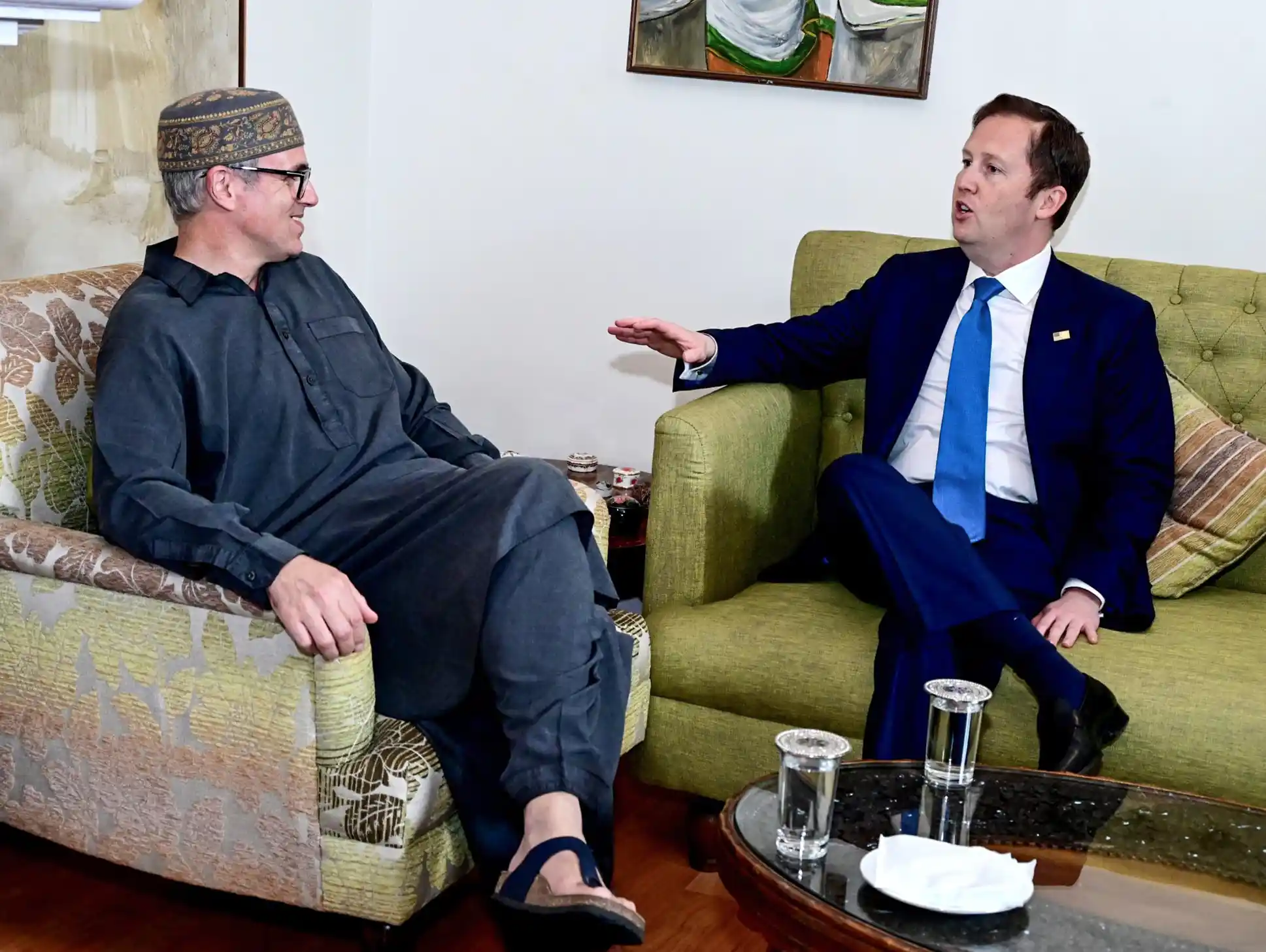
Sergio Gor, the United States Ambassador to India, during his two-day maiden visit to Jammu and Kashmir (J&K) and Ladakh, stated a possible reconsideration of the travel advisory, taking note of the improvement in the security situation in the region. But the key highlight of the visit was the Ambassador’s statement that Kashmir is an “important part of India.” As widely argued by political analysts, the envoy’s remarks were just an unofficial view and are subject to change. India’s position that J&K is an integral part of the nation is legally cemented by the Instrument of Accession, the Constitution, and the 2019 Reorganisation Act, which updated the region’s territorial framework along with Ladakh as Union Territories. Hence, by choosing to neither endorse nor condemn the Ambassador’s remarks, India has demonstrated a measured and intentional approach to diplomacy.
Also, India has strongly opposed third-party mediation in resolving the Kashmir conflict; therefore, the involvement of the Washington administration has been negated on several occasions. In fact, in his first term, President Donald Trump offered to mediate the Kashmir conflict during Imran Khan’s visit to Washington in 2019. While Pakistan has been keen in reviving its strategic status under Trump 2.0, the unexpected commentary from the US envoy generated significant friction in Islamabad. Pakistan interprets this remark as a major departure from the established US position regarding the Kashmir conflict as an internationally recognized disputed territory subject to UN Security Council resolutions. Hence, showing its discontent, Islamabad lodged a strong demarche after it summoned the top U.S. diplomat, Chargé d’Affaires Natalie Baker.
In this regard, the evolving regional dynamics and shifting ties within India’s neighborhood, particularly regarding Pakistan, nevertheless warrant careful analysis. The recent escalating unrest in PoK has exacerbated political anxieties in Islamabad, with growing resentment and demands for electoral and constitutional reforms. The use of force to silence the protestors, however, faced widespread global backlash.
On the other hand, the Mecca Joint Defence Agreement signed on 07 August 2026 between Saudi Arabia, Pakistan and Turkiye establishes a mutual defense rule where aggression against one signatory will be treated as an attack on all three. This trilateral agreement is a follow-up to the Strategic Mutual Defense Agreement signed by Saudi Arabia and Pakistan in Riyadh on September 17, 2025. The collective defense and formalized military arrangement has also attracted other players, including Egypt and Bangladesh.
Albeit none of these agreements explicitly target India, Türkiye’s foreign policy, however, has been pro-Pakistan, while Pakistan is a hostile nuclear-powered neighboring state that has initiated wars against India. Among the three signatories of the treaty, India shares strong diplomatic ties with Saudi Arabia. India had a similar arrangement post the 1971 Treaty of Friendship, Peace and Cooperation with Soviet Russia, but has since rejected becoming part of any full-fledged NATO-style military alliance in the region.
In addition to these developments, Pakistan since its early formative years has maintained a foreign policy centered primarily on the US. Historically, the previous policy of the Washington administration leaned toward Pakistan’s perspective while it held an ambivalent posture toward India’s juridical sovereignty over Kashmir. Despite Pakistan’s constant support for terrorist activities and extremism and its declaration of wars against India, the US has continued to have diplomatic outreach with Pakistan, including defense cooperation and the sale of weapons. Comprehensibly, Pakistan- a ‘zipper nation’ with its geographical location linking South, Central and West Asia provides the strategic depth catering to the interests of global powers including the US. In contrast to Pakistan, India maintains a newer or less established connection with the US government. The Ambassador’s statement has therefore touched a nerve in Pakistan given its deep sensitivity to Kashmir and PoK issues.
Nevertheless, any possibility of US intervention in resolving the Kashmir issue carries unpredictable implications for its role and influence, especially given its strategic relationship with Pakistan. Also, it would pave the way for an unwelcome guest- China- an ‘all weather friend’ of Pakistan and a neighbouring country which has unresolved territorial disputes with India. Given China’s surging global influence and economic weight, the US is forced to tread carefully in its bilateral engagement. It is interesting to note that Ambassador Gor avoided a meeting with His Holiness the Dalai Lama during his visit to Leh. The visit to Ladakh took place just a few days before Trump’s official visit to Beijing and a meeting with Chinese Premier Xi Jinping. Evidently, this could be seen as a conscious decision to avoid any unwarranted diplomatic awkwardness between the two leaders during the meeting.
While one of the ‘mutual’ interests that bolstered the bilateral relations between India and the US is the China factor, the diluting role of the US in the Indo-Pacific has intensified India’s skepticism regarding its partnership with the US. Without robust US backing in the region, India risks losing its strategic clarity without clear direction to counter China’s growing presence in the maritime domain. Moreover, the current bilateral engagement between India and the US has renewed scrutiny, given the unilateral actions against India through the imposition of tariffs on exports, visa concerns with tighter rules, pressure on buying Russian oil, and, more importantly, the US’ relations with Pakistan, which have complicated its engagement with New Delhi.
Nevertheless, whether the remarks by Ambassador Gor were a diplomatic miscalculation or a deliberate strategy to restore trust with India, the Washington administration may tread carefully by treating the Kashmir issue with sensitivity. Also, India’s strategic autonomy stands for ‘diplomacy with dignity’. In this direction, acknowledgment of an external actor’s involvement in India’s territorial sovereignty, whether in favor of or against its interests, would only mean that India gives a foreign government the power to validate the Kashmir conflict- a position New Delhi has consistently rejected in the past and will do so in the coming years.