When Kabul fell on 15 August 2021, India did what it had done once before in 1996: it shut its embassy and pulled its people out. Five years later, that same government has an upgraded Indian embassy operating in its capital, a Taliban-appointed Chargé d’Affaires running the Afghan mission in New Delhi, and a Foreign Minister who has walked the corridors of South Block as an honoured guest. This did not happen overnight, nor by accident. It happened one calculated step at a time, largely because Pakistan’s own relationship with the Taliban deteriorated faster than anyone in Islamabad expected, opening a door New Delhi was ready to walk through. What follows traces exactly how that shift took shape, piece by piece, across diplomacy, humanitarian relief, and economics, before turning to the reasons behind it.
From Silence to a Seat at the Table
For the first year after the takeover, India’s posture was contact without commitment. Sixteen days after Kabul fell, India’s ambassador to Qatar, Deepak Mittal, met Taliban political-office chief Sher Mohammad Abbas Stanekzai in Doha, a meeting confined to the safety of stranded Indian nationals and a warning that Afghan soil must not be used against India. It took until June 2022 for that contact to acquire an address as a senior Indian diplomatic team, led by Joint Secretary J.P. Singh toured India-built infrastructure in Kabul and laid the ground for a technical mission there.
What followed next was not a straight line. The Afghan mission in New Delhi suddenly stopped its operations at the end of 2023, citing a lack of support from the Indian government. It took over a year for the relationship to recover momentum and when it did, it moved fast. In January 2025, India’s foreign secretary met Afghan Foreign Minister Amir Khan Muttaqi in Dubai, the highest-level contact since 2021, and the two sides discussed routing trade through Iran’s Chabahar port.
After these quiet contacts then came the most significant diplomatic exchange between India and Afghanistan since Taliban 2.0 took over. In October 2025, Muttaqi did something no Taliban minister had done before, he spent a week in India, meeting industry leaders, visiting a seminary in Uttar Pradesh, and securing India’s commitment to fully reopen its Kabul embassy, which had been running as a technical mission for three years. India also announced six new development projects particularly in sectors of healthcare, public infrastructure and capacity building.
Three months later, in January 2026, a Taliban-nominated senior diplomat, Mufti Noor Ahmad Noor, took charge of the Afghan embassy in Delhi as Chargé d’Affaires for the first time since 2021, replacing what had, until then, been a holdover from the old republic. That October visit had only been possible because a UN sanctions committee lifted a travel ban on Muttaqi, and it stood as the first high-level, face-to-face meeting between India’s leadership and the interim Taliban government.
In under five years, the relationship had traveled from a hurried evacuation to a fully staffed, reciprocally recognized diplomatic channel, though, notably, still without formal recognition of the Taliban government by India.
Why Delhi is Doing This
Four reasons, layered on top of each other, explain why India has been willing to engage with the Taliban 2.0 without ever taking the final step of officially recognizing them.
The first is India’s history with Afghanistan and its previous investments. India shares an age-long cultural history with Afghanistan. Building upon this, It has a $3 billion economic and infrastructural footprint in Afghanistan, including more than 500 projects spread across 34 provinces of the country.
Second, Afghanistan is important for India’s trade link with Central Asia. The trade between Central Asia and India stands at around $1.7 billion. This figure may look huge but according to experts these figures are very low and there is a lot more potential for India-Central Asia trade especially in the Petrochemical industry, renewable energy, textile manufacturing, healthcare etc. In order to unlock this potential Afghanistan can play a major role as it shares land borders with Central Asia which India doesn’t.
The third reason is related to China’s expanding engagement with Taliban 2.0. China’s outreach with the Taliban-administered Afghanistan began in July 20221, even before the Taliban took over Kabul in August 2021. Since then China has stepped up its diplomatic, economic and humanitarian engagement with Taliban-administered Afghanistan. China became the first country to appoint an ambassador to Afghanistan, with Zhao Xing officially becoming the sixteenth Chinese ambassador to Afghanistan. China has also provided tonnes of humanitarian relief material, costing around $13 million. To extend economic cooperation China has offered Afghanistan tariff free access to its vast construction, energy and consumer sectors. To tap the minerals sector of Afghanistan, China has signed a 25 year contract with Taliban in 2023 for the Amu Darya oil field. Under this contract China’s Xinjiang Central Asia Petroleum and Gas Co. (CAPEIC) would invest $150 million annually to increase the capacity of the Amu Darya oil field. In July 2024, China also revived the $3 billion Mes Ayank copper mine agreement, originally signed in 2008.
The fourth is the terrorism threat from Afghanistan-based Islamic State of Khorasan Province (ISKP), formed in 2015 largely out of defected Tehreek-e-Taliban Pakistan militants. Though the Taliban has waged a sustained campaign against ISKP since 2021, degrading its territorial control and killing several senior commanders, the group has not disappeared; instead it has shifted toward covert cells and external operations, plotting or executing attacks around the world. After getting pushed back in Afghanistan the ISKP managed to conduct attacks in Russia, Turkey, Pakistan, Iran etc. Indian intelligence assessments have grown more explicit about this danger with officials warning ahead of Ramadan in 2025 that ISKP was capable of striking in both Afghanistan and India. ISKP has also turned this hostility into an information war, running a digital propaganda campaign through its magazine Al Azaim that explicitly targets Indian narratives on Jammu and Kashmir and seeks to turn Afghan public opinion against the Taliban’s growing ties with New Delhi.
What the Deepening Actually Looks Like
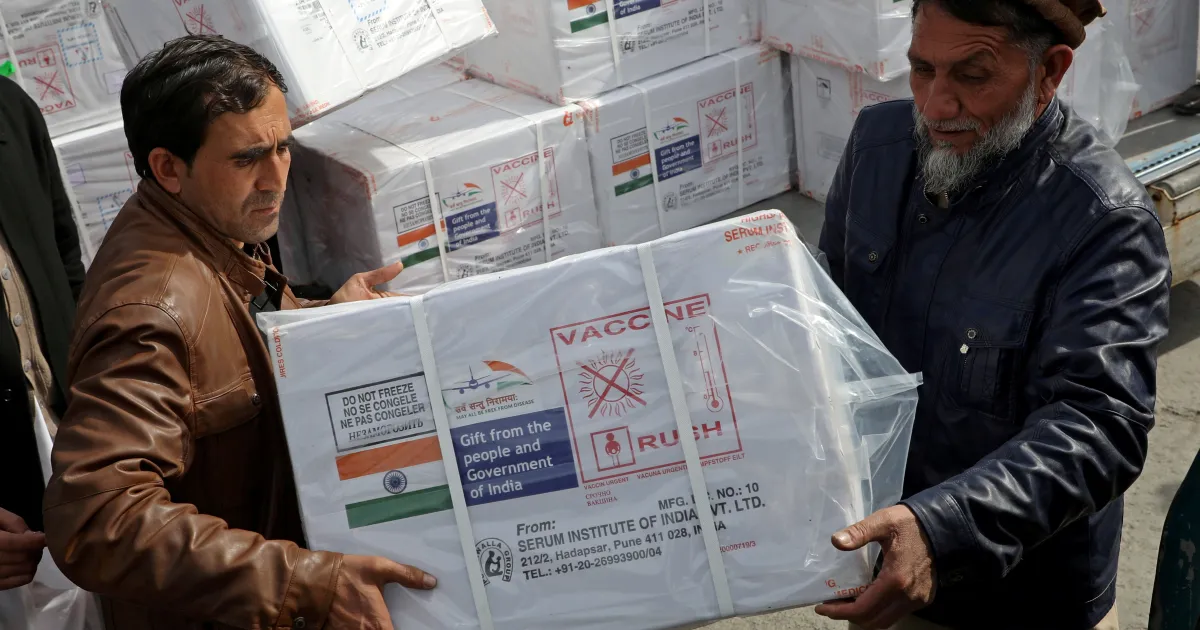
The diplomatic opening was further reinforced by aid and commerce. As early as December 2021, before any technical mission existed, India sent 1.6 tonnes of essential medicines to Afghanistan through the World Health Organization (WHO. Then to assist Afghanistan in fighting COVID-19, India sent around 15 lakh doses of COVID vaccines, 13 tonnes of essential medicines and 60 million doses of polio vaccines for Afghan people and Afghan refugees in Iran along with food supplies via the United Nations (UN), the World Food Programme (WFP), and the United Nations Children’s Fund (UNICEF) channels. Till now India has also sent more than 47,500 metric tons of wheat to Afghanistan since 2021 in collaboration with WFP. Furthermore, in November, 2025, to address Afghanistan’s urgent healthcare needs, India sent 73 tonnes of medicines, vaccines and essential supplements. Recently in March, 2026, when Pakistan launched an airstrike on Kabul, India delivered 2.5 ton consignment of medicines and other medical supplies for the treatment of injured people. India has also renewed more than 1,000 e-scholarships for Afghan students since 2023 India is providing Healthcare cooperation has also deepened alongside disaster relief and educational assistance. India handed over 20 ambulances along with medical equipment to Afghanistan in October, 2025
On the commercial side, India’s exports to Afghanistan fell from $662 million in 2021 to $482 million in 2022 and just $362 million in 2023, before stabilising around $333 million in 2024. The decline in trade was driven partly by a temporary suspension of Iran-Afghanistan transit after border closures. By 2025, the picture had reversed dramatically. India overtook Pakistan to become Afghanistan’s largest export destination, with Afghan exports to India climbing from $612 million in 2024 to $755 million in 2025, a 23 percent rise. During the same period Afghan exports to Pakistan fell from $817 million to $505 million, a 38.2 percent drop. Total bilateral trade between India and Afghanistan stood at roughly $992 million in 2025, with Afghanistan’s imports from India that year totalling about $237 million.
None of this would move without infrastructure, which is why Chabahar sits at the centre of the story. On 13th May, 2024, India Ports Global Limited signed a ten-year, $120 million agreement with Iran’s Ports and Maritime Organization to equip and operate the Shahid Beheshti Terminal. This investment in Chabar port by India came after both the sides agreed to deepen their cooperation in development projects during Muttaqi’s visit to India in October, 2025. Furthermore, on 27 November 2025, a $100 million pharmaceutical MoU was signed between Afghanistan’s Raoufi International Group and India’s Zydus Lifesciences. According to the MoU, Indian company Zydus will initially export its medicines to Afghanistan before shifting a formal branch in the country. This move helped Afghanistan in improving healthcare standards within the country and came amid Afghanistan’s ban on trade with Pakistan, including pharmaceuticals.
Mining has also followed the same arc. Both governments announced a joint working group on mining and investment during Afghanistan’s Minister of Commerce and Industry, Nooruddin Azizi’s 2025 visit to India. Azizi also offered a 1 percent tariff on raw materials and machinery, free land allocation, and five-year tax exemptions for new industries, particularly those established by Afghan refugees. Although there is no official confirmation of any finalized agreements by Indian companies in Afghanistan’s mining sector still some sources have indicated that Afghan authorities have submitted several tenders to the Indian side for the bidding of mines including for lead, zinc, talc etc. Separately, Taliban mining officials have confirmed direct discussions with an Indian delegation over copper and iron extraction, describing the investment climate on offer as favourable.
The most recent developments show this economic track accelerating rather than slowing down. On 13 May 2026, Afghanistan’s Standards and Quality Authority signed a five-year, $46 million contract with the Indian firm TCRC to build and equip standard laboratory complexes in Kabul and nine major Afghan customs facilities. The agreement also included domestic and overseas training programmes for Afghan staff authorities to strengthen technical capacity in quality control and standards enforcement. According to the experts, establishing and equipping standard laboratories could help Afghanistan in increasing confidence in domestic products and reducing the import of low-quality goods. Barely few weeks after this MoU, in end-June 2026, the Afghanistan Chamber of Commerce and Investment and India’s ASSOCHAM signed an institutional MoU in New Delhi specifically to strengthen business-to-business linkages and expand trade and investment cooperation going forward. Under the MoU, ASSOCHAM and ACCI will collaborate in areas such as information exchange, trade and investment facilitation, business matchmaking, delegation exchanges, joint conferences, exhibitions, sectoral interactions etc.
Conclusion
Five years on, India’s Afghanistan policy has travelled a long distance without ever crossing its most important line. New Delhi has rebuilt embassies, shipped tens of thousands of tonnes of wheat, gifted ambulances, signed pharmaceutical and mining deals, and hosted a Taliban foreign minister. Yet it has consistently stopped short of formal recognition, unlike Russia in July 2025. Whether that calibrated distance holds, or eventually gives way as more countries follow Moscow’s lead, will be the defining question of the next phase of this relationship.