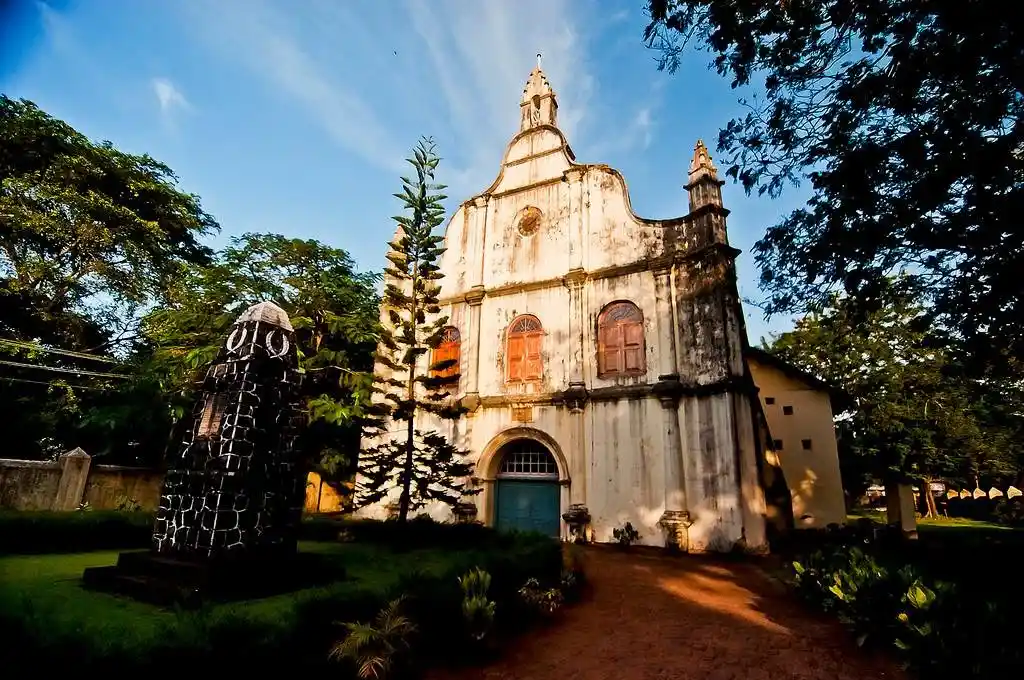
A slab of stone on the floor of St. Francis Church in Fort Kochi is something most visitors walk right past on their way to somewhere shinier. It is unadorned, slightly worn, roped off with a modest cord that says, without needing to shout, this matters. For fourteen years, this was the grave of Vasco da Gama — the man who cracked open the sea route between Europe and India and, in doing so, rewrote the balance of the world.
He died here, in Kochi, on Christmas Eve of 1524, on his third and final voyage to the land he had once merely discovered. He was buried in this church — then a modest structure standing inside a Portuguese fort, dedicated to St. Anthony. Only in 1538, fourteen years later, did his son have the remains disinterred and shipped home to Lisbon, where da Gama now rests in the grand marble hush of the Jerónimos Monastery. What Fort Kochi kept was not the body, but the memory of it — a tombstone inscribed in Portuguese, still legible, still visited, still the reason half the world seems to know this small whitewashed church by name.
It is easy, walking through St. Francis Church today, to let the da Gama connection swallow everything else. It shouldn’t. Because the more remarkable thing about this building isn’t who was buried here five centuries ago — it’s who still walks through its doors today.
A church built to survive
St. Francis Church has outlasted three empires, which is not a small thing for a building made first of wood and then of little more than lime and stone. Franciscan friars raised the original structure in 1503, soon after the Portuguese arrived in Kochi with Pedro Álvares Cabral’s fleet. It was rebuilt in stone by 1516, dedicated to Santo Antonio. When the Dutch seized Kochi in 1663 and set about demolishing every Catholic church the Portuguese had left behind, this one alone survived — repurposed, not razed, and converted to Protestant worship. In 1795 the British took the city in turn, and the church became Anglican, rechristened for St. Francis. Today it belongs to the Church of South India, a Protestant denomination born of the 1947 union of Anglican, Methodist, and Reformed congregations — one more layer in a building that has never stopped changing hands without ever stopping being a church.
Inside, the architecture keeps its own quiet record of that history: a high timber roof, punkah fans that once needed a servant to pull them by hand, granite floor-slabs carved with Dutch and Portuguese epitaphs marking where minor colonial officials were laid to rest. The building is austere by the standards of Kerala’s more ornate churches — no riot of gold leaf, no baroque flourish — and that plainness is, in its own way, the point. This was never meant to dazzle. It was meant to last. Its façade would go on to become the template other churches across the region were modeled on.
And then there’s the tombstone. Da Gama’s story is really a footnote to the church’s larger one, but it’s the footnote everyone comes for — the granite marker on the floor, the plaque nearby quoting his epitaph, the steady trickle of visitors who arrive knowing nothing else about the building except that a legend once lay dead inside it.
What the church becomes at midnight
But ask anyone in Fort Kochi what the church actually means to the town, and the conversation rarely stays with a Portuguese admiral for long. It turns, instead, to December.
Kerala has a reputation, well earned and often remarked upon, for treating its major religious festivals as communal property rather than private ones. Onam, a harvest festival rooted in Hindu tradition, is celebrated by Christian and Muslim households as enthusiastically as Hindu ones. Eid brings neighbors of every faith into each other’s homes. And Christmas — especially Christmas Eve, especially the midnight service — has long worked the same way in reverse. It is not unusual, in towns across the state, to see mosques and temples empty out a little after eleven at night as friends and neighbors head toward the nearest lit-up church, not to convert, not even necessarily to pray in the Christian sense, but to be present for something the whole community has quietly agreed belongs to everyone.
Fort Kochi carries that spirit as intensely as anywhere in the state, and it isn’t hard to see why. This is a town built, layer upon layer, by people who were never going to be only one thing — Portuguese traders, Dutch merchants, British administrators, Arab spice dealers, Jewish settlers, and the Malayali families who were here before any of them and remained after all of them left. Hindu shrines, mosques, and churches sit within a few minutes’ walk of one another in Fort Kochi and neighbouring Mattancherry, and the town has largely treated that proximity as a fact of daily life rather than a source of friction. When St. Francis Church lights its candles for midnight Mass, it does so inside a town that has spent five hundred years learning to celebrate together by necessity as much as by choice.
So the church that once quietly held a Catholic explorer’s bones under a Protestant roof, in a building the Dutch spared for reasons of governance rather than grace, now fills — on one night each year — with people who don’t share a single doctrine among them. Some come to pray. Some come because a friend asked them along. Some come simply because the carols are good and the night air off the Arabian Sea is cool enough, finally, to make standing outside a church at midnight feel like a small mercy rather than an ordeal. Nobody at the door is checking which of those reasons brought you.
The long view
There is something fitting, if you let yourself sit with it, in the fact that a church founded by a colonial power, converted by conquest not once but twice, and famous chiefly for briefly housing a dead man’s bones, has become a place where the lines between religions blur most easily. St. Francis Church was never really built to unite anyone — it was built to plant a flag. But buildings outlive the intentions of the people who raise them, and five centuries is long enough for a flag to become, instead, a meeting place.
Vasco da Gama’s grave marker will still be there in the morning, roped off, dutifully photographed, its Portuguese inscription slowly wearing smoother with each passing decade. But the more telling measure of the church isn’t the stone on its floor. It’s who shows up, year after year, once the candles are lit and the doors are open to whoever wants to walk through them.