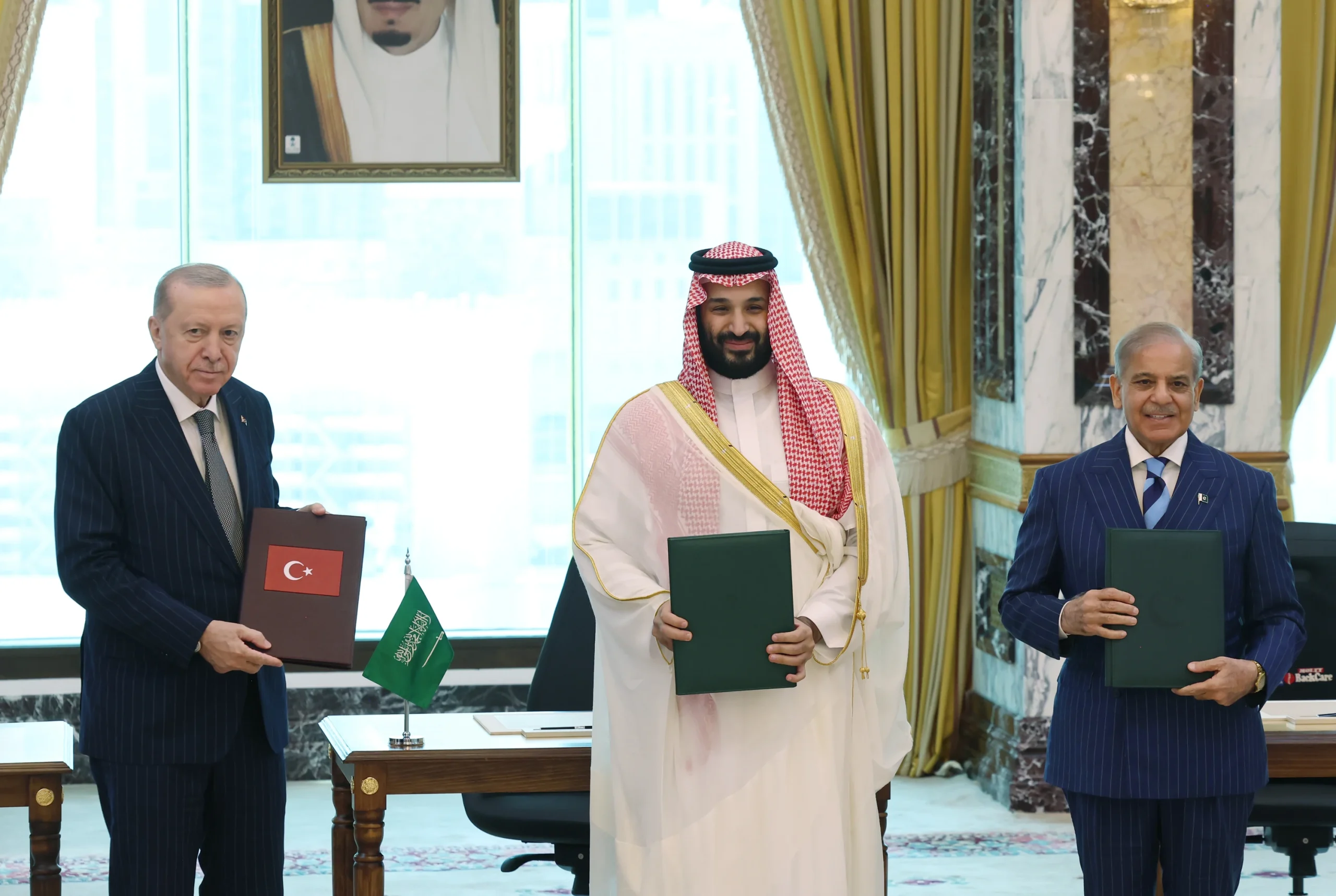
The Makkah Defence Agreement marks a new shift in the evolving security architecture linking the Middle East and South Asia. Its potential to strengthen Pakistan, expand Türkiye’s influence and deepen China’s strategic footprint presents a growing challenge for India.
The recent Makkah Joint Defence Agreement, signed at Al-Safa Palace in Makkah, Saudi Arabia, on August 7, 2026, by Saudi Crown Prince Mohammed bin Salman, Pakistani Prime Minister Shehbaz Sharif, and Turkish President Recep Tayyip Erdoğan, between Saudi Arabia, Pakistan and Türkiye, comes at a critical geopolitical moment as the regional landscape of the Middle East is undergoing rapid transformation New power equations are emerging, while many of the traditional assumptions underpinning the region’s security, engagement and stability are increasingly obsolete. The United States, once the dominant security provider in the region, is no longer the sole major power shaping regional dynamics, as other actors, particularly China, are expanding their presence and influence, both directly and indirectly through Pakistan and other partners. More importantly, the possibility of other Muslim countries eventually joining this emerging security framework cannot be overlooked, as such an expansion could further alter the strategic balance across the Middle East, South Asia and the wider region.
The agreement reportedly aims to strengthen collective defence and strategic coordination among the three countries, covering joint military exercises, defence-industrial collaboration, technology transfer, intelligence sharing, defence cooperation and other areas of military engagement, although significant details of the pact remain confidential. Crucially, the agreement stipulates that any armed attack against any one of the three states shall be regarded as an attack against all three, thereby establishing a formal collective-defence commitment among Saudi Arabia, Pakistan and Türkiye.
Now, what are the implications of this agreement for India?
First, when Pakistan and Saudi Arabia signed their Strategic Mutual Defence Agreement in September 2025, the geopolitical implications of the agreement for South Asia were relatively limited. In the event of India taking military action against Pakistan in the future, whether under another Operation Sindoor or in any other scenario, in response to Pakistan’s provocative actions or its continued sponsorship of cross-border terrorism against India, Saudi Arabia’s response would likely have remained constrained. Given India’s strong ties with Saudi Arabia and Riyadh’s view of New Delhi as a long-term strategic partner amid its rapid economic transformation under Vision 2030, the Kingdom would have been unlikely to jeopardise its relationship with India.
As Riyadh seeks to transform Saudi Arabia into a major global tourism, business, investment and economic hub, India is becoming increasingly important to these ambitions. India is the world’s fastest-growing major economy, a crucial energy market and investment partner, and home to a large and talented diaspora that contributes significantly to Saudi Arabia’s economic development. These deepening economic and people-to-people ties would have created strong incentives for Riyadh to maintain a careful balance between its relationship with Pakistan and its increasingly important partnership with India. Consequently, even in the event of a conflict between India and Pakistan, Saudi assistance to Islamabad would likely have remained largely confined to financial and diplomatic support rather than direct military involvement.
But now Türkiye has entered the equation, and if other Muslim countries eventually join the emerging security framework, the dynamics could shift significantly.
Türkiye’s Expanding Geopolitical Ambitions and the Challenge for India
Türkiye is an ambitious country, and under President Erdoğan it has become increasingly assertive in pursuing a broader geopolitical role. Erdoğan views Türkiye as an important regional and global power and seeks to revive and expand Turkish influence—driven by a neo-Ottoman vision to reclaim the Ottoman Empire’s historical geopolitical reach and civilizational leadership—beyond its immediate neighbourhood, including in South Asia, Southeast Asia, Central Asia and other strategic theatres. Closely aligned with this vision is Ankara’s promotion of political Islam, an ideological framework that converges deeply with Pakistan’s state identity and strategic outlook, thereby compounding regional complexities. By seeking to export political Islam across South Asia and beyond, Türkiye aims to cultivate transnational alignments to advance its broader geopolitical objectives.
As part of its Asia Anew initiative, Türkiye seeks to expand its influence across Asia, including South Asia and the Indian Ocean region. As part of this broader strategy, Ankara has been courting Muslim-majority countries in the region, including Bangladesh, whose Army Chief, General Waker-Uz-Zaman, recently visited Türkiye for high-level meetings with Turkish Defence Minister Yaşar Güler and Chief of the General Staff General Selçuk Bayraktaroğlu, alongside visits to defence manufacturing hubs such as Baykar and Aselsan. Pakistan’s Army Chief, General Asim Munir, also visited Türkiye just days ago to coordinate trilateral mechanisms.
Türkiye is already strengthening Pakistan’s military capabilities vis-à-vis India. During Operation Sindoor, Türkiye reportedly provided intelligence and technical assistance to Pakistan, while Turkish personnel were reportedly present on the ground operating Turkish Bayraktar TB2 and Akıncı drones and other electronic warfare equipment. In response to Türkiye’s support for Pakistan during the conflict, India subsequently expanded its outreach in the Eastern Mediterranean, including by strengthening its engagement with countries such as Cyprus and Greece. At the same time, Türkiye has intensified its engagement with South Asia and the Indian Ocean region, seemingly as part of a broader effort to expand its influence and counter India’s growing presence.
Türkiye is providing Pakistan with drone technology, while it is also developing its fifth-generation KAAN stealth multirole fighter programme. Türkiye has recently released the prototype of the KAAN at Turkish Aerospace Industries (TAI) facilities, while India’s Advanced Medium Combat Aircraft (AMCA) remains at the design and development stage. Türkiye also operates American and other Western military platforms—such as its fleet of F-16 fighter aircraft—and possesses considerable expertise in Western defence technologies. As a NATO member, it has access to and experience with a wide range of Western military systems, and Washington is currently discussing Türkiye’s potential return to the F-35 Lightning II joint strike fighter programme.
Pakistan, meanwhile, also operates several American-origin weapons platforms, most notably its inventory of F-16 Fighting Falcons. This could facilitate greater interoperability and integration between Turkish and Pakistani military systems. Under the new agreement, Türkiye could potentially expand its defence-technology cooperation with Pakistan, including the possibility of future cooperation involving the KAAN fighter programme, thereby further complicating India’s security environment.
Beyond the military domain, Ankara’s engagement with Pakistan has also acquired an important information dimension. During and after Operation Sindoor, narratives critical of India were amplified across digital and social-media platforms, with disinformation, manipulated content and coordinated messaging seeking to shape international perceptions of the conflict and undermine India’s global image. This information offensive included state-linked bot networks orchestrating geopolitical campaigns, alongside Turkish state broadcaster TRT World amplifying critical reports, which prompted India to block its social media accounts on X within the country. Türkiye has also been seen as sympathetic to narratives from other actors critical of India—such as aligning digital outputs with Chinese state media to amplify pro-Pakistan strategic messaging— thereby creating the possibility of a broader information ecosystem in which diplomatic, political and digital channels reinforce one another. This information dimension is particularly significant because India’s growing global influence increasingly depends not only on its military and economic capabilities but also on its international image and diplomatic credibility.
In this context, the earlier agreement between Saudi Arabia and Pakistan represented a different strategic equation. With Türkiye now entering the framework, however, the situation has changed.
During an India-Pakistan conflict, Türkiye may not necessarily deploy military personnel directly to fight India. Such a scenario would be difficult to anticipate. However, given reports that Turkish personnel were directly involved in operating military equipment on the ground during Operation Sindoor, the possibility of deeper Turkish military support for Pakistan cannot be dismissed.
Even if Türkiye does not put boots on the ground in support of Pakistan, the assistance it could provide could still be substantial, including military equipment, intelligence, logistical and technical support, political backing, training, and other forms of defence assistance.
Beijing’s Shadow
There is another major dimension that cannot be overlooked: China.
More than 80 per cent of Pakistan’s defence equipment comes from China, and there is already deep defence, strategic and intelligence cooperation between Beijing and Islamabad. Pakistan also functions as an important strategic node for China in the Middle East and the wider region.
Therefore, the emergence of a Saudi-Pakistan-Türkiye security framework could indirectly expand China’s strategic footprint in the region. Given the existing tensions between India and China, China’s support for Pakistan during Operation Sindoor, and the broader strategic competition between New Delhi and Beijing, particularly following the Galwan Valley clashes, it would be premature to assume that China would remain entirely disconnected from these emerging dynamics.
China already enjoys significant influence in the Middle East and has developed deep economic, diplomatic and strategic relationships with several countries in the region. Its growing presence in the Gulf and expanding ties with Saudi Arabia, Pakistan and Türkiye could therefore add another layer of complexity for India and other like-minded countries.
Beyond individual bilateral relationships, these countries together bring distinct strategic capabilities to the table: Pakistan brings its nuclear arsenal, large military establishment and geographical position; Saudi Arabia brings enormous financial resources and strategic weight; while Türkiye brings defence technology, military-industrial capabilities, drones, Western technological expertise and geopolitical reach.
The combination of these capabilities could indirectly strengthen Pakistan’s strategic position. Furthermore, this agreement is poised to embolden Pakistan and its domestic radical elements, who will likely reference this powerful alignment to further indoctrinate and radicalise cadres against India, thereby intensifying cross-border security challenges.
Strategic Imperatives for India
Therefore, the Makkah Joint Defence Agreement cannot be dismissed as merely another regional defence arrangement. Unlike the previous Saudi-Pakistan agreement, the inclusion of Türkiye adds a further strategic dimension, particularly because Ankara has broader geopolitical ambitions and increasingly seeks to expand its influence in South Asia and the Indian Ocean region.
Türkiye’s growing engagement with Pakistan and other countries in India’s wider neighbourhood could complicate India’s security environment and challenge its strategic interests. Saudi Arabia may also find it increasingly difficult to balance its relationships with India, Pakistan and Türkiye if the trilateral framework expands and acquires a broader military dimension.
For India, this is therefore the time to recalibrate its strategic approach. New Delhi needs to examine the agreement not merely in terms of its immediate military implications but also through the lens of its possible future evolution, the potential entry of other countries, China’s role, Türkiye’s ambitions, Pakistan’s military capabilities, and the emerging strategic competition across South Asia, the Middle East, and the Indian Ocean.
India should closely monitor these developments, deepen its engagement with like-minded partners, and strengthen its defence-industrial capabilities, intelligence cooperation, strategic partnerships and regional outreach.
The Makkah agreement may not immediately create an anti-India military bloc, but its potential evolution should not be underestimated. India must therefore look beyond the agreement’s immediate optics and prepare for the wider strategic possibilities that could arise from this evolving security architecture.
The copyright of this article remains with the Politeia Research Foundation ©️PRF.
References
“Saudi Arabia, Turkey, Pakistan Pledge Mutual Defence as Middle East Turmoil Escalates,” Reuters, August 7, 2026, accessed August 11, 2026, https://www.reuters.com/world/asia-pacific/saudi-arabia-turkey-pakistan-sign-joint-defence-deal-amid-regional-turmoil-2026-08-07/
Priyanka Shankar, “Turkiye, Saudi Arabia, Pakistan Sign Joint Defence Agreement: What’s in It?” Al Jazeera, August 7, 2026, accessed August 11, 2026, https://www.aljazeera.com/news/2026/8/7/turkiye-saudi-arabi-pakistan-sign-joint-defence-agreement-whats-in-it
“Saudi Arabia ‘One of India’s Most Valued Partners, a Trusted Friend and a Strategic Ally’: Indian PM Narendra Modi Tells Arab News,” Prime Minister’s Office, Government of India, April 22, 2025, accessed August 11, 2026, https://www.pmindia.gov.in/en/news_updates/saudi-arabia-one-of-indias-most-valued-partners-a-trusted-friend-and-a-strategic-ally-indian-pm-tells-arab-news
“Saudi Delegation to Visit India to Showcase Investment Opportunities,” The Hindu, accessed August 11, 2026, https://www.thehindu.com/news/international/saudi-delegation-to-visit-india-to-showcase-investment-opportunities/article70262357.ece
Lior Ben Ari, “Turkey’s Growing Footprint in Lebanon: Military Ties, Aid and Erdogan’s Regional Ambitions,” Ynetnews, August 10, 2026, accessed August 11, 2026, https://www.ynetnews.com/article/b1yz5rs8fe
Swasti Rao, “Turkey’s ‘Asia Anew’ Isn’t Just a Slogan—it’s a Growing Strategic Surprise for India,” The Print, June 20, 2025, accessed August 11, 2026, https://theprint.in/opinion/turkey-indian-ocean-region-strategy/2664858
“Bangladesh Army Chief Visits Turkiye amid Growing Ankara-Islamabad-Dhaka Defence Nexus,” The Economic Times, July 20, 2026, accessed August 11, 2026, https://m.economictimes.com/news/international/world-news/bangladesh-army-chief-visits-turkiye-amid-growing-ankara-islamabad-dhaka-defence-nexus/articleshow/132522399.cms
Shivani Sharma, “Turkey Helped Pakistan Attack India, Sent 350+ Drones, Military Operatives,” India Today, May 14, 2025, accessed August 11, 2026, https://www.indiatoday.in/india/story/turkey-helped-pak-army-plan-attack-on-india-supplied-350-drones-military-operatives-sources-2724565-2025-05-14
Tony Osborne, “Turkish Aerospace Industries’ Kaan Fighter Jet Begins Taxi Trials,” Aviation Week, July 24, 2026, accessed August 11, 2026, https://aviationweek.com/defense/aircraft-propulsion/turkish-aerospace-industries-kaan-fighter-jet-begins-taxi-trials
Imran Khurshid, “Get Ready for the Turkey-Pakistan Axis,” Middle East Forum Observer, July 17, 2026, accessed August 11, 2026, https://www.meforum.org/mef-observer/get-ready-for-the-turkey-pakistan-axis
NDTV News Desk, “India Blocks X Account of Turkish State Media Outlet TRT World,” NDTV, May 14, 2025, accessed August 11, 2026, https://www.ndtv.com/india-news/trt-world-global-times-xinhua-india-blocks-x-account-of-turkish-state-media-outlet-trt-world-8410889
“Why Chinese Media Is Amplifying Pakistan’s Role in US-Iran Conflict,” The Print, April 1, 2026, accessed August 11, 2026, https://theprint.in/opinion/chinese-media-amplifying-pakistan/2893255
Imran Khurshid, “How Pakistan Enables China’s Expanding Defense Presence in the Middle East,” Middle East Forum Observer, July 2, 2026, accessed August 11, 2026, https://www.meforum.org/mef-observer/how-pakistan-enables-chinas-expanding-defense-presence-in-the-middle-east