Moscow rarely floats a rail line toward a country it has, at most, skirted the edges of for a century; since the Great Game, Russian planners have not taken physical connectivity to India seriously. So when Deputy Prime Minister Marat Khusnullin told TASS on 9 August that Russia should study a corridor to the Indian Ocean through Turkmenistan, Iran, Afghanistan and Pakistan, the instinct across Delhi’s commentariat was to read it as an assault on Beijing’s Belt and Road (Deccan Chronicle 2026). That instinct is understandable. It is also, on the evidence assembled here, largely wrong, or at least premature. What the proposal actually measures is not a Sino-Russian rupture but the depth of India’s leverage inside a system Farrell and Newman (2019) would call weaponized: one in which control of chokepoints, not armies, increasingly decides who trades with whom.
Here is the first complication. Most of what Khusnullin described already exists. Russia has shipped freight into Iran via Kazakhstan and Turkmenistan since 2014, and a western spur through Azerbaijan is complete but for a single 162-kilometre gap (Observer Research Foundation 2025). Even where rails exist, gauges do not agree: Russia runs broad (1,520 mm), Iran standard (1,435 mm), India broader still (1,676 mm), so no unbroken train was ever going to cross this route regardless of who signs what. The genuinely missing piece is narrower than “a railway to India”: an overland link from Iran that never touches the Gulf, because the route India already uses, Mumbai to Bandar Abbas, sails past the very strait everyone is trying to escape, through a port American forces struck in May (Council on Foreign Relations 2026). Call it, if the phrase is allowed, a proposal to finish a sentence Russia started twelve years ago.
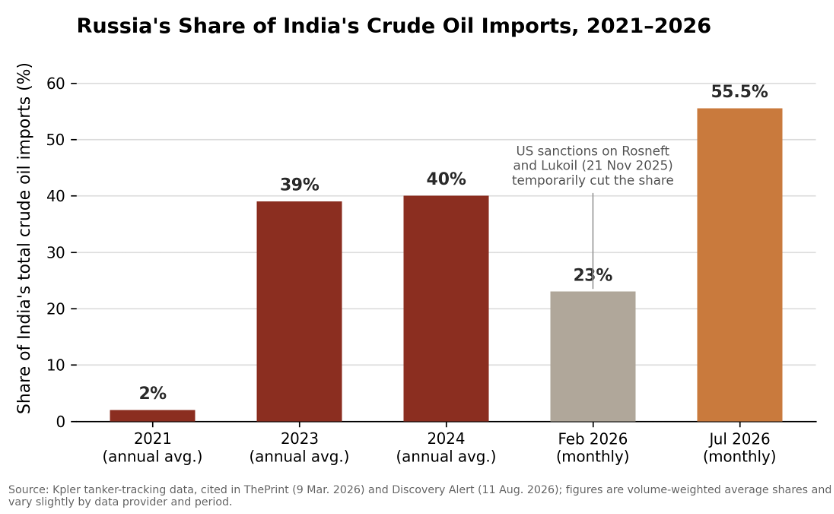
Numbers travel further than rhetoric here. Russian crude supplied roughly 2 percent of India’s imports before 2022; by July 2026 the figure had reached 55.5 percent, a new high struck even as the Gulf burned (Discovery Alert 2026; see Figure 1). That is not diplomatic friendship. It is structural dependence, running in both directions, since Moscow now needs this buyer nearly as much as Delhi wants the discount, and Farrell and Newman’s (2019) network logic applies squarely: asymmetric position, not sentiment, is what generates leverage. Whether either capital intends to use that leverage coercively is a separate, unresolved question, and the honest answer is that nobody outside the Kremlin currently knows.
Pakistan complicates the map twice over, and Table 1 makes the contradiction legible at a glance. Islamabad brokered the April ceasefire and hosted the Islamabad Talks, the highest-level US-Iran contact since 1979 (Al Jazeera 2026), a genuine diplomatic asset, earned honestly and worth crediting. Yet the same government has kept its own border with Afghanistan closed since a separate clash with the Taliban in February (Council on Foreign Relations 2026), and Attari-Wagah, the sole land crossing into India, has not reopened since the Pahalgam attack of May 2025 (Outlook Business 2025). Pakistani officials had in fact raised route options with Moscow as early as the 2025 Kazan Forum (The Researchers 2026). A state that cannot currently move goods across either of its land borders is an improbable linchpin for someone else’s railway. Optimism, evidently, is not the scarce resource here. Capacity is.
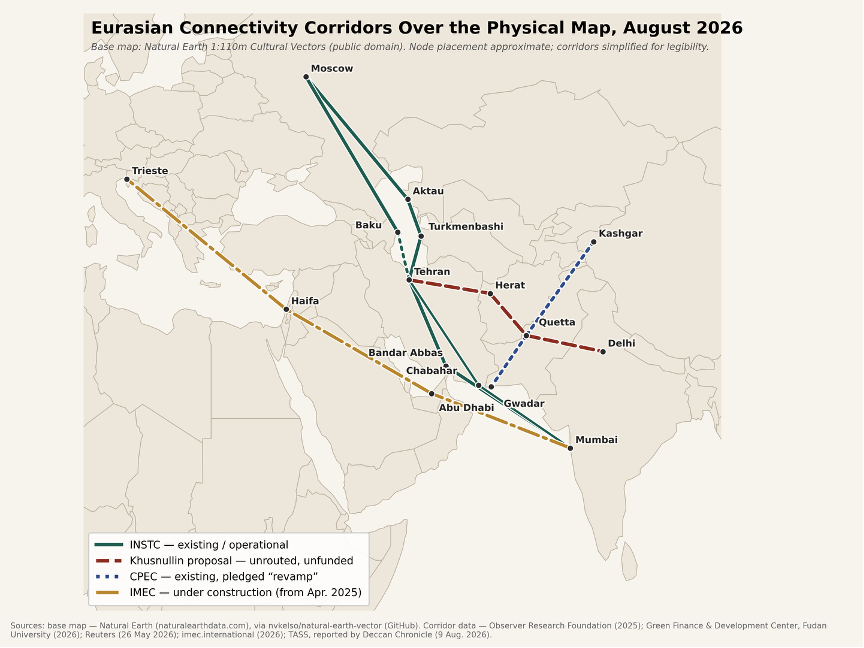
This is where the more excitable coverage overreaches, and it is worth naming the disagreement rather than dissolving it. Wire reports have called the proposal a direct challenge to Chinese infrastructure dominance (Indo-Asian News Service 2026); the claim is intuitive and, on the numbers, unpersuasive. Russia-China trade fell 7 percent in 2025, its first annual decline since 2020 (Moscow Times 2026), a cooling with causes of its own, unconnected to India. Xi Jinping and Shehbaz Sharif met in Beijing in May and pledged a “high-quality” revamp of the China-Pakistan Economic Corridor (Reuters 2026a); the Green Finance and Development Center (2026) at Fudan University recorded, in that same half-year, zero fresh Chinese capital committed to Pakistan. Rhetoric without money is not competition so much as caution, Beijing hedging its own exposure to a corridor plagued by militant attacks on its nationals, quite apart from anything Moscow proposes (see Figure 2).
Table 1. Competing Eurasian Connectivity Architectures
| Corridor | Core Route | Main Actors | Mode | Strategic Purpose | Key Vulnerability | India’s Position | Current Status |
| Russia–India proposal | Russia–Kazakhstan/Turkmenistan–Iran–Afghanistan/Pakistan–India (under study) | Russia, Iran, Afghanistan, Pakistan, India | Rail (proposed) | Bypass Hormuz and Bosphorus risk | Afghan/Pakistani instability; no finished rail link; unfunded | No public response (as of 13 Aug. 2026) | Preliminary proposal (9 Aug. 2026); unrouted, unfunded |
| INSTC | Mumbai–Bandar Abbas/Chabahar–Caspian–Astrakhan–Moscow/St Petersburg | India, Russia, Iran +10 states | Sea, rail, road | Cut Suez/Hormuz time and cost | Rasht–Astara gap; Bandar Abbas exposed to war; sanctions | Founding member; top Asian beneficiary | ~75% built; 26.9m tonnes in 2024 (+19% y/y) |
| BRI | Six land corridors + Maritime Silk Road, from China | China + approx. 150 countries | Rail, road, port, pipeline | China-centred infrastructure and trade network | Debt-sustainability criticism; uneven financing | Non-member; objects to CPEC’s route via Pakistan-administered Kashmir | Record H1 2026 globally ($126.3bn); zero in Pakistan/Russia |
| CPEC | Kashgar (Xinjiang)–Karakoram Hwy–Gwadar | China, Pakistan | Road, rail, pipeline, port | Chinese access to Arabian Sea, bypassing Malacca | Attacks on Chinese nationals; financing gaps; Baloch insurgency | Opposes; route transits Pakistan-administered Kashmir | “Revamp” pledged May 2026; energy built, transport lags |
| IMEC | Mumbai (sea)–UAE–Saudi/Jordan (rail)–Haifa (sea)–EU | India, US, UAE, Saudi Arabia, EU, France, Germany, Italy | Sea, rail, energy cable | Suez alternative; anchors India–Gulf–EU ties | Transits Israel amid regional war; Oman abstains | Founding member; central node | Construction began Apr. 2025; early phase |
Sources: Observer Research Foundation (2025); Green Finance and Development Center (2026); Reuters (2026a); imec.international; Deccan Chronicle (2026). Figures as of 13 Aug. 2026; “under study” and “proposed” routes are not committed alignments.
Seen from Delhi, none of this was ever really about a railway. India rejected the Belt and Road on sovereignty grounds in a formal 2017 statement objecting specifically to a route crossing Pakistan-administered Kashmir, and has not wavered since (Ministry of External Affairs 2017). That position reads less like stubbornness now than foresight, given how thin the 2026 financing data shows Beijing’s actual commitment to be. Brewster (2014) describes India’s Indian Ocean posture as a search for primacy without a single fixed anchor, and Chabahar, IMEC, INSTC and now, conceivably, a Russian rail spur read as successive instances of the same habit: each a hedge, not a wager. New Delhi is not choosing a patron. It is building a position where Moscow, Washington and Beijing all have to compete to become one option among several, which is a considerably stronger place to stand than being anyone’s chosen corridor.
“New Delhi is not choosing a patron. It is building a position where Moscow, Washington and Beijing all have to compete to become one option among several.”
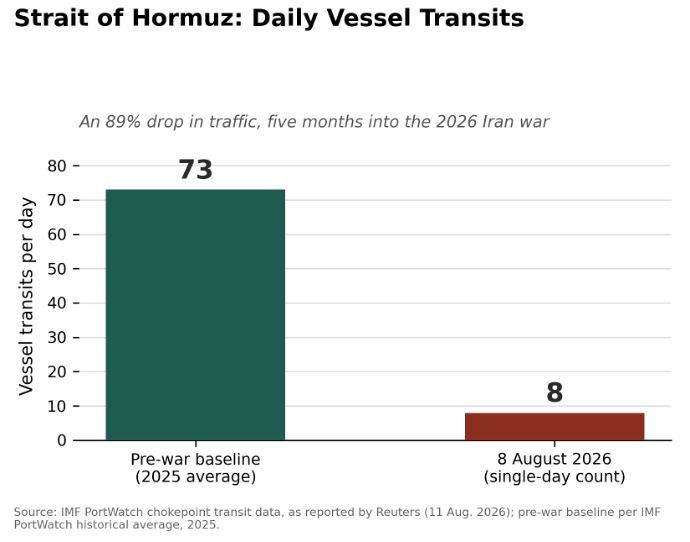
Scepticism is warranted and should be stated plainly rather than argued around. Khusnullin announced no financing, no route survey, no treaty; New Delhi has not responded publicly at all. Three paths remain genuinely open. Sustained Hormuz disruption, still running at roughly one-ninth of pre-war traffic in early August (Reuters 2026b; see Figure 3), could eventually force real money toward an Iran-India land link; watch for an actual Pakistan-Afghanistan-India transit accord as the tell, not another interview. More probably, Russia continues trading with both India and China through overlapping networks that were never mutually exclusive, competition nowhere required. Least dramatically, continued war, unresolved Pakistan-Afghanistan hostility and Chabahar’s sanctions limbo simply let the idea die on the page, which is roughly where matters stand in mid-August.
Whichever path holds, India’s position does not depend on Khusnullin’s railway ever being laid. Pakistan gains diplomatic standing this year without gaining a corridor that answers to its own economy, let alone India’s. China gains rhetorical continuity without gaining fresh capital discipline. Russia gains options without relinquishing Beijing. Of the four capitals tested against the evidence in this account, only India gains structurally under every scenario: a widening set of routes, each individually replaceable, none individually decisive. That asymmetry, and not the fate of one unrouted line through four contested borders, is the finding worth carrying forward.