India did not merely reject a communiqué. It rejected a pattern — and the world should pay attention.
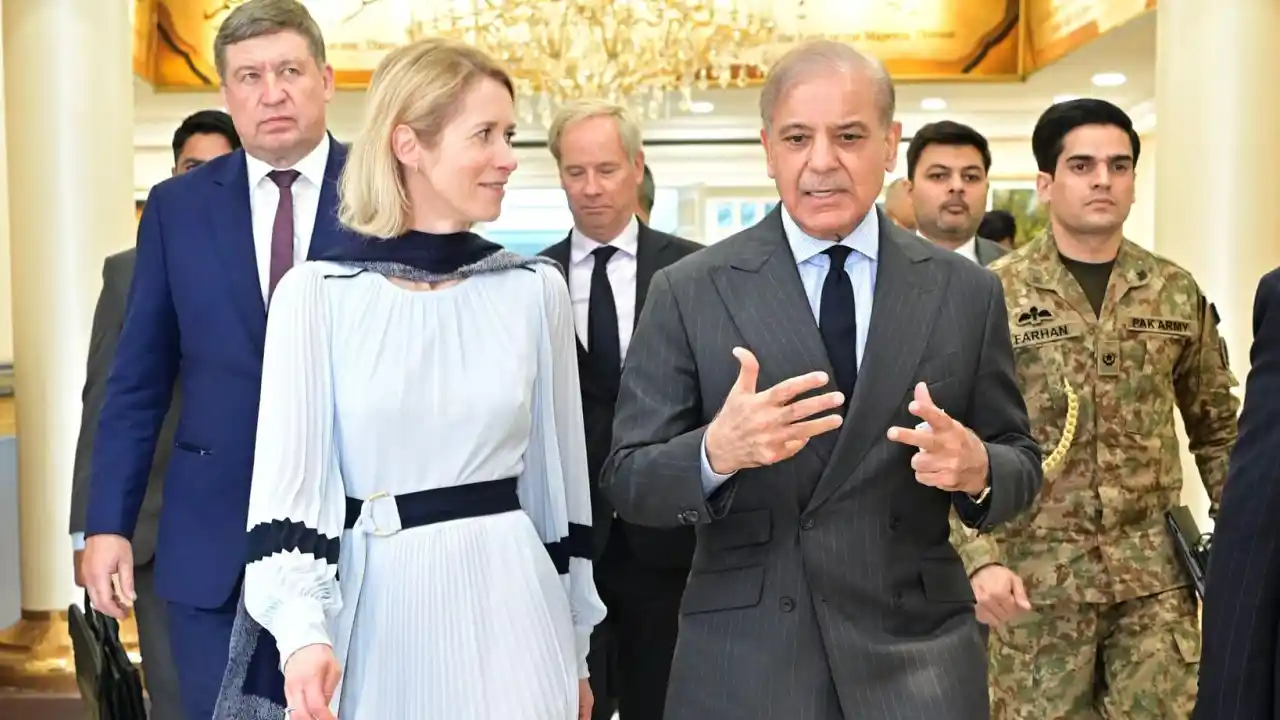
In June 2026, the European Union’s Foreign Policy Chief Kaja Kallas flew to Islamabad for the Eighth EU-Pakistan Strategic Dialogue. She arrived carrying a familiar European message: Pakistan’s preferential trade access under the GSP+ framework — which gives Islamabad duty-free entry to European markets and makes the EU Pakistan’s single largest export destination — is not a blank cheque. It comes with conditions: human rights, rule of law, labour standards, democratic accountability. The EU, true to its self-image as a values-driven actor, wanted Pakistan to know that commerce and conscience travel together.
Then the joint communiqué dropped. And New Delhi read it.
Buried inside the diplomatic language was a reference to Jammu and Kashmir — framed around peaceful conflict resolution under the United Nations Charter. India’s Ministry of External Affairs responded without ambiguity or delay. Jammu and Kashmir and Ladakh are integral and inalienable parts of India. The references were “unwarranted.” India was considering formally raising objections with the European Union. The message from South Block was clear: this is not acceptable, and we will not treat it as acceptable simply because it comes wrapped in diplomatic courtesy.
The EU preached governance to Islamabad in the morning and gifted Islamabad a Kashmir reference in the afternoon. That is not normative diplomacy. That is having it both ways.
What happened in Islamabad is not a minor diplomatic mishap. It is a symptom of something larger — a pattern of selective attention by Western powers that India has had to fight, decade after decade, on its own sovereign soil. The EU is not the first. It will not be the last. But June 2026 is a useful moment to name what is actually happening, and to be honest about what it costs.
I. Kashmir Is Not a ‘Conflict’ — It Is Indian Territory
Let us begin with something that should not need restating but apparently does, given the content of the EU-Pakistan communiqué: Jammu and Kashmir is not a disputed territory waiting for international resolution. It is an integral part of India, constitutionally confirmed and administratively consolidated. When the Government of India revoked Article 370 in August 2019 and reorganised the region into two Union Territories, it was not altering the facts on the ground — it was completing an administrative alignment that the constitutional framework had always permitted and that the people of the region deserved.
India’s Parliament acted. India’s Supreme Court has since upheld the validity of those changes. There is no vacancy here for external arbitration, no role for the United Nations Charter that Pakistan invokes so ritualistically, and no legitimacy for communiqués drafted thousands of kilometres away in Islamabad and Brussels to suggest otherwise.
The 1948 UN resolutions that Pakistan cites were passed under entirely different geopolitical circumstances and have never been implemented — largely because Pakistan itself failed to meet the preconditions they demanded, including the withdrawal of Pakistani forces from the territory they had illegally occupied. As the late strategic affairs scholar K. Subrahmanyam repeatedly noted, those resolutions have no operative relevance to the contemporary legal and political status of Jammu and Kashmir. India has said this consistently. The EU chose to ignore it.
II. Pakistan’s Strategy — and Why Europe Keeps Falling for It
Pakistan’s foreign policy on Kashmir is not improvisation. It is architecture — carefully constructed, patiently maintained, and periodically refreshed. Unable to alter facts on the ground through military means after three failed wars, Islamabad has pivoted to diplomacy: keeping Kashmir alive as an international question, ensuring that no major power simply accepts India’s position as settled, and collecting references in communiqués, statements, and multilateral resolutions the way a lawyer collects precedents.
The China-Pakistan joint statement earlier in 2026 carried a similar Kashmir language. India protested that too. The pattern is deliberate and cumulative. No single reference changes anything. But together, they build a discourse — an international atmosphere in which Kashmir remains a live question rather than a closed one. Pakistan understands that discourse shapes reality over time, even when ground realities do not immediately shift.
What makes this particularly galling is that Pakistan is simultaneously the country that has sponsored cross-border terrorism against India for decades. The same state that asks the international community to be concerned about Kashmiri welfare is the state that trained and dispatched the militants who killed Kashmiri civilians, Kashmiri politicians, and Indian security personnel across thirty years of proxy war. Europe knows this. It has not forgotten the 2008 Mumbai attacks, planned on Pakistani soil. Yet in Islamabad, Kallas spoke of Pakistan as “a major regional power and an important EU partner” — language that, in context, carries its own uncomfortable implications.
Pakistan could not take Kashmir by force in 1947, 1965, or 1999. So it has spent seventy-five years trying to take it by paperwork. The EU just handed it a useful page.
III. Europe’s Selective Memory — From Ukraine to Kashmir
Europe’s record on the principle of territorial integrity deserves direct examination. Since February 2022, the European Union has positioned itself as the world’s most vocal and consistent defender of sovereignty, territorial integrity, and the inadmissibility of changing borders by force. The response to Russia’s invasion of Ukraine has been, by the standards of recent European history, remarkably unified and principled. Sanctions, weapons, diplomatic support, reconstruction pledges — Brussels has put considerable weight behind its stated commitment to the rules-based order.
The question India is entitled to ask is: which rules, and for whom?
When Russia invades Ukraine, European capitals immediately invoke the UN Charter — Articles 2(4) on the prohibition of force and the sanctity of territorial integrity. When Pakistan raises Kashmir in a joint communiqué, European diplomats invoke — also from the UN Charter — language about peaceful conflict resolution, implicitly suggesting an unresolved dispute that merits international attention. The same Charter, applied to produce diametrically opposite implications, depending on who is asking and who is being accommodated.
This is not principle. This is pragmatism wearing the costume of principle. And India, which has watched this pattern long enough to recognise it, is not fooled.
Turkey provides an even sharper illustration of the same pattern. Ankara has made opposition to India’s position on Kashmir a near-permanent feature of its foreign policy. Turkish President Erdogan raised Kashmir at the UN General Assembly in 2019, in 2020, and again in subsequent years — framing it as a cause requiring international solidarity. Turkey maintains warm relations with Pakistan, is a NATO member in good standing with Western capitals, and faces minimal diplomatic consequences for its consistent interference in a matter that is plainly India’s internal affair. European governments that routinely lecture India on human rights have little to say about Erdogan’s Kashmir posturing.
The selectivity is not incidental. It reflects a worldview in which India is expected to be grateful for engagement and restrained in its responses, while Pakistan and Turkey are accommodated as strategically convenient partners regardless of their behaviour.
IV. Why India’s Response Was Not Just Right — It Was Necessary
Some commentators in European capitals will privately say that India overreacted — that the communiqué language was anodyne, formulaic, the kind of diplomatic boilerplate that appears in hundreds of documents and means very little. This view is dangerously mistaken, and it is worth explaining precisely why.
Diplomatic language accretes. A reference that seems routine in one communiqué becomes cited precedent in the next. It gets picked up by UN rapporteurs, by NGO reports, by academic analyses. It begins to constitute, slowly and almost invisibly, an international consensus that the question remains open. India has spent decades fighting exactly this process — preventing the gradual institutionalisation of ambiguity around Kashmir’s status. It cannot afford to let any reference pass without challenge, not because every reference is catastrophic in isolation, but because the pattern of silence is.
India’s Ministry of External Affairs has, since 2014, become considerably more direct in its responses to unwanted external commentary on Kashmir. This is not nationalism overwhelming diplomacy. It is diplomacy catching up with the reality of what India has become: the world’s most populous country, its fifth-largest economy, a nuclear-armed state with a growing capacity to act on its preferences in the international system. Countries that matter do not accept unsolicited judgements on their sovereign territory. They respond, clearly and promptly, and let the consequences follow. India did exactly that.
The broader context strengthens India’s hand. The India-EU relationship is one of genuine mutual interest — an FTA under negotiation, technology partnerships, supply chain cooperation, Indo-Pacific engagement. India is not a supplicant. It is a partner with alternatives and with leverage. Brussels needs New Delhi as much as, and arguably more than, New Delhi needs Brussels on any given diplomatic question. That asymmetry — which has shifted considerably over the past decade — means India can afford to be direct in ways it perhaps could not have been in the 1990s.
V. The Strategic Cost of Looking Away
There is a temptation, particularly in the corridors of South Block and in Indian strategic commentary, to treat each of these episodes as isolated irritants — to protest, to move on, and to continue business as usual. That temptation should be resisted.
The EU-Pakistan communiqué, Turkey’s UNGA speeches, the occasional European Parliament resolution on human rights in Kashmir, the periodic statements from Organisation of Islamic Cooperation member states — individually, none of these is decisive. Collectively, they form an environment of sustained diplomatic pressure designed to prevent the international community from treating India’s position on Kashmir as settled. That pressure has a cumulative effect, and responding only to individual episodes without addressing the pattern means always fighting on the back foot.
India needs a forward strategy, not merely a reactive one. That means deeper engagement in European think tanks and parliamentary networks, where Pakistani influence has been disproportionately built over many years. It means institutionalised pre-consultation mechanisms with the EEAS so that problematic language is flagged before communiqués are finalised, not after they are published. It means making clear — to Brussels, to Ankara, to every capital that thinks Kashmir references carry no diplomatic cost — that they do carry a cost, and that India is prepared to impose it.
The relationship with the EU, in particular, should be managed with this clarity. Europe is a valuable partner. The FTA matters. Technology cooperation matters. Indo-Pacific alignment matters. But none of it functions if the foundational issue of trust — trust that a partner will not lend legitimacy to positions directly hostile to India’s sovereign claims — remains unaddressed. India should pursue European partnership energetically and simultaneously make European governments understand that consistency on sovereignty is the price of strategic depth.
Conclusion: Sovereignty Is Not Negotiable, and Neither Is Credibility
Brussels arrived in Islamabad in June 2026 with a message about governance and values. It left having handed Pakistan a diplomatic reference on Kashmir that New Delhi found deeply objectionable. That gap — between what Europe says it stands for and what it actually produces in its diplomatic documents — is the story that matters.
India’s response was appropriate, calibrated, and strategically necessary. It reflected not the reflexes of an insecure state but the clear-eyed calculations of a rising power that understands how international discourse is shaped and refuses to allow its sovereign territory to become a subject of indefinite international debate. Jammu and Kashmir is India. That is not a position open to negotiation in any communiqué, regardless of where it is issued or who has signed it.
Europe must decide what kind of actor it wants to be in the twenty-first century. If it truly believes in the rules-based international order it so passionately defends over Ukraine, it must apply those rules with consistency — including in South Asia, including on questions that matter to India. Selective principle is not principle. And a European Union that preaches sovereignty in Warsaw and undermines it in New Delhi will find, over time, that its credibility as a strategic partner is worth considerably less than it imagines.
India has the patience, the strategic weight, and the moral clarity to wait for Europe to understand this. But it should not have to wait long.
References
1. Ministry of External Affairs, Government of India. Official Statement on EU-Pakistan Joint Communiqué References to Jammu and Kashmir. New Delhi, June 2026. https://www.mea.gov.in
2. European External Action Service (EEAS). “Eighth EU-Pakistan Strategic Dialogue: Joint Statement.” Brussels/Islamabad, June 2026. https://www.eeas.europa.eu
3. European Commission. “GSP+ Beneficiary Countries and Conditions.” Trade Policy Documents, 2024–2026. https://www.ec.europa.eu/trade
4. Kallas, Kaja. Remarks at the EU-Pakistan Strategic Dialogue Press Conference, Islamabad, June 2026. As reported by Reuters and AFP.
5. The Hindu. “India Rejects Kashmir Reference in EU-Pakistan Joint Communiqué as Unwarranted.” June 2026. https://www.thehindu.com
6. The Print. “India to Raise Formal Objection with EU Over Kashmir Language in Pakistan Communiqué.” June 2026. https://theprint.in
7. Economic Times. “EU-Pakistan Dialogue: New Delhi Pushes Back on J&K Reference.” June 2026. https://www.economictimes.indiatimes.com
8. Hindustan Times. “India Protests EU-Pakistan Joint Statement on Kashmir.” June 2026. https://www.hindustantimes.com
9. Observer Research Foundation (ORF). “Pakistan’s Kashmir Diplomacy: The Long Game at International Forums.” Strategic Studies, 2025. https://www.orfonline.org
10. Vivekananda International Foundation (VIF). “Article 370 and the International Legal Dimension of Jammu and Kashmir.” Policy Brief, 2020. https://www.vifindia.org
11. Subrahmanyam, K. “UN Resolutions on Kashmir: A Dated Framework.” Strategic Analysis, Institute for Defence Studies and Analyses (IDSA), New Delhi. Cited in multiple ORF and ICWA compilations.
12. Indian Council of World Affairs (ICWA). “Turkey and the Kashmir Question: A Pattern of Interference.” Policy Study, 2021. https://www.icwa.in
13. Chatham House. “The EU’s South Asia Policy: Between Values and Interests.” Research Paper, Royal Institute of International Affairs, London, 2024. https://www.chathamhouse.org
14. Carnegie Europe. “Normative Power Europe and Its Limits.” Strategic Commentary, 2024. https://www.carnegieeurope.eu
15. Ministry of External Affairs, Government of India. India’s Objection to Kashmir References in China-Pakistan Joint Statement. New Delhi, 2026. https://www.mea.gov.in