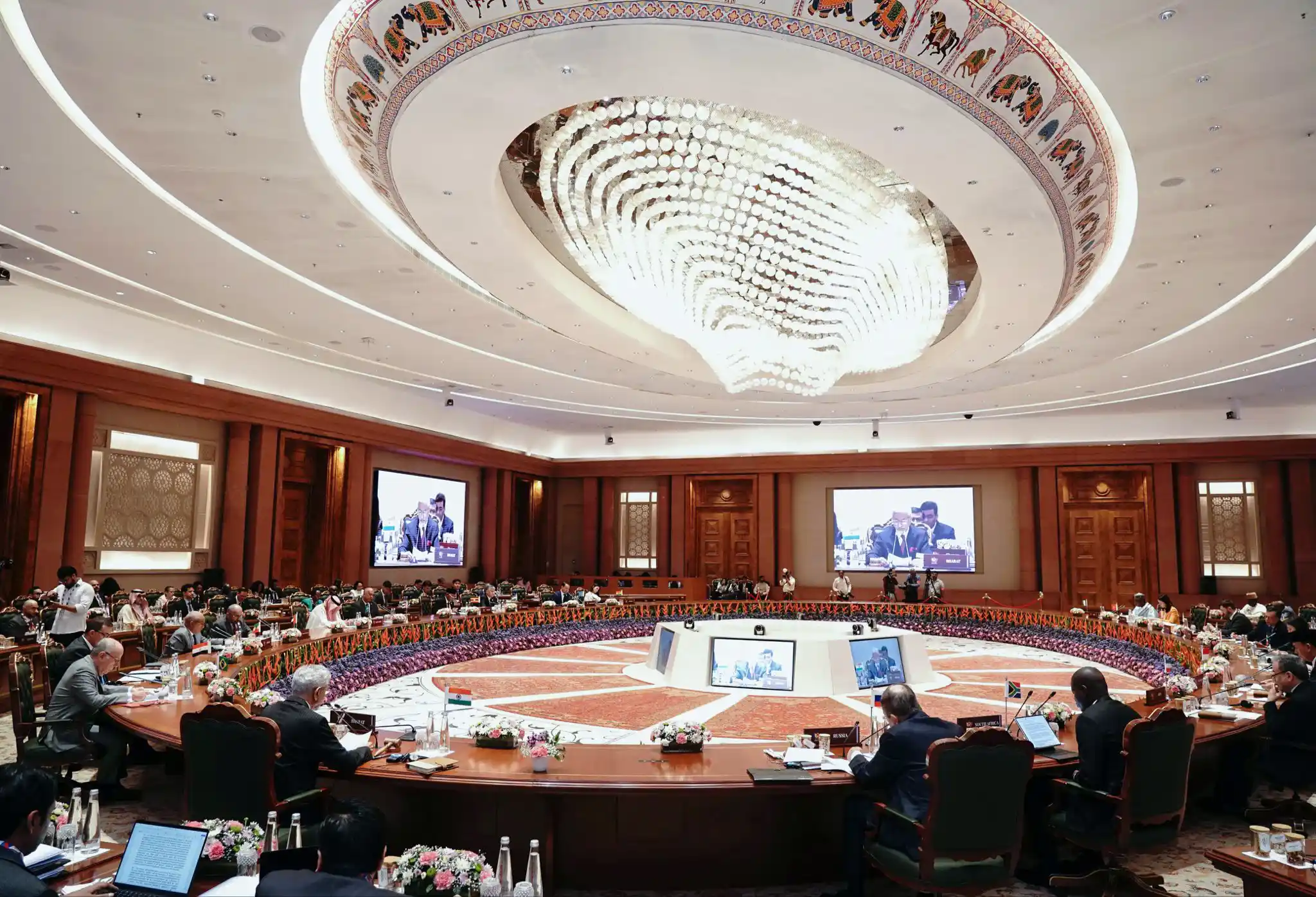
India’s 2026 BRICS chairship arrives at a fraught moment for global governance. War, debt distress, disrupted supply chains, mounting climate impacts, and frayed great‑power trust have weakened traditional multilateral responses. Against that backdrop, New Delhi has framed its chairship around resilience, innovation, cooperation, and sustainability — themes reinforced at the May 2026 BRICS Foreign Ministers’ Meeting in New Delhi. Far from a routine rotation, India’s term is a strategic opportunity to recast an expanded BRICS as a practical vehicle for development and institutional reform, rather than a rhetorical counter‑weight to the West.
A test of diplomatic range
Hosting BRICS tests India’s diplomatic agility. The grouping includes powers with divergent interests and threat perceptions, most notably China and Russia. India must demonstrate it can engage these actors without ceding strategic autonomy or diluting partnerships with the United States, Europe, Japan, and key Indo‑Pacific allies. That balancing act is central to Indian foreign policy: influence through issue‑based coalitions and convening authority rather than binding bloc alignment.
The chairship also confers agenda‑setting power. By prioritizing resilient supply chains, digital cooperation, sustainable development, and development finance, India can steer BRICS away from being defined primarily by anti‑Western rhetoric. The grouping’s credibility will depend on practical, implementable initiatives that alleviate the everyday economic and developmental pressures member states face — not on grand declarations alone.
Consolidating leadership in the Global South
India has been cultivating a leadership narrative within the Global South since its G20 presidency, focusing on debt relief, food security, climate equity, and multilateral reform. BRICS amplifies that role by providing a multilateral platform where these priorities already find sympathetic partners. Chairship gives New Delhi a megaphone to push for a more representative international order while offering tangible cooperation that benefits lower‑income members.
India’s advantage is reputational: it is perceived by many members as a reform‑oriented actor that values institutional flexibility and development outcomes over ideological posturing. That positions New Delhi to manage the coherence problems an enlarged BRICS now faces. More members increase political weight but also bring more diverse priorities; India’s task is to focus the group on mutual, technocratic goals where consensus is feasible.
A pragmatic agenda for coherence
A development‑first agenda can preserve internal cohesion. Practical areas where BRICS can generate near‑term wins include food systems resilience, public health cooperation, disaster response, digital and technology partnerships, and energy transition measures. These domains allow countries with different geopolitical stances to collaborate on shared vulnerabilities, building trust through delivery.
There is also a financial dimension. The New Development Bank remains BRICS’ most tangible institutional achievement. Recent reporting on interest in rupee‑denominated borrowing and other localized financing mechanisms points to an opportunity: India’s chairship could deepen efforts to diversify BRICS‑related finance and root projects in domestic capital markets. Such moves would support infrastructure, climate adaptation, and social development projects across member states, offering a credible alternative financing pathway that complements existing institutions.
Moderating geopolitical interpretations
BRICS is ambiguously read: supporters see it as correcting Western overrepresentation in global governance; critics fear it could harden into a calibrated geopolitical counter‑bloc. India’s strategic value lies in its moderating posture. New Delhi is unlikely to endorse transforming BRICS into an overtly anti‑Western alliance; instead it advocates systematic reform of the United Nations, the international financial architecture, and multilateral institutions to reflect a genuinely multipolar world.
This distinction matters. India seeks influence without sacrificing credibility — assertive but measured. By centering the chairship on cooperation and resilience, New Delhi aims to keep BRICS a forum for negotiated multipolarity rather than geopolitical disruption, preserving room for engagement with a wide range of partners.
Constraints and realistic expectations
Despite the opportunity, meaningful gains are not guaranteed. Persistent Sino‑Indian tensions, Russia’s global posture, and the heterogeneity introduced by expansion complicate consensus on strategic and economic questions. India’s chairship will be judged less by rhetorical framing and more by whether it can convert visibility into concrete outcomes.
Realistic benchmarks for success would include:
- New Development Bank outputs: clearer project pipelines with measurable timelines, increased lending in local currencies (including rupee instruments), and pilot projects for climate adaptation and infrastructure.
- Supply‑chain resilience: a BRICS roadmap with pilot initiatives in essential commodities, joint logistics or corridor development, and coordinated approaches to critical minerals and agricultural inputs.
- Digital and technology cooperation: interoperable standards, joint R&D funds, data‑sharing pilots for health and disaster response, and capacity‑building initiatives for digital infrastructure.
- Climate and development commitments: measurable finance flows and technical support packages tailored to vulnerable BRICS members, with transparent monitoring.
If New Delhi can secure progress on these fronts, the chairship will be remembered as a stabilizing, purpose‑driven phase for BRICS. Incremental, operational gains would demonstrate that expansion need not produce incoherence; instead, it could yield a grouping with greater political weight and pragmatic utility.
Why this matters beyond BRICS
The stakes extend beyond the five letters. If India uses the chairship to produce tangible, replicable outcomes, it strengthens its claim as a convening power of the Global South and a credible voice for institutional reform. For the broader international system, a functional BRICS that pursues development‑first cooperation would offer complementary channels of finance, technology, and governance reform — useful in a world where existing institutions struggle to respond to transnational challenges.
India’s 2026 BRICS chairship is therefore a moment of choice: it can either amplify geopolitical polarization or model a negotiated, delivery‑oriented multipolarity. New Delhi’s emphasis on resilience, innovation, and cooperation suggests a preference for the latter. The test will be converting high‑level frameworks into projects, finance, and measurable benefits — the concrete proof that BRICS can be both influential and constructive.