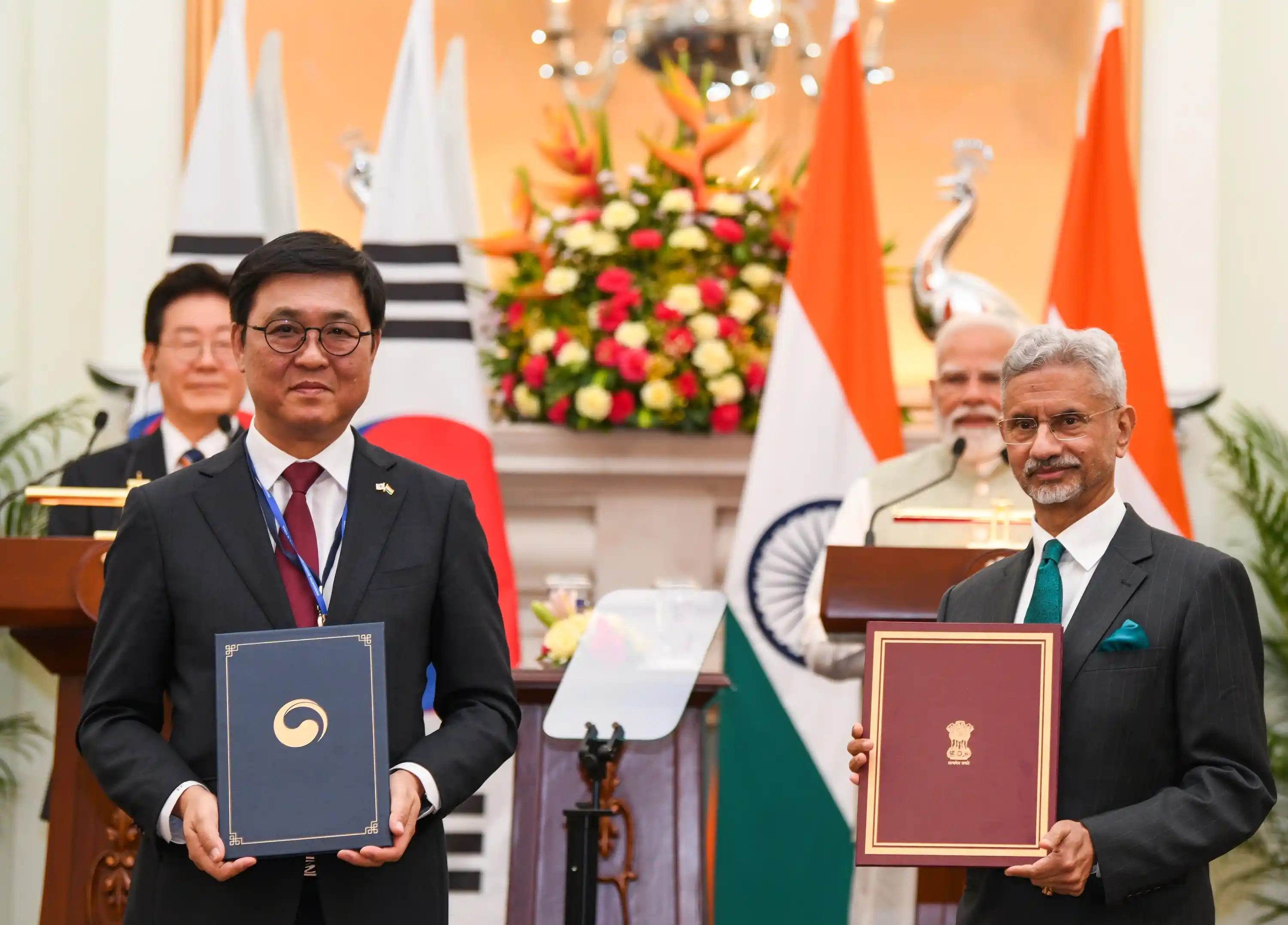
South Korea’s President Lee Jae‑myung’s first state visit to India marks a decisive recalibration of the Indo‑Korean partnership, elevating it from a sturdy but uneven economic partnership into a high‑stakes, technology‑driven strategic alliance. Anchored by a joint pledge to nearly double bilateral trade to 50 billion dollars by 2030, the visit signals that both New Delhi and Seoul now see each other as indispensable nodes in their respective strategies to de‑risk supply chains, diversify away from over‑reliance on China, and consolidate influence in the Indo‑Pacific and the broader Global South.
A “strategic reboot” in New Delhi
Lee’s visit is being framed in Seoul as a “strategic reboot” of a relationship that, despite formal designation as a “Special Strategic Partnership” since 2015, had not fully matured in terms of depth or symmetry. A key marker of this intent is the scale of the Korean business delegation—over 150–200 executives from Samsung, Hyundai, SK Group, LG and other major conglomerates—showing that the visit is as much about economic security as it is about diplomacy. For India, the message is clear: South Korea is not just a cultural and trade partner but a core industrial and technological ally in the quest to build a “Microchip India” and expand its shipbuilding and defence‑industrial base.
The timing is also highly intentional. Lee’s itinerary slots India between an early‑year visit to China and a summit with Japan, underscoring that Seoul now views New Delhi as part of a tripod of major Asian anchors—China for markets, Japan for technology and finance, and India for manufacturing depth, geopolitical heft, and Global South credibility. In an era of war‑driven disruptions in the Middle East and uncertainty over traditional maritime corridors, both countries are repositioning their ties as a hedge against systemic shocks, labour shortages, and the weaponisation of supply chains.
Economic ambitions: from 27 to 50 billion
The most visible outcome of the visit is the roadmap to lift bilateral trade from roughly 27 billion dollars to 50 billion dollars by 2030. This is not merely a symbolic target; it is tied to concrete mechanisms such as the acceleration of the Comprehensive Economic Partnership Agreement (CEPA) upgrade, the launch of an India–Korea Financial Forum, and the establishment of an Industrial Cooperation Committee and a dedicated “Economic Security Dialogue.” These structures are designed to treat trade and investment not as low‑politics transactions but as instruments of national resilience, covering critical sectors such as semiconductors, AI, advanced manufacturing, and green energy.
대한민국과 인도는 신뢰와 우의를 바탕으로 번영하는 미래를 함께 열어갈 것입니다.
— 이재명 (@Jaemyung_Lee) April 20, 2026
모디 총리님의 환대에 감사드리며, 총리님의 국빈방한을 손꼽아 기다리겠습니다. https://t.co/SBtTejpUmN
A particularly telling element is the planned creation of Korean‑style industrial townships in India, which would replicate clusters of Korean firms in electronics, batteries, and heavy engineering. For India, such enclaves are a means to compress technology transfer timelines and plug into global value chains at higher tiers, while for South Korea they offer a politically stable, large‑market alternative to China‑centric assembly bases. In parallel, India’s push for semiconductor “back‑end” operations—testing, packaging, and assembly—has found a willing partner in Korea, whose firms already anchor the high‑end segment of the global chip ecosystem.
Technology, security, and supply‑chain politics
Beyond trade figures, the visit crystallises a convergence on technology and security. Delegation‑level talks in New Delhi focused on shipbuilding, artificial intelligence, semiconductors, and critical technologies, underscoring how “economic security” and “national security” are now treated as two sides of the same coin. In the shipbuilding domain, India is pushing to become a major regional ship‑repair and manufacturing hub, while Korea, the world’s largest commercial shipbuilder, brings scale, design capability, and global networks. A joint thrust on this sector could translate into Korean‑designed vessels constructed or retrofitted in Indian yards, dovetailing with India’s broader maritime‑security ambitions in the Indo‑Pacific.
On advanced technologies, both sides are mindful of the limits of open‑source goodwill. The creation of an Economic Security Dialogue hints at ongoing coordination on export controls, investment screening, and protection of dual‑use technologies, especially in areas such as AI‑driven defence systems, space‑based infrastructure, and undersea connectivity. Here, India’s expanding “tech‑diplo” toolkit—foreign‑direct‑investment curbs in critical sectors, tighter cybersecurity norms, and export‑control frameworks—finds a natural counterpart in Seoul’s own tightening of foreign‑investment regulations and technology‑transfer safeguards.
India as Seoul’s bridge to the Global South
For South Korea, one of the most under‑discussed but consequential aspects of the visit is India’s role as a bridge to the Global South. Seoul has adopted the notion of a “Global Focal State,” seeking to position itself as a central node in global governance, technology diffusion, and development finance, yet it still lacks the historical anticolonial credibility and soft‑power networks that India commands in Africa, West Asia, and Southeast Asia. By deepening politico‑economic ties with India, South Korea can piggyback on India’s strategic centrality in forums such as the G20, BRICS Plus, the Indo‑Pacific Economic Framework, and various regional development partnerships.
Indian officials, in turn, have quietly welcomed Korea as a more “pliable” technological partner than the major Western powers, especially on issues such as technology transfer, co‑development, and non‑interventionist norms. New Delhi has long sought to diversify its technological partnerships beyond the United States, Japan, and Europe; Seoul’s willingness to engage on terms that respect India’s developmental priorities and industrial‑policy space makes it an attractive anchor.
Strategic implications for the Indo‑Pacific
Viewed through a broader Indo‑Pacific lens, the Modi–Lee summit reinforces a quiet but steady alignment of two democracies that are neither fully wedded to the U.S. bloc nor reconciled to China‑centric ordering. India’s “multi‑alignment” posture and Korea’s “value‑based but hedging” strategy meet in a shared discomfort with Beijing’s coercive economic statecraft and a mutual interest in keeping key sea lanes, undersea cables, and critical‑mineral routes open. This is visible in their joint emphasis on supply‑chain resilience, maritime industrial cooperation, and green‑energy partnerships, all of which can be repurposed for security‑relevant functions without explicitly invoking deterrence or alliance rhetoric.
At the same time, both sides remain cautious about overstating the strategic component. Publicly, they emphasise “friendship,” “economic cooperation,” and “shared values,” avoiding explicit referencing of China as a counter‑point. This calibrated language allows them to deepen functional ties—on shipbuilding, semiconductors, AI, and finance—while preserving the flexibility to manage their own relationships with Beijing and Washington.
Lee Jae‑myung’s state visit to India is less about a single breakthrough than about institutionalising a new normal: a comprehensive, technology‑anchored partnership that treats trade, industrial policy, and supply‑chain security as joint strategic assets. If India and South Korea can translate the 50‑billion‑dollar target and the slew of new dialogues into sustained project execution, the visit will come to be seen as the moment when their relationship shed its “promising but under‑delivered” image and grew into a genuine Indo‑Pacific anchor for the 2030s.