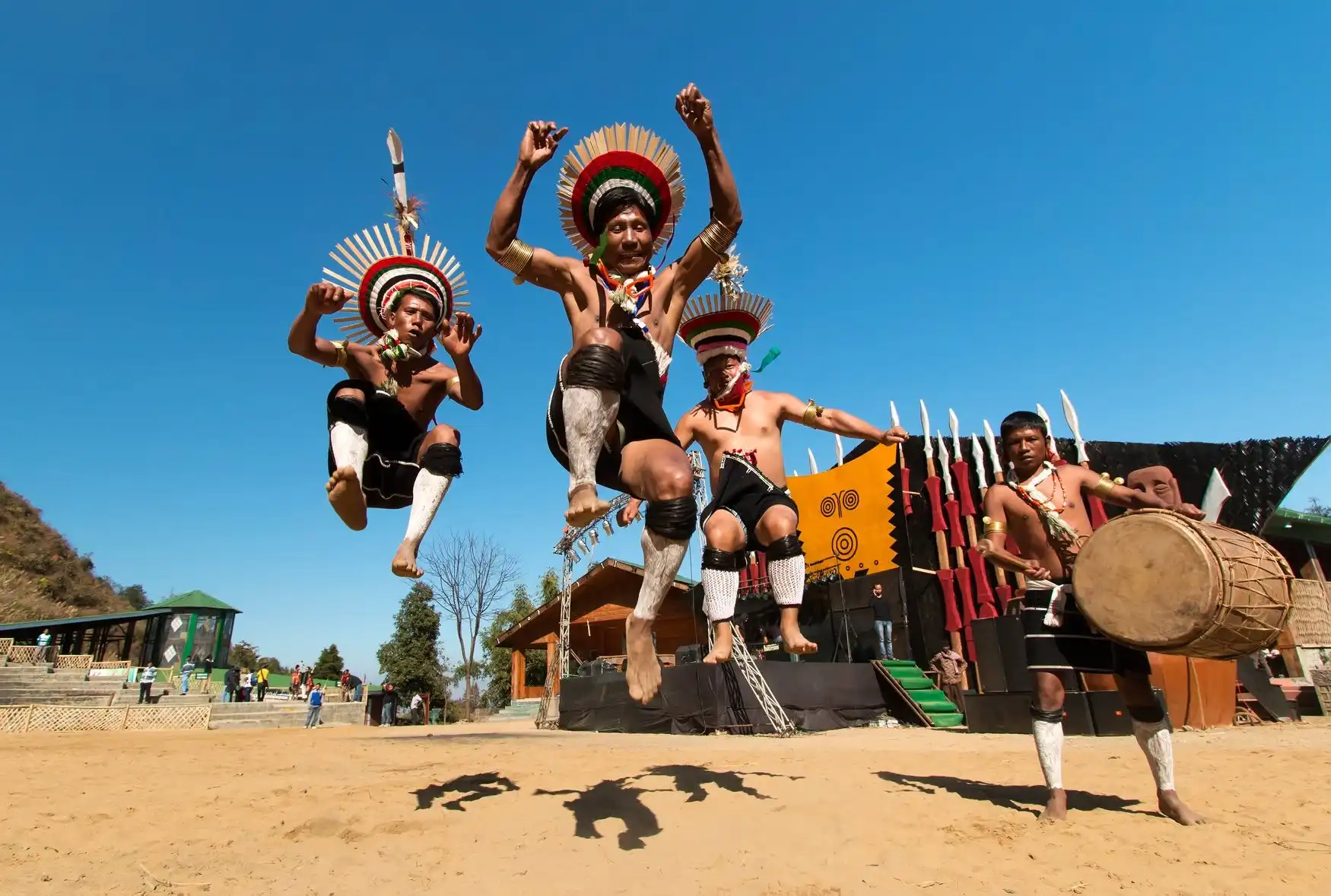
As dusk settles over the terraced ridges of Kisama Heritage Village, twelve kilometers south of Kohima, the rhythm of Nagaland’s annual Hornbill Festival, running from December 1 to 10, undergoes a quiet metamorphosis. Throughout each afternoon of the ten-day gathering, Unity Plaza pulses with the polyphonic chants, feathered headdresses, and percussive footwork of 18 cultural troupes representing the state’s diverse Naga communities. Yet when darkness claims the eastern Himalayan foothills, the gaze shifts upward. Coinciding with the December 9 new moon during the festival’s closing nights, visitors gather beside eight-inch Dobsonian telescopes trained on Saturn’s rings, the Pleiades star cluster, and—earlier in the ten-day run—the rugged terminator of lunar craters. This deliberate pairing—ancestral performance alongside guided dark-sky tourism—captures an emerging paradigm of frontier modernity. Twenty-six years after its 2000 debut, the festival’s 27th edition demonstrates how post-colonial borderlands can cultivate sub-regional economic autonomy without fracturing indigenous identity.
For decades, conventional development economics treated upland frontiers across Northeast India and the broader Global South as extractive peripheries. In this top-down calculus, remote regions were valued primarily for timber, minerals, or hydropower—industries that exported raw wealth while leaving behind ecological scars and social dislocation. Nagaland’s strategic pivot turns that logic inside out. Rather than viewing indigenous heritage as an obstacle to modernization or a static museum curiosity, state planners and tribal communities have re-imagined culture as a dynamic economic engine. Across the December 1–10 calendar, anchoring the festival in value-added cultural services—ranging from the daily showcases of 18 cultural troupes and indigenous sports like Naga wrestling to contemporary music stages, art fairs, and archival exhibitions spanning 1832 to 1947—builds an economy rooted in living knowledge rather than resource depletion. Every woven shawl displaying clan-specific geometry, bamboo vessel, and folk ballad functions simultaneously as an expression of lineage and a high-margin creative product.
At the heart of this transformation is a high-value, low-footprint business model designed to keep capital circulating within local communities. Dark-sky tourism exemplifies this discipline. Unlike heavy infrastructure projects that carve into fragile mountain ecosystems, astro-tourism monetizes environmental preservation itself: unpolluted early-December winter skies become a premium asset. Through public-private partnerships that pair festival stargazing at Kisama—peaking during the moonless nights of December 8 to 10—with plans to train local youth as astronomy guides and establish permanent observatories across districts, Nagaland is linking scientific curiosity with ecological stewardship. Beyond the ten-day festival window, clear winter nights in Dzukou Valley and atop Japfu Peak extend the tourism calendar, drawing specialized travelers who stay longer, spend deliberately, and tread lightly.
Equally vital is how this cultural infrastructure decentralizes regional income. Historically, tourism revenue in hill states concentrated around capital cities and transit hubs. Today, Nagaland is actively pushing economic dividends outward. Dedicated district extensions—including Hornbill Festival programming in northern Mon from December 8 to 10—bring international and domestic visitors directly to remote artisan clusters and heritage sites. Back at Kisama, each tribe’s traditional morung—the communal dormitory that historically anchored Naga village life—operates throughout the ten days as both an architectural classroom and a direct-to-consumer marketplace. Weavers, woodcarvers, herbalists, homestay hosts, and culinary entrepreneurs capture revenue directly, bypassing extractive middlemen. What emerges is a distributed network of micro-enterprises where cultural fluency translates into household livelihood, easing seasonal pressure on Kohima’s urban infrastructure while multiplying rural touchpoints.
Global cultural tourism carries an ever-present hazard: the flattening of sacred traditions into hollow spectacle for external consumption. Nagaland mitigates this risk by grounding commercial growth in community sovereignty. Customary institutions, tribal bodies, and village councils retain authorship over their narratives, deciding which rituals, oral histories, and art forms are shared across the December 1–10 showcase and on what terms. Reinforced by constitutional protections for Naga customary law and communal land ownership, this governance model ensures that outsiders enter as guests rather than landlords. Rather than diluting tribal distinctiveness, the annual gathering has fostered unprecedented inter-tribal solidarity among communities once separated by rugged topography and colonial-era administrative boundaries, transforming heritage for younger generations from an inherited obligation into an active, appreciating asset.
The implications extend far beyond the Naga Hills. Across the post-colonial Global South—from the Andean highlands and Mekong uplands to sub-Saharan frontiers—peripheral regions confront a familiar false choice: surrender their landscapes to extractive industries or accept chronic economic marginalization. Nagaland’s experiment offers a compelling third path. By proving that intact ecosystems, sovereign tribal institutions, and living cultural traditions are competitive advantages in the global experience economy, the Hornbill model reconciles global market integration with local self-determination. Beneath the pristine December constellations of Kisama, the frontier is no longer a distant margin waiting to be mined—it is a confident center authoring its own modernity.