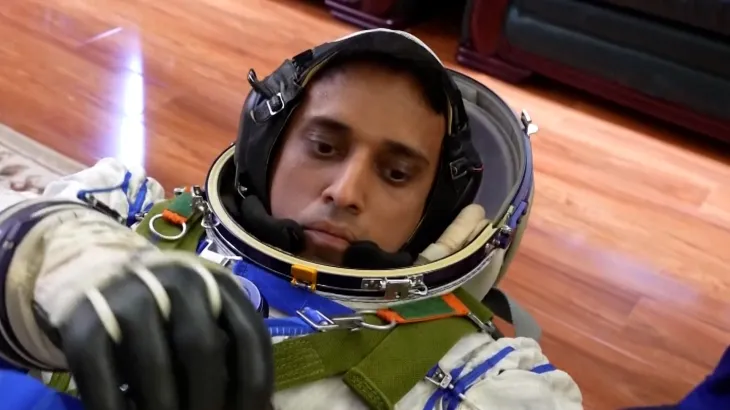
Pakistan has entered the history of human spaceflight with the successful launch of its first astronaut, Wg Cdr Muhammad Zeeshan Ali, aboard China’s Shenzhou-24 spacecraft on 25 November 2026. The 40-year-old Pakistani Air Force pilot travelled alongside two Chinese astronauts aboard a Long March-2F class rocket, bound for China’s Tiangong space station, where he is expected to spend approximately one week conducting scientific experiments. His spaceflight also marks a special importance as Wg Cdr Ali becomes the first foreign astronaut to visit the Chinese space station.[1]
This achievement is undoubtedly a significant moment for Pakistan, particularly at a time when the country faces considerable economic and political difficulties, as well as an international recognition for the professional abilities of the Pakistani military pilots selected for the mission. However, the achievement cannot become a celebration for Pakistan’s space capability prowess, as the country has reached space through China, and they have not independently demonstrated the capability to launch or sustain human spaceflight.
Riding on the Chinese Dragon
The mission follows an astronaut cooperation agreement signed between Pakistan’s Space and Upper Atmosphere Research Commission (SUPARCO) and the China Manned Space Agency (CMSA) in February 2025.[2] Under the agreement, two Pakistani candidates were selected and trained in China, with one eventually chosen for the mission.
Wg Cdr Ali’s role, as the payload specialist for the mission, would require him to undertake scientific experiments, including research involving photosynthetic cyanobacteria, while representing Pakistan’s scientific community. Pakistani universities submitted more than 300 experimental proposals, of which four biotechnology experiments were selected for the mission, focusing on food security and climate change.[3]
Nevertheless, the critical distinction between being part of the mission and independent capability needs careful understanding. The spacecraft, launch vehicle, launch facility, astronaut training infrastructure and mission operations are all Chinese. Pakistan’s limited capability stops at providing two professionally well trained Air Force pilots to be trained specifically for the mission, including language training. Therefore, Wg Cdr Ali’s successful participation demonstrates Pakistan’s ability to prepare a qualified individual and contribute scientific payloads, but not an indigenous human spaceflight ecosystem.
Can Pakistan sustain the momentum?
The most relevant question is related to the financial commitments required for such ambitious projects. Pakistan’s approved project cost for its Manned Space Mission stands at approximately PKR 2.18 billion. Budget documents provided for an allocation of PKR 600 million in 2025–26, while a further PKR 1.29 billion was proposed for 2026–27. The total budget allocation for SUPARCO was approximately PKR 5.4 billion for 2025-2026 which is equivalent to $19.55 million.[4] These figures represent the broader Pakistani space programme expenditure, not a disclosed payment to China for Wg Cdr Ali’s individual flight. Neither government has publicly established the precise amount Pakistan paid to China for the launch, training and associated services.[5]
Therefore, given the troubled national economic condition, it raises question related to whether Pakistan can guarantee sustained funds for such human spaceflights in the future. Given Pakistan’s fiscal constraints, sustained future human spaceflight is unlikely without long-term Chinese assistance for a very long time.
Pakistan’s space capabilities – A Reality
Established in 1961, SUPARCO has developed capabilities in satellite communications, remote sensing, satellite applications and space research. SUPARCO’s published inventory lists seven Earth-observation satellites and two communication satellites which include PRSS-1, PakTES-1A, the EO series, PakSAT-1R and PakSAT-MM1.[6] Pakistan’s National Space Programme 2047 envisages ambitious greater indigenous capability in satellite development, launch vehicles and space infrastructure. The agency also reports the development of Synthetic-Aperture Radar (SAR) and hyperspectral imaging capabilities. The country has once again partnered with China in its Chang’E 8 mission scheduled for 2028 to send its Lunar Rover to the South Pole of the Earth’s Moon.[7] However, these capabilities only exhibit the nascent stage at which the country’s space programme is currently in and the snail pace at which the organisation has grown over its six decades of its existence.
The significant limitation is Pakistan’s inability to launch capabilities as they do not have any space launch vehicle existing. Its satellites have relied on foreign launch providers, predominantly China. The country has historically conducted atmospheric research using sounding rockets, beginning with Rehbar-I in 1962 and the country has wide experience with missile technology.[8] However, these experiences have not culminated in the development of a space launch programme which also demands sustained massive budget allocations.
On the contrary, India’s space agency, Indian Space Research Organisation (ISRO) which also had humble beginnings since 1969 and was even mocked by Westerners for using animal-propelled carts to transport satellite parts during its early days has grown into an undeniable global player in its space prowess. Its unmatched success rate for launch capabilities with its PSLV & GSLV launch vehicles, has made ISRO one of the most sorted after by foreign countries’ customers for cheap satellite launch and deployment.
Pakistan’s first human space flight in 2026 can be loosely compared to India’s first space flight in 1984 by Wg Cdr Rakesh Sharma, the Indian Air Force pilot who became the first Indian in space by flying aboard the Soviet Soyuz T-11 mission. Similar to Wg Cdr Ali’s current mission, Wg Cdr Rakesh Sharma also spent 7 days 21 hours in space. Although both countries’ first human space flights were through another country’s space programme, the difference in time period between the two events is almost 42 years. This highlights how far behind the Pakistani space programme is crawling compared to the prowess of Indian capabilities.
China-Pakistan Space Cooperation and its Strategic Implications
China has supported Pakistan’s satellite programme for decades, while cooperation has expanded into navigation, the current human spaceflight and the future lunar exploration. By successfully including and welcoming a Pakistani astronaut into its space station, Beijing tries to position Tiangong as an international alternative for space cooperation for foreign countries, particularly when China remains excluded from direct NASA-led International Space Station cooperation. Pakistan, meanwhile, gains exposure and access to advanced space infrastructure without having to develop the entire technological ecosystem independently.
On the Indian front, the country is developing its own human-rated LVM3 launch vehicle, crew module, life-support systems and crew escape mechanisms, with ISRO coordinating the development and testing of critical technologies.[9] Pakistan’s participation in a Chinese human space flight mission is neither a threat nor does alter India’s technological position or its programme trajectory.
Nevertheless, the wider strategic implications should not be overlooked. China’s willingness to accommodate a Pakistani astronaut for human space flight demonstrates its intent to expand its space partnerships with prospective foreign countries and strengthen its strategic presence at the global stage. This has opened a new window of opportunities for many developing and underdeveloped countries to establish deeper collaboration with China on the Space front. The Pakistan’s success must be credited to its diplomatic ability for being able to convince the Chinese to include their personal as the first foreign astronaut in the Chinese space station.
While Pakistan’s first astronaut deserves his due recognition, the achievement should not be mistaken for the country’s technological independence. As a standalone event, it only adds value to the optics and narratives of Pakistani capabilities. The real question is how much tangible experience SUPARCO has gained from this human space flight mission which could in turn be used to develop its indigenous research, satellite manufacturing, launch capability and a sustainable national space programme. For now, Pakistan has chosen the easy path of successfully sending one of its citizens to space aboard a Chinese spacecraft. Next, the country’s space agency SUPARCA faces the difficult journey of taking Pakistan to space with independent capabilities and technologies.
[1] “China’s Shenzhou-24 space flight takes off with Pakistani national as first foreign astronaut”, Reuters, 25 November 2026. https://www.reuters.com/science/chinas-shenzhou-24-space-flight-takes-off-with-pakistani-national-first-foreign-2026-11-25/?, accessed on 25 Nov 2026.
[2] Jack C, “Pakistani Astronaut to be Tiangong’s First International Visitor”, China in Space, 28 February 2026. https://www.china-in-space.com/p/pakistani-astronaut-to-be-tiangongs, accessed on 25 Nov 2026.
[3] Saad Sayeed & Ariba Shahid, “ China’s Space Diplomacy Lifts Pakistani Astronaut toward orbit”, Reuters, 28 Sep 2026. https://www.reuters.com/science/chinas-space-diplomacy-lifts-pakistani-astronaut-toward-orbit-2026-09-28/?, accessed on 25 Nov 2026.
[4] “Public Sector Development Programme 2025-2026”, Planning Commission Ministry of Planning, Development and Special Initiatives, Government of Pakistan, November 2025, https://www.pc.gov.pk/uploads/archives/PSDP_2025-26_Final.pdf, accessed on 25 Nov 2026.
[5] News Desk, “Space Mission Starts at 8:18 am today”, International The News Pakistan, https://www.thenews.pk/print/1450716-space-mission-starts-at-8-18am-today, accessed on 25 Nov 2026.
[6] Official website of Pakistan Space and Upper Atmosphere Research Commission, Government of Pakistan, https://www.suparco.gov.pk/major-programmes-satellite-programs/, accessed on 25 Nov 2026.
[7] Official website of Pakistan Space and Upper Atmosphere Research Commission, Government of Pakistan, https://www.suparco.gov.pk/major-programmes/lunar-rover-program.html, accessed on 25 Nov 2026.
[8] Abdul Ghafoor Babar and Dr Zahid Mehmood, “Pakistan’s Missing Indigenous Satellite Launch Vehicle and the Search for Orbital Sovereignty”, Perspectives in Social Sciences, Vol. 5, No. 11(II).
[9] Official website of Indian Space Research Organisation (ISRO), “Gaganyaan”, https://www.isro.gov.in/ISRO_EN/Gaganyaan.html, accessed on 25 Nov 2026.