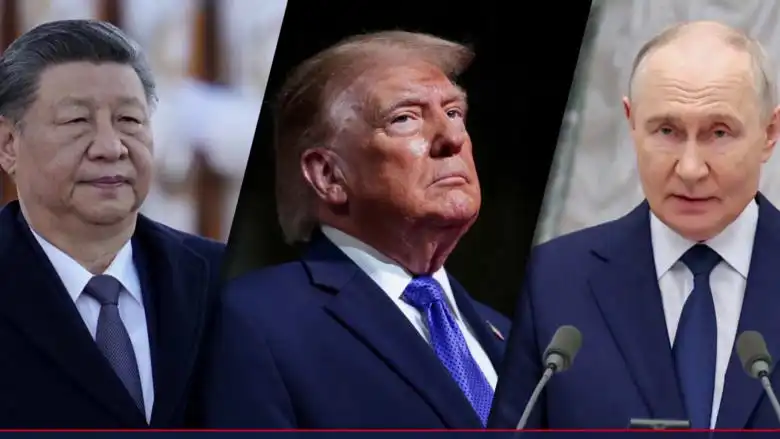
For the first time, the US, China, and Russia are holding a trilateral meeting in China on 19th November. This meeting of the big powers, held against the backdrop of ongoing conflicts, especially the Iran conflict, and increasing strategic competition aimed at influencing the balance of power in the global order, is significant. The big power meeting is just another show of the balance of power or just another attempt to manage this power politics.
The Rising Temperature
There have been various instances where big powers rush to secure strategic stability through diplomatic means when they anticipate a heightened risk of conflict or intense strategic competition, opening doors for new areas of conflict. Such off-ramping attempts were quite glaring in the Cold War era. The 1961 Vienna Summit between the USSR and the US, where President John F. Kennedy and Premier Nikita Khrushchev met against the backdrop of the Berlin Crisis and the failed Bay of Pigs invasion, sought an off-ramp, or at least a way to manage the threat of escalating conflict. Similarly, in 1986, Cold War arch-rivals met again to manage another situation of escalating conflict. President Ronald Reagan and General Secretary Mikhail Gorbachev convened at the height of Reagan's Strategic Defence Initiative (SDI) push and Euro-missile deployments. Decades back, multiple big powers met against the backdrop of North Korea’s withdrawal from the Nuclear Non-Proliferation Treaty (NPT) and its resumption of plutonium reprocessing. This sparked fears of a nuclear arms race in Northeast Asia, threatening the balance of power at regional and global levels. A Six-party talk was convened, with major powers (Russia, China, US) participating alongside other regional powers.
A multilateral framework hosted by Beijing was worked upon in the early 2000s, and years of talks produced the 2005 Joint Statement, in which North Korea agreed to abandon its nuclear programmes in exchange for security assurances and economic aid, before ultimately collapsing in 2009. However, these big-power meetings aim not only to manage tensions but also to draw lines of cooperation and common ground, driven by a strong sense of balancing and transactionalism to prevent a zero-sum game. Negotiating the Joint Comprehensive Plan of Action (JCPOA) against the backdrop of rising tensions between the US, Russia, and China, where Russia annexed Crimea, threatening NATO and the European security architecture, and China engaged in aggressive manoeuvring in the South China Sea.
Despite simmering tensions, big powers maintained a united front to manage Iranian uranium enrichment, which threatened to trigger either a pre-emptive U.S-Israeli military strike or drive the Middle East into war, leading to a global oil shock. Despite deep divisions, Russia agreed to physically ship Iran's enriched uranium stockpile out of the country. At the same time, China, as Iran’s top oil buyer, used its economic leverage to press Tehran towards concessions, leading to the finalisation of the JCPOA in 2015, which placed strict, verifiable limits on Iran’s nuclear program in exchange for sanctions relief. Similarly, major powers again set aside their strategic divergences and negotiated to prevent a zero-sum outcome or a complete loss of the balance of power. Russia and China supported US sanctions against North Korea through the United Nations Security Council.
The reason for supporting sanctions by voting alongside the US against North Korea in the UNSC was a strategic move to contain US influence in Northeast Asia. Both Russia and China viewed North Korea as a vital strategic buffer and sought to use multilateral diplomacy to block unilateral U.S. action on their borders. The most notable cooperation occurred in 2013, after chemical attacks in Syria authorised by the then government of Bashar Al Assad. This was to ensure the US did not initiate a full military strike against Syria, which would destabilise Bashar Al Assad’s regime, backed by Russia, and give the US a further influential grip over the Levant region.
The big powers, the US, Russia, and China, came together, with Russia offering a diplomatic off-ramp that saved Washington from launching an unpopular military intervention while preserving Moscow's Syrian ally. China supported the framework financially and diplomatically, providing maritime escorts to help transport the chemical agents for destruction. This led Syria to accede to the Chemical Weapons Convention.
The Guard Rail Diplomacy
The big powers meeting against the backdrop of heightened tension and strategic competition, seeking strategic cooperation and conflict management, is a simple demonstration of guard rail diplomacy, where big powers, instead of resolving deep ideological or territorial disputes, attempt to stabilise and manage the game of power. Guard rail diplomacy is driven by two strategic considerations. First, to manage the balance of power, preventing a zero-sum game or any power from gaining an undue strategic advantage that would influence the spheres of influence of competing powers. Second, escalation control to manage active conflicts from spiralling out of control. The instances discussed above demonstrate that major powers converge either to control escalation or to prevent another power from intervening in another power’s sphere of influence through diplomatic means. These diplomatic efforts aim to set the stage for crisis communication, creating room for negotiating competing interests to reach a point of stability in competition.
The China Meet
The upcoming China meeting will be the first time, at least in recent times, that the leadership of US-China-Russia will meet in a trilateral/G-3 setup. This meeting will take place against the backdrop of intensifying strategic competition on the economic and tech fronts, compounded by ongoing conflicts, especially the Iran conflict, which is on the brink of resurfacing. The priorities of the talks would focus on finding ways to control escalation and maintain stability in strategic competition while managing the balance of power. As per reports, arms/nuclear control (New START dialogue), AI governance, and supply chain stabilisation are likely to be key focus areas. The intent and objectives of the talks on the sidelines of the 33rd APEC Economic Leaders ' Meeting in Shenzhen, China indicate that no big power can afford an unchecked or zero-sum game mentality in the present evolving global scenario where both conflict and competition are set to become riskier and more intense; therefore, a strategic opportunity must be utilised by big powers to find the means of crisis control, communication and management to prevent mindless gambles from fracturing global order stability.