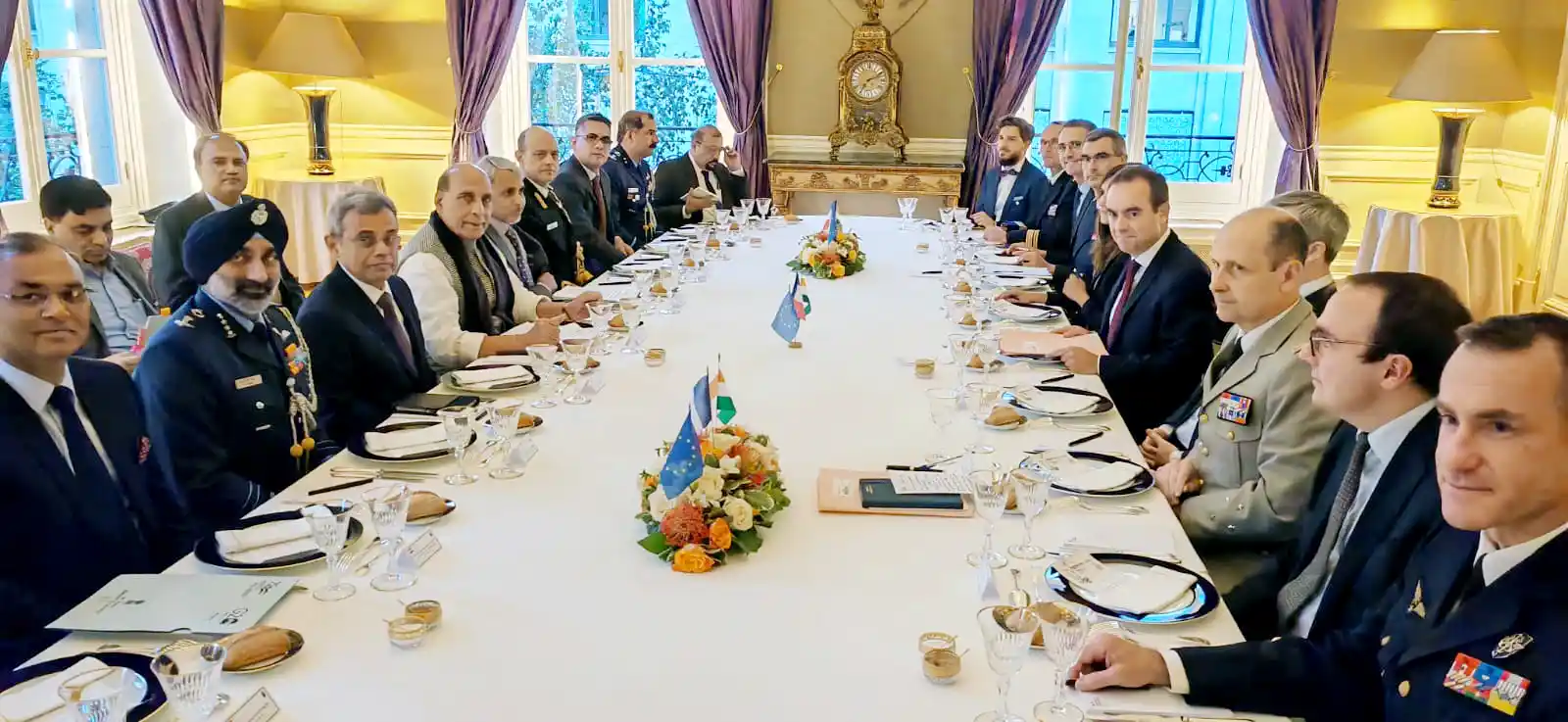
On November 10, inside the gilded rooms of the French Foreign Ministry in Paris, Indian Foreign Secretary Vikram Misri and his French counterpart Martin Briens quietly altered the architecture of modern technological diplomacy. The two senior diplomats sat down to cochair back to back sessions of the third Strategic Space Dialogue and the inaugural Economic Security and Critical Technologies Dialogue. While global television networks remained fixated on post election political drama in Washington and escalating trade wars across the Pacific, New Delhi and Paris chose to build a practical shield against global supply chain shocks. Conceived during Prime Minister Narendra Modi’s visit to France in June 2026, this new bilateral mechanism brings space assets, critical minerals, cybersecurity, and high technology manufacturing under a single strategic roof.
For decades, the relationship between India and France was viewed through the narrow prism of military hardware. From the delivery of 36 Rafale fighter aircraft in 2022 and the commissioning of the sixth Scorpene submarine in January 2025 to the recent contract for 26 Rafale Marine jets, Paris has long stood as India’s second largest defence supplier. Yet military hardware alone cannot guarantee national security when the invisible components that power modern economies remain vulnerable to foreign choke points. A fighter jet or a power grid is only as sovereign as the silicon chips, rare earth magnets, and satellite networks that keep it running. By pairing orbital security directly with terrestrial supply chains in Paris this week, both nations recognized that economic resilience is the true foundation of military strength.
The commercial numbers behind this pivot tell a compelling story of steady integration. Bilateral trade between India and France has more than doubled over the past decade to reach 13.6 billion euros, or roughly 15 billion dollars, in the 2025 to 2026 fiscal year. Within the European Union, France now ranks as India’s third largest trading partner after the Netherlands and Germany, with Indian merchandise exports accounting for 6.1 billion euros and bilateral services trade crossing 8 billion euros. On the ground, more than 700 French companies currently operate across India, employing nearly 450,000 Indian workers and driving cumulative foreign direct investment equity inflows past 12.25 billion dollars since the turn of the century. Both governments have already activated a formal mechanism to double this trade volume again within the next five years.
What elevates the Paris talks above routine trade meetings is the deliberate merger of space capabilities with industrial policy. Outer space is no longer a peaceful scientific sanctuary. It is a contested commercial corridor that underpins everything from banking encryption to artificial intelligence. Over the past year, three Indian space companies signed contracts with a leading French manufacturer to acquire advanced electric propulsion systems, while private firms from both nations Inked an agreement to deploy optical ground stations for tracking orbital debris and hostile satellites. By prioritizing low Earth orbit satellite constellations alongside the joint TRISHNA climate monitoring mission, New Delhi and Paris are ensuring their digital communications cannot be switched off by rival powers during a geopolitical crisis.
This technological convergence is already visible in traditional industries. The inauguration of the Tata and Airbus final assembly line for H125 helicopters gave India its first private sector rotorcraft manufacturing facility, moving the partnership from simple buyer and seller transactions toward genuine codevelopment. In the energy sector, French utility giant EDF has deployed over 5 million smart meters across India and signed agreements earlier this year with NTPC to explore Small Modular Reactors, supporting New Delhi’s goal of reaching 100 gigawatts of nuclear power capacity by 2047.
The deeper brilliance of the Paris dialogue lies in its political philosophy. Today, developing and middle powers face an uncomfortable choice between an unpredictable American tariff regime that demands strict camp loyalty and a dominant Chinese manufacturing ecosystem that uses critical mineral export controls as diplomatic weapons. France and India share a historic refusal to be absorbed into anyone else’s alliance system, an ethos rooted in their 1998 strategic partnership. Neither nation wants its domestic factories or digital networks held hostage by policy swings in Washington or Beijing. By locking arms on cybersecurity, critical minerals, and orbital tracking, New Delhi and Paris are constructing an independent third pole of technological sovereignty, proving that strategic autonomy is strongest when built with an equal partner.