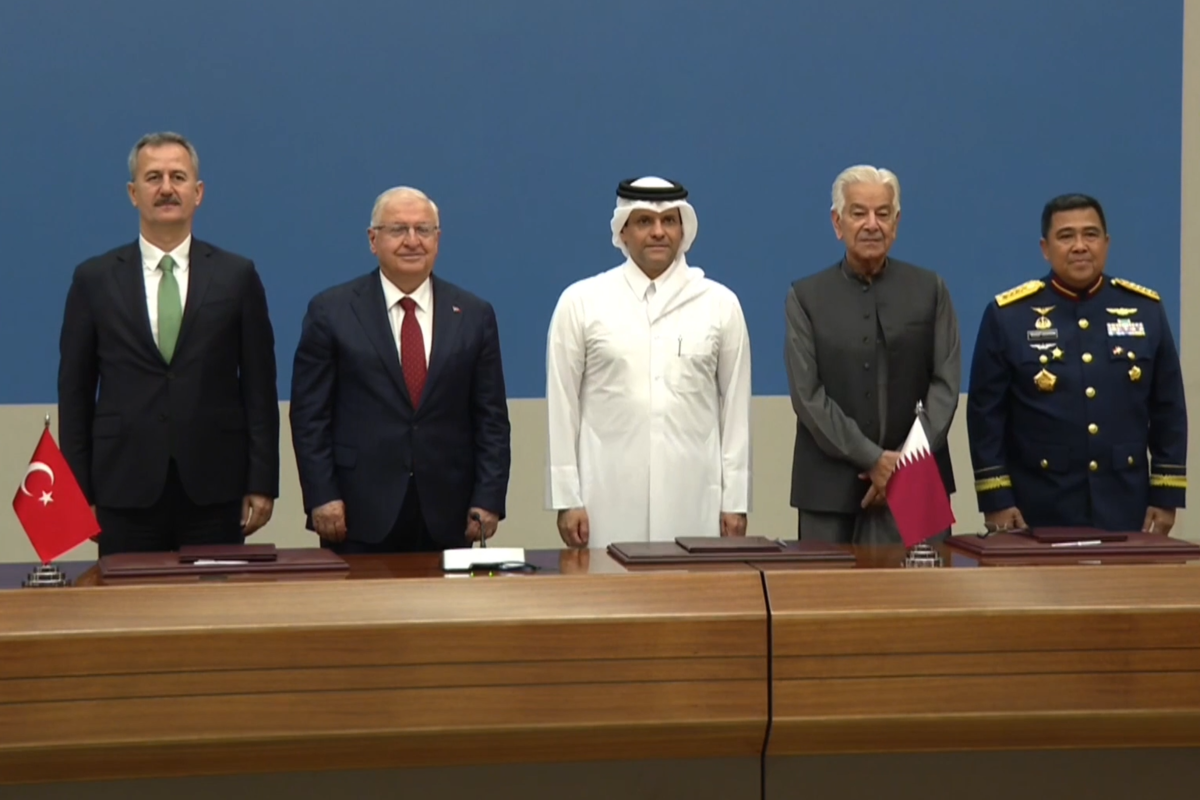
On 21 October 2026, the defence ministers of Türkiye, Pakistan, Qatar and Indonesia signed the Badr Memorandum of Understanding in Doha. Unlike the Mecca Joint Defence Agreement of August 2026 (involving Saudi Arabia, Pakistan and Türkiye), which contains a collective-defence clause treating an attack on one as an attack on all, the Badr MoU contains no mutual-defence pledge. It is framed as industrial policy: joint production, research and development, technology transfer, technical training and the creation of more resilient defence supply chains. The arrangement is open to other “friendly” countries under criteria agreed by the four signatories. It establishes an Executive Board to identify projects and a Strategic Board to approve them and set timelines.
For India, the MoU is not an immediate military alliance directed against New Delhi. Its significance lies in the longer-term enhancement of Pakistan’s defence-industrial capacity, the deepening of Türkiye’s already close military relationship with Islamabad, and the involvement of Indonesia—a country with which India has recently expanded defence ties. These developments sit within a broader pattern in which Türkiye and Pakistan are constructing an interconnected network of defence arrangements stretching from the Gulf to Southeast Asia, emphasising deterrence by denial through arsenals and supply chains rather than automatic intervention in each other’s wars.
Pakistan remains heavily dependent on Chinese systems for major platforms. The Badr framework offers a partial diversification path. Türkiye brings a maturing indigenous defence ecosystem—Bayraktar drones, ASELSAN electronics, naval platforms such as the MILGEM-derived Babur-class corvettes already being co-produced with Pakistan, and advanced projects including the KAAN fighter. Qatar contributes capital and demand (it has been among the world’s largest arms importers). Indonesia supplies manufacturing capacity, a growing defence budget and a large potential market. Existing bilateral projects—Turkish-Indonesian co-development of the Kaplan/Harimau medium tank, Indonesian orders for KAAN fighters with local content, and Pakistani shipbuilding links with Türkiye—can now be coordinated more systematically.
Over time, this could improve Pakistan’s ability to produce, maintain and upgrade systems, reduce single-source vulnerabilities and expand export potential. Pakistani officials have described the arrangement as contributing to self-reliance and regional stability. For Indian planners, the practical questions are which technologies move, at what pace, and whether joint production eventually includes more advanced sensors, munitions or unmanned systems that narrow conventional asymmetries. Past Turkish support to Pakistan during the May 2025 short war has already illustrated the value of such partnerships in crisis.
Indonesia’s participation is the element that most directly intersects with Indian interests. In July 2026, during Prime Minister Narendra Modi’s visit to Jakarta, the two countries advanced a major defence package including BrahMos supersonic cruise missiles and Astra beyond-visual-range air-to-air missiles, estimated at around $630 million, alongside broader maritime security and industrial cooperation. Indonesia is also a key partner in India’s Act East policy and Indo-Pacific maritime strategy, with shared concerns about regional stability and connectivity projects such as the Sabang port development.
Indonesian officials have presented the Badr MoU as a means to strengthen national defence production by partnering with countries that have complementary strengths. Analysts note that Indonesia has long pursued multi-alignment in defence procurement—working with Türkiye on fighters and tanks, with Western suppliers, and now deepening ties with India on missiles. The risk most frequently discussed in Indian commentary is not the automatic cancellation of existing contracts but the possibility of sensitive technical information or operational insights migrating through industrial cooperation channels. Indian experts, including former BrahMos leadership, have stated that export agreements are structured with safeguards limiting technology transfer to user documentation rather than design data. Still, closer integration of supply chains involving Pakistan and Türkiye warrants close monitoring.
India’s response so far has been to double down on the bilateral relationship rather than treat Indonesia’s multi-alignment as zero-sum. Continued high-level engagement, co-production opportunities and maritime exercises remain the most effective ways to preserve India’s position as a preferred partner.
Qatar’s role is primarily financial and industrial. India maintains substantial energy, trade and people-to-people ties with Qatar; any disruption would carry economic costs. The MoU’s emphasis on meeting the needs of “allied and friendly nations” and reducing dependence on Western suppliers reflects wider Gulf concerns about the reliability of external security guarantees amid regional tensions. It is consistent with other recent arrangements, including the Mecca Pact, but remains distinct in its industrial focus. Divergent threat perceptions among the participants—Pakistan’s focus on India and Afghanistan, Türkiye’s interests in the Eastern Mediterranean and Syria, Gulf priorities regarding Iran and the Houthis—limit the prospect of seamless operational coordination. Industrial cooperation faces fewer of these constraints.
The Badr MoU reinforces a pattern rather than creating a new front. Türkiye and Pakistan gain influence by embedding themselves in partners’ defence ecosystems, potentially creating longer-term dependencies through weapons and components. For India, this raises the prospect of a Pakistan that is somewhat less dependent on any single supplier, more capable of sustaining operations, and diplomatically better connected. It does not, however, constitute a unified “Muslim NATO” ready to intervene on Pakistan’s behalf against India. The Mecca Pact’s collective-defence clause has already faced credibility tests and remains subject to consensus and national decisions; the Badr MoU is even more limited.
India’s practical responses are already visible in its broader strategy. Accelerating indigenous production under the Atmanirbhar Bharat initiative reduces the relative value of external technology inflows to adversaries. Deepening defence-industrial ties with Indonesia, other ASEAN partners, Israel, France and the United States creates alternative networks. Economic interdependence with Gulf states provides leverage that pure military arrangements do not. Intelligence monitoring of technology flows, careful drafting of future export contracts, and sustained diplomatic engagement with Jakarta remain essential. Speculation about further expansion (for example, toward other Muslim-majority states) should be tracked, but the current four-party industrial framework is best assessed on the concrete projects it eventually delivers rather than on its symbolic framing.
In short, the Badr MoU is a meaningful development in the evolving defence-industrial landscape of West and Southeast Asia. It offers Pakistan incremental advantages in capacity and diversification while drawing Indonesia into a new multilateral channel. For India, it underscores the need for continued partnership-building with Jakarta, vigilance on technology transfer, and relentless progress on domestic defence manufacturing. It is not a direct military threat, but it is a structural shift that will shape relative capabilities over the coming decade.