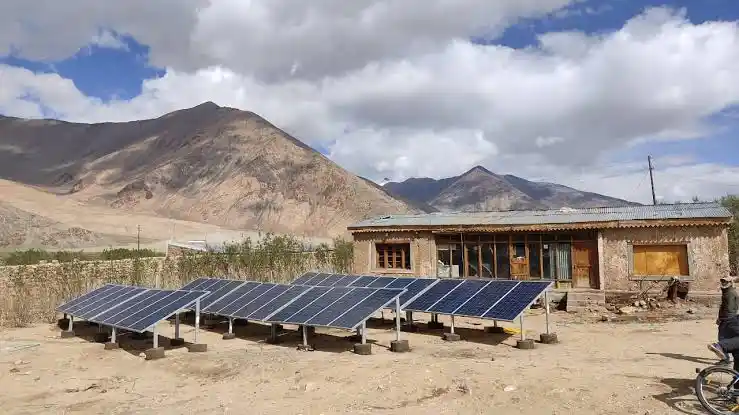
Until the late 1980s, Ladakh, a high-altitude region in northern India now a Union Territory, had little to no access to electricity. The local population had to rely on primitive or traditional means to survive extreme cold—a challenge in the cold deserts. The generations of Ladakhis had learned to survive these unforgiving conditions through ingenuity, resourcefulness, and a deep understanding of their natural surroundings, even when the temperature used to plunge below minus 30°C.
The darkness of winter nights was part of everyday life, braving an extraordinarily harsh climate, and winters were particularly freezing. The studies show the communities remained closely connected to the rhythms of nature, adapting to the extreme cold, scarce resources and isolation of the region.
As times changed, modern innovations began transforming Ladakh’s landscape. Electricity became essential not just for heating homes during harsh winters, but also for lighting, cooking, communication, education, healthcare, and everyday life.
Ladakh’s first major project and process to build electric supply infrastructure began only with the commissioning of the Stakna Hydel Project, built on the Indus River in 1986. The project provided 24-hour electricity supply to around 3,000 households in and around Leh town, between March and November.
The arrival of electricity in Ladakh was not a single event, but a long, gradual process that stretched over decades due to the region’s extreme high-altitude terrain.
The region only got connected to the National Electricity Grid in 2019, as till then it was completely cut off from the main Indian power grid, leaving most villages in darkness or reliant on a few hours of diesel generator power during winters.
The past is now history. Ladakh is fast marching ahead to become India’s powerhouse for renewable energy, and the upcoming Rs 20,773 crore Green Energy Corridor, approved by the Union Cabinet in 2023, will transform the region’s energy landscape while balancing clean energy ambitions with environmental protection and local development.
“Ladakh has vast, high-altitude landscapes that could play a significant role in India’s clean-energy transition. Generating renewable electricity in such a remote and inhospitable region is not merely a technological challenge but a test of engineering capabilities,” admits a senior official of the New and Renewable Energy (MNRE).
The officials also recall that Prime Minister Narendra Modi had announced Ladakh’s Mega Solar energy initiative on August 15,2020 during his Independence Day speech .Since then much has changed on the ground.
What powers the plans to make Ladakh India’s shining case of renewable energy is its naturally gifted conditions. Ladakh receives over 300 sunny days annually and high daily solar radiation (5.29 kWh/kWp), making it a major hub for clean energy and large-scale solar projects.
As per the October 2023 decision of the Union Cabinet, approval has been granted for an ambitious Green Energy Corridor Phase-II project, an inter-state transmission system. This will significantly evacuate the power from a proposed 13-gigawatt renewable energy project in the Ladakh region.
With an estimated cost of Rs 20,773.70 crore, the project is set to be completed by 2030. The Center has also provided assistance of Rs 8,309.48 crore to meet the timeline.
The details available to India Narrative suggest that nearly 713 kilometers of transmission lines and high-voltage direct-current terminals are planned at Pang in Ladakh and Kaithal in Haryana. The transmission network will pass through high mountain areas of Himachal Pradesh and Punjab before connecting with the national grid. A battery energy storage system of 12 gigawatt-hours is also envisaged alongside the proposed renewable energy generation capacity.
The project could help India integrate more solar and wind power into its electricity network, strengthen long-distance power transmission and advance its target of 500 GW of installed electricity capacity from non-fossil fuel sources by 2030.
Alongside this, there is a 13 GW hybrid project comprising 9 GW of solar power, 4 GW of wind energy, and a 12 GWh battery energy storage system at Pang, Debring, and Kharnak, respectively.
Further, Tata Power has installed the region’s first commercial rooftop solar project (a 50 kWp system) in Leh. Hundreds of homes, schools, and government buildings are using subsidized rooftop solar and off-grid systems.
The Indian Air Force has also set up a 1.5 MW solar power plant at its Leh station. Several establishments, including the ITBP, use concentrated solar power for water heating and other useful purposes
The UT administration is now working to see how the renewable energy sector can help the Ladakh communities to generate meaningful employment and livelihood opportunities while also protecting the fragile ecology, water and land resources, which are precious for safeguarding the environment as infrastructure projects take shape there.
Says Tsering Norboo, a social activist, “For us, in Ladakh, the proposed Green Energy Corridor is not merely about a clean initiative of the government; it is also about striking a fine balance between economic and social development of the local population within the limits of ecological boundaries in the Himalayan frontiers”
Meanwhile, the Energy Conservation Building Code (ECBC) and Eco Niwas Samhita have identified five climatic zones across India to guide building design based on local climatic conditions. Ladakh falls under the cold region zone with Jammu & Kashmir, parts of Himachal Pradesh, Uttarakhand, Sikkim, and Arunachal Pradesh.
In India, apart from Ladakh, the world’s largest upcoming hybrid (solar and wind) renewable energy installation, spanning over 72,600 hectares in the Rann of Kutch in Gujarat, has already started supplying power to the national grid.