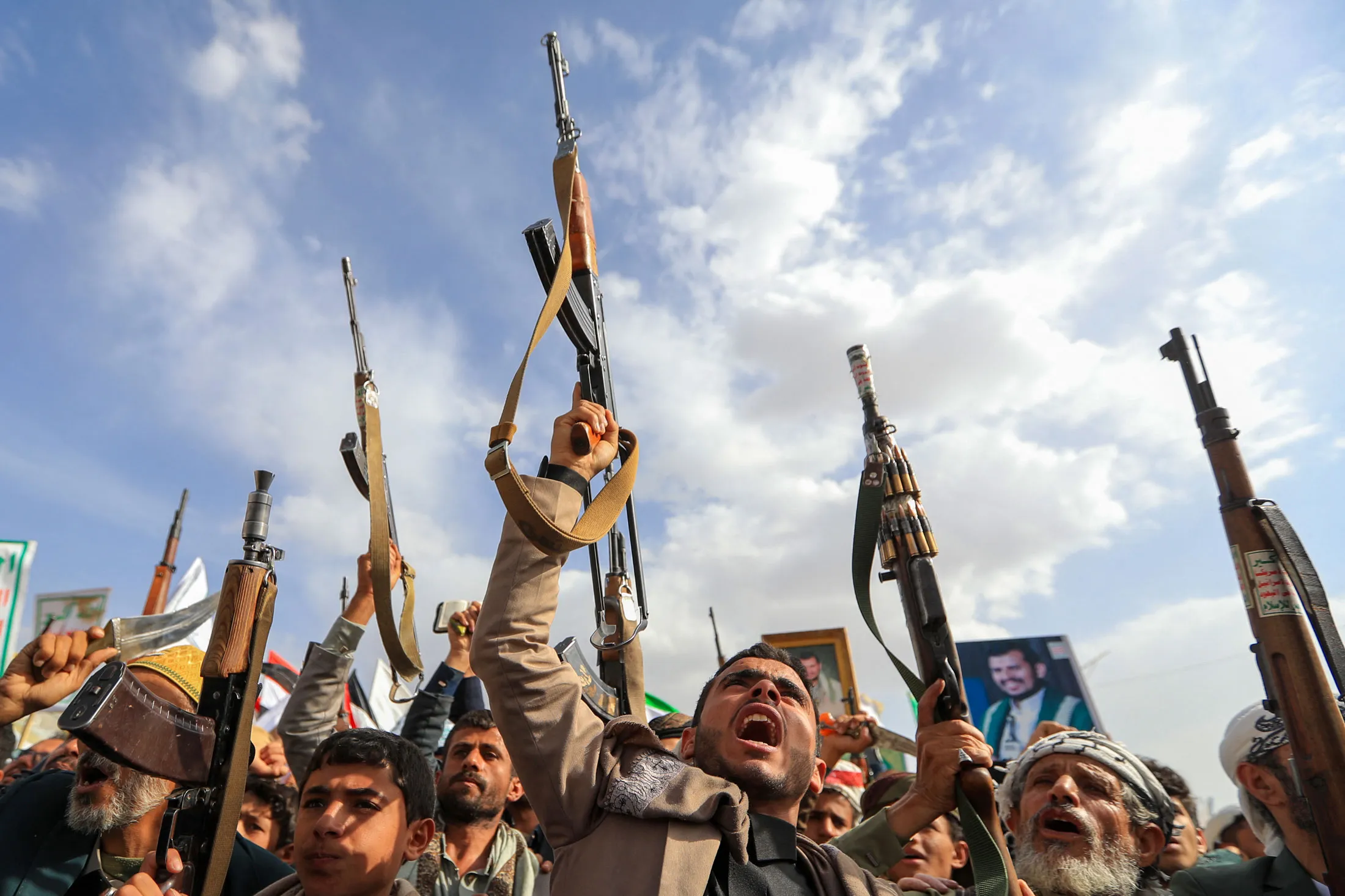
In another strategically audacious move, Iran has unleashed its proxy network, especially the Houthis, to launch targeted strikes in Saudi Arabia, damaging key oil pipeline networks and advancing towards the Red Sea, almost gaining strategic control to significantly control and even close the Bab el-Mandeb Strait, which can severely put pressure on global oil supply chains, compounded by the already conflict-ridden Strait of Hormuz. The sudden unleashing of proxy power by Iran carries a strong and loud strategic message, apart from being a move to solidify its asymmetrical power against the US and its effort to rebuild Gulf allies’ security resilience.
The Proxy Power
Apart from strategic firepower and political will, Iran’s asymmetrical arsenal includes proxy networks operating across the Middle East, especially in Iraq and Yemen. For decades, Iran has mastered this proxy network not only to challenge US security responses against Iran but also to influence regional influence and stability. These proxy networks, especially the Houthis and Shia militants in Iraq, have considerable strength at both strategic and political levels, which can deliver deep, sustainable strikes across the region at Iran’s behest. Iran uses these proxy networks not only to execute strikes but also to nurture cross-proxy networks; for example, Iran’s Lebanon proxy network, Hezbollah, serves as an intermediary trainer and organiser. Hezbollah’s Unit 3800 was specifically tasked with travelling to Iraq and Yemen to train local fighters in guerrilla tactics and intelligence collection.
Most importantly, Iran continues to use its shadow banking and financial networks via illicit oil smuggling, drug trafficking, and traditional hawala cash networks to fund these networks despite severe sanctions. To keep these proxy networks politically powerful, Iran pushes its proxies to run for office and integrate into official security apparatuses. The most recent instance is in Iraq, where Iran has heavily pushed its proxy militias under the Popular Mobilisation Forces (PMF) to form political parties. The pro-Iran political blocs emerged as strong winners in recently held elections. This gives them a certain degree of legitimacy to consolidate their political and financial influence, divert funds to pro-Iran proxy outfits, and, most importantly, block the government from sanctioning or disarming them and even pressure the government to expel western/US forces’ influence or presence.
Similarly, for the Houthis in Yemen, Iran’s full-powered backing ensures that the Houthi rebels gain political space in Yemen’s ministries and helps them secure a political grip by transferring social control and surveillance tactics, including training to operate an intelligence network inside Yemen’s political offices and influential centres, a strategy directly imported from the Iranian regime.
Iran has helped the Houthis establish a media echo chamber (Al-Masiarh) in Hezbollah-controlled areas in Beirut to ensure the Houthis have political propaganda capabilities and project a state-like authority in Yemen. Iran’s strategic sustainability playbook has ensured that its proxy networks, primarily in Iraq and Yemen, remain strong even after sanctions and US-Israeli strikes in recent years. The case of Hezbollah is quite different; it has struggled to retain political integration and strategic depth, and back-to-back military campaigns, the decapitation of its top leadership, and the collapse of its Syrian supply corridor have profoundly weakened the group.
The Old Nurturing
The old nurturing of these proxy groups, especially those in Iraq and the Houthis in Yemen, had one thing in common: they were systemically institutionalised by Iran’s IRGC, capitalising on their historic struggles. Iran’s relationship with Shia militants goes back to the 1980s, when Iran sheltered and armed exiled Iraqi Shia dissidents during the Iran-Iraq War to destabilise Saddam’s regime. Later, then IRGC-Quds Force chief Qassem Soleimani organised these groups into “Special Groups” to carry out asymmetric attacks. As the threat of sanctions and military operations increased, Iran’s IRGC and intelligence services gave them political cover by organising these Shia militias under the state-sanctioned PMF umbrella, with Iranian military aid. Over the years, this strategic and political depth grew, consolidating their influence and stability in the region.
However, the Houthis’ history was independent of this proxy politics, which later became a strategic tool of the IRGC by capitalising on the vacuum caused by political instability in Yemen and the Houthis’ rise. The Houthi rebels are a product of historic political and ideological struggle and are rooted in the Sa’dah governorate of northern Yemen. They practice Zaydism, a distinct branch of Shia Islam unique to Yemen. For nearly 1,000 years, Zaydi Imams ruled Yemen until a 1962 nationalist revolution overthrew them. This was a major shock and blow to the Houthis’ political and cultural identity. The situation further deteriorated when Saudi-funded Islamist movements marginalised them by the 1980s.
In 1992, to preserve cultural identity and revive Zaydi culture, religious scholar Hussein Badreddin al-Houthi helped establish a youth movement called the Believing Youth (Al-Shabab al-Mu’min). By 2003, particularly after the U.S. invaded Iraq again, the group transformed into a radical militant political resistance. Aggrieved by foreign intervention by the U.S., the Houthis strongly condemned Yemen’s president, Ali Abdullah Saleh, for aligning with the U.S. “War on Terror.”
Seeing the Houthis as a threat to his regime, President Saleh initiated a military crackdown. In September 2004, Yemeni forces killed Hussein al-Houthi. Rather than dismantling the movement, his death made him a martyr and led to six consecutive wars between the government and the Houthi clan, now led by Hussein’s brother, Abdul-Malik al-Houthi. Each conflict gave the Houthis more combat experience and drew the group closer to Iran.
In 2011, when the Arab Spring forced President Saleh to step down, Yemen transitioned to a weak interim government led by Abdrabbuh Mansur Hadi. Exploiting the vacuum and widespread anger over corruption, the Houthis launched a massive offensive and, by 2014, captured key cities, including the capital, Sanaa, effectively taking over the western heartland of Yemen. This prompted a devastating military intervention by a Saudi-led coalition in 2015. This was the moment when Iran’s IRCG effectively stepped in to provide strategic support to the Houthis; it aggressively scaled up its support, providing advanced guidance systems, drone kits and intelligence support. This support transformed the Houthis into a more hardened group capable of threatening global trade routes in the Red Sea.
US Security Choices
The Houthis of Yemen and the Shia militias of Iraq’s attacks on Saudi Arabia, with the Houthis group almost reaching the point of becoming fully capable of disrupting or closing the strategically important Strait in the Red Sea, knocking down another global oil supply route, create a double chokepoint nightmare, as it creates a simultaneous dual blockade of the Middle East’s most vital energy corridors. Market analysts from platforms like Reuters warn this dynamic could almost instantly drive global oil prices past $150 a barrel. It also cuts off a massive pipeline of Liquefied Natural Gas (LNG) from Gulf nations like Qatar to Europe. Without the Suez Canal route accessible from the south, Europe would face severe energy shortages and a drastic spike.
Iran’s proxy network, especially the Houthis, is drastically upping the ante of conflict by striking and threatening vital global trade routes and Saudi Arabia’s oil network. Three strategic objectives clearly drive this. First, breaking the Sunni solidarity and Pact politics. Deep strikes in Saudi Arabia seriously exposed how fractured the Mecca pact actually is when so-called Sunni Solidarity didn’t come to the rescue of Saudis, and even Americans snubbed Saudi Arabia.
Second, US allies in the Middle East are weakening. Iran, through proxy attacks, is directly challenging the notion that arming up and providing defence to allies will protect them from Iran’s attacks. In short, US security guarantees are still not credible, and any political or security architecture aimed directly or indirectly against Iran will not sustain in the long term, thereby demonstrating Iran’s influence and ability to remain a dominant force in the region. Third, the Houthis’ recent advance to the strait and their territorial gains in Yemen have helped IRGC hardliners and Iran’s leadership keep the upper hand in negotiations and force the US to come to the table, keeping the door open to negotiating on its own terms and conditions instead of interim arrangements that were done earlier by managing the moderates in Iran. Now, since almost all the decision-making authority has been taken over by the hardliners, these kinds of audacious acts have serious implications for regional security and not only for the deal prospects; if some reports are to be believed, then a sabotage attempt by IRGC hardliners was already made to derail the interim deal with the US and Iran in July.
According to recent reports, the US may have managed backdoor negotiations with the Houthis, but for the US’s long-term security choices, as one may argue, they hang by a thread. On the one hand, it seems to be creating greater strategic dependence on the US-Israel axis. On the other hand, it creates high costs, dilemmas, and credibility issues that, in the long term, may create a conundrum-like situation for the US in the Middle East, leaving less room for allies to balance and bank on.