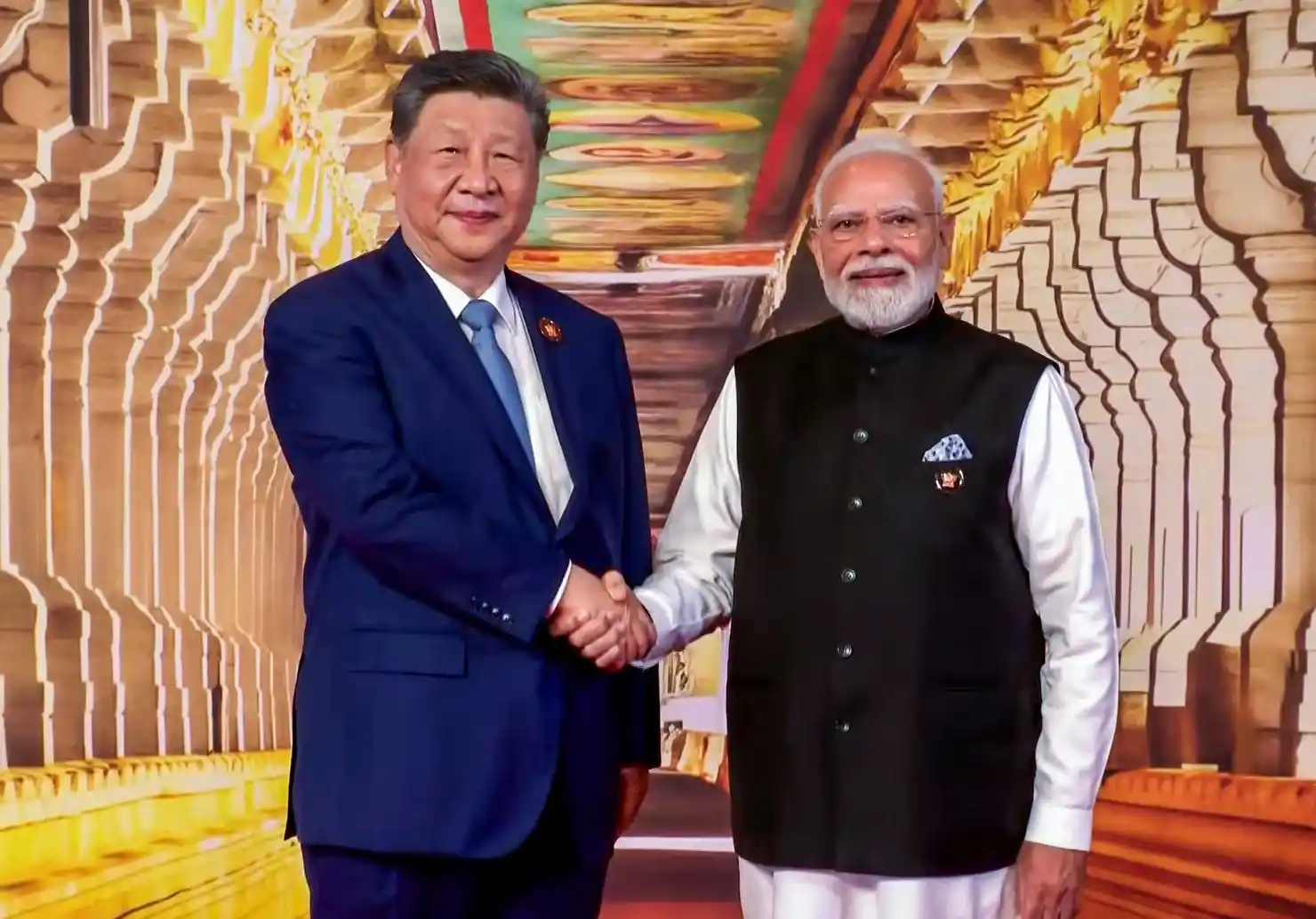
India’s bilateral meeting with China on the sidelines of the recently concluded BRICS is largely seen as a reset in Indo-China ties. However, this ‘reset’ is not the full picture and is simply a plain reading of the visit. A strategic reading suggests that this is standard practice or strategic behaviour by China, not something unprecedented.
The Reset Game
After the Galwan Clash in 2020 and the Chinese President’s visit in October 2019, many running commentaries suggested a reset was on the horizon. The reading of a reset is not driven by the genuineness of a reset; it is driven by temporariness and the necessity to balance the relationship. In India’s strategic calculus, the Indo-China relationship is driven by both competition and cooperation. This balance shapes the Indo-China relationship. The reset happens because China has a strategic necessity. The first reset attempt from China perhaps played out after the 1962 War, or more precisely after Sino-Soviet border tensions escalated following the Soviet Union’s bloody retaliation at the border in 1969-1970.
The strategic environment for China became more complex as Indo-Soviet relations began to grow on one front, while on the other, Americans were engaged in Vietnam. Americans exploited this environment to force China to pivot towards the US to counter China. This process led to Henry Kissinger’s secret trip in 1971 and Nixon’s visit in 1972. Mao needed to aggressively break China’s diplomatic isolation. In May 1970, at a Tiananmen Square reception in Beijing, Mao Zedong singled out Brajesh Mishra and smiled to express a desire to repair relations. Mao remarked, “We cannot keep on quarrelling like this. We should try and be friends again.” However, this thaw attempt from China’s side ultimately failed to achieve an immediate breakthrough, as there was initial hesitation at New Delhi’s end, where the Principal Secretary of the then Prime Minister Indira Gandhi and the Former Foreign Secretary remained deeply suspicious and advised caution.
Later, to counter the US-Pakistan-China axis, India moved closer to the Soviets and signed the 1971 treaty with Moscow. This further strengthened Indo-Soviet relations, especially at the strategic level, against the backdrop of the Sino-Soviet split and the ongoing Vietnam conflict. The developments in the 1970s prompted China to break the ice and repair ties with India, driven more by anxiety about Indo-Soviet closeness. This prompted China to agree to restore ambassadors with India in 1976. However, a major shock came in 1979 when China-Vietnam relations reached serious open hostility.
The Vajpayee Visit
Former PM and then External Affairs Minister Vajpayee visited Beijing in February 1979, and Deng Xiaoping had recently taken the reins of China. It was a landmark, ice-breaking trip to Beijing, the first high-level visit by an Indian official since the 1962 Sino-Indian War. The visit aimed at stabilising the border and diplomatic relationship against the backdrop of advancing Indo-Soviet relations, which by 1979 had taken major leaps in the strategic and economic domains. When Vajpayee was still in China, Deng’s leadership ordered a limited war against Vietnam to teach Vietnam a lesson after Vietnam invaded Cambodia(China’s ally) to overthrow the Chinese-backed Khmer Rouge regime. In protest against the timing and the action, Vajpayee cut short his diplomatic mission and hurried back to India.
Tactical and strategic motivations drove China’s decision to invade Vietnam. First, it was to ease pressure from Cambodia, launch a counterstrike, and drive Vietnamese forces out of Cambodia. The second was strategic: Vietnam had recently signed a Treaty of Friendship and Cooperation with the Soviet Union. China viewed this alliance as a hostile attempt by Moscow. But behind this strategic motivation, a larger intent and messaging were hidden; it was also an attempt to show that, despite the Soviet-Vietnam Friendship Treaty, Soviet security guarantees were effectively toothless, especially for its neighbours. Many analysts argue that, given the timing of Vajpayee’s visit and the invasion, China also wanted to send a similar message to India. This incident led to another episode of frozen ties with China.
Teaching Another Lesson
In the 1980s, China was again guided by necessity to normalise relations with India, as China was gradually on the brink of facing a multi-front threat, where the internal environment was marked by a weak economy and brewing internal political instability; in the external environment, China was witnessing its northern border turning into a military zone by the Soviets. The Soviet Union stationed nearly one million troops, backed by thousands of tanks. Even after the limited invasion of Vietnam in 1979, Vietnam continued to engage deeply with the Soviets and even allowed the Soviet Navy access to Vietnam, granting the Soviet Navy access to Cam Ranh Bay, essentially allowing Soviet warships to anchor right on China’s southern maritime doorstep just weeks after fighting subsided.
Indo-Soviet relations deepened strategically as economic and military ties were upgraded. In the mid-1980s, this included leasing a Charlie-class nuclear-powered submarine (INS Chakra), supplying MiG-29 fighter jets and Tu-142 maritime reconnaissance aircraft, and increasing technological support. In such a situation, China tried to normalise ties with India gradually; however, China did it with hidden strategic motivation, that is, negotiations on its own terms, i.e border talks with the upper hand, for which China began creeping inside Indian territory the classical Chinese strategy of Salami Slicing” or “talking peace while changing facts on the ground.” This action was further motivated by two strategic motivations. First, China wanted to set a “New Normal” in ties with India, where it holds strong strategic space. Second, India’s increasing assertiveness in border upgradations and, most importantly, granting Arunachal Pradesh full statehood in 1986, which China falsely claims as South Tibet. China strategically twisted this normalisation as an act of bringing peace through grey coercion. By marching a company of the People’s Liberation Army (PLA) into the Wangdung pasture (south of the Line of Actual Control) in 1986, China wanted to shift the border further south quietly- to “teach India another lesson” if it didn’t back down. This led to the 1986 Sumdorong Chu standoff.
Operation Falcon
However, under the leadership of General Krishnaswamy Sundarji, the Chief of Army Staff (COAS), the Indian Army bypassed the conventional, cautious bureaucratic channels of Prime Minister Rajiv Gandhi’s civilian government to execute Operation Falcon. Between October 18 and 20, 1986, they carried out a massive airlift entirely under the radar of the mainstream press and the civilian political class. An entire infantry brigade was transported directly into the remote Zimithang sector, successfully occupying the commanding heights of the Hathung La ridge, overlooking the Chinese positions.
The Deception
Rather than triggering a war, India’s sudden position of strength forced China to the negotiating table. It paved the way for Rajiv Gandhi’s historic visit to Beijing in 1988 and laid the foundation for the 1993 Border Peace and Tranquillity Agreement. Though this agreement is debated, many saw it as deception. Under the guise of creating peace, Beijing intentionally engineered a flawed agreement that institutionalised asymmetry and paved the way for the border crises India faces today.
The most critical flaw India accepted in the 1993 agreement was the commitment to respect the Line of Actual Control (LAC) without actually defining or mapping where that line was. Apart from border talks, India focused heavily on economic partnership. The peace opened the door to cooperation, but it also quietly expanded competition, and China used those peaceful decades to build an unparalleled network of all-weather roads, military airfields, logistics hubs, and missile sites across Tibet. By the time India woke up to the infrastructure gap in the 2010s, the modern-day context had shifted.
Cut to the Doklam crisis in 2017; even that crisis resulted from salami-slicing and a deceptive strategy driven by coercion. The Doklam standoff took place between June and August 2017. Crucially, the 19th National Congress of the Chinese Communist Party was scheduled for October 2017. Xi Jinping was preparing to consolidate absolute power, eliminate political rivals, and cement his status as the unchallenged “Core” leader. At the same time, China was facing an economic slowdown and mounting anxiety over the centralisation of his power. By flexing China’s military muscles against a neighbour, Xi intended to project himself to the domestic audience and the military as a strong, Mao-like figure.
However, following a tense 73-day military standoff at Doklam, China sought rapid de-escalation immediately before hosting the 2017 BRICS Summit in Xiamen. This was a strategic necessity for China, not only to de-escalate border tensions but also to normalise relations before a major diplomatic event to forge consensus and confidence. Similar tactics were used in Galwan, when China faced severe international pressure, specifically from the US, and domestic pressure from COVID and economic lockdowns. Perhaps for the first time in decades, the public openly criticised the CCP’s competence on Chinese social media. The Mao and Deng playbook was reactivated at the grey level to maintain pressure and conflict below the war threshold, deliver strategic messaging, evoke hyper-nationalism in China, and divert attention. China was also driven by strategic anxiety at the border, which forced it to create tensions with India.
During that time, India completed the critical Darbuk–Shyok–Daulat Beg Oldie (DS-DBO) road, which runs parallel to the LAC and connects Leh directly to the strategic Karakoram Pass. After six years of the Galwan Clash and BRICS in India, China is clearly witnessing India’s strategic rise. According to China’s strategic thinking, this is a long-term problem, but the current strategic environment does not allow any misadventures, especially for China. Brief confontration at the LAC
China’s security and strategic thinking is always governed by two doctrinal approaches. First, Deng thinking: “Hide your strength, bide your time”, by maintaining ambiguity and forging normalisation. Second, Mao thinking, which seeks to re-establish China as the preeminent power in Asia and the undisputed leader of the revolutionary developing world. However, China has realised that an all-out competitive approach is not feasible, and that some cooperation, especially with India, is required for strategic reasons like trade and economic necessities; hence, a temporary thaw always appears on the horizon, as it did in BRICS this year. Therefore, India must not rush towards optics and read the situation as a “Reset”; rather, it should be seen as balancing cooperation and competition with China.