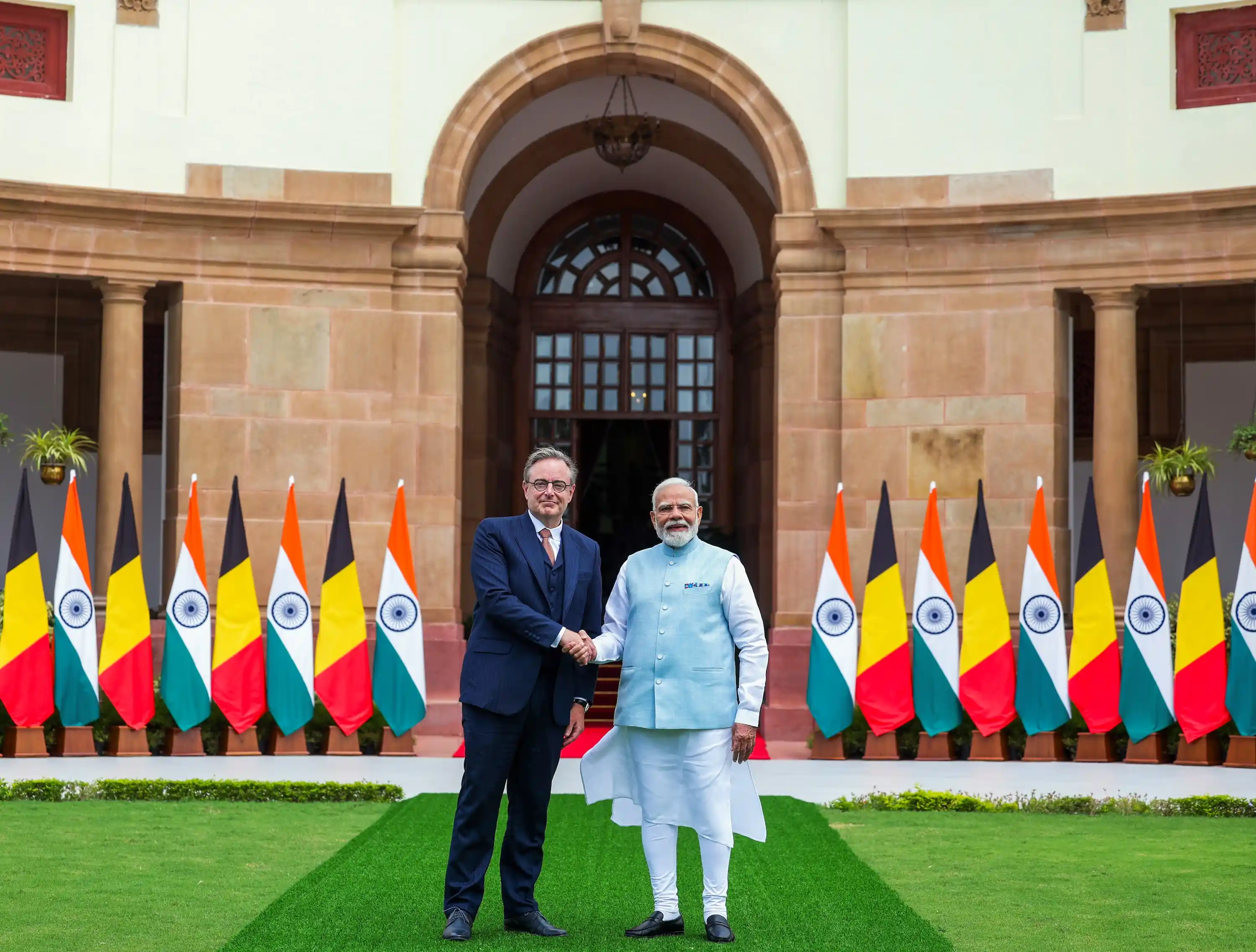
Belgian Prime Minister Bart De Wever spent three days in India from September 2 to 4, holding talks with Prime Minister Narendra Modi in New Delhi before moving on to business meetings in Mumbai. The visit was the first by a Belgian head of government in two decades. The last was in 2006; Modi travelled to Brussels in 2016.
That gap is the first thing to understand about the trip. India and Belgium have traded steadily for years without much political attention. This visit was an attempt to change that, and its timing was not accidental.
India and the European Union concluded negotiations on their long-discussed free trade agreement in January this year, a deal Indian officials have taken to calling “the mother of all deals.” Both sides have made a political commitment to sign and implement it before the end of 2026. The EU and India also signed a Security and Defence Partnership in January, and their Trade and Technology Council met at ministerial level in Brussels in July.
Belgium, which hosts both the EU institutions and Europe’s second-largest seaport, has an obvious interest in positioning itself early. De Wever was explicit about the logic in Delhi, arguing that India brings scale, talent and ambition while Belgium offers technology, specialisation and access to European markets.
The groundwork was laid over the past 18 months. Princess Astrid led a large Belgian economic mission to India in 2025, and the first India-Belgium Strategic Dialogue was held in Brussels in July, co-chaired by External Affairs Minister S. Jaishankar and Belgian Deputy Prime Minister and Foreign Minister Maxime Prévot.
The numbers
Bilateral trade stood at about $13 billion in 2025-26, according to India’s Ministry of External Affairs, and is close to balanced, with roughly $6 billion flowing each way. The two prime ministers set a target of doubling that within five years.
Belgian foreign direct investment into India has totalled around $4.2 billion since April 2000. Some 235 Belgian companies currently operate in India, concentrated in specialty chemicals, advanced steel and wire, materials recycling, marine engineering, pharmaceuticals and food processing.
To speed things up, the two governments established an Investment Fast-Track Mechanism for Belgian investors and agreed to make the India-Belgium Business Forum a standing body. Officials also reviewed engagement between Belgium’s sovereign wealth fund and India’s National Investment and Infrastructure Fund.
Defence was the surprise
The most substantive outcome was in an area few would have predicted from a relationship built on gemstones. The two governments signed a Letter of Intent on defence cooperation, giving the relationship a formal institutional basis for the first time. The Belgian Security and Defence Industry Association and India’s Society of Indian Defence Manufacturers signed a parallel arrangement, and around eight company-level MoUs were concluded at an industry meeting on the sidelines.
India announced it would post a defence attaché to Brussels, matching Belgium’s posting of one to New Delhi earlier this year.
Some of this cooperation is already live. Belgian engineering group John Cockerill supplies the turret for the Zorawar light tank, India’s high-altitude platform developed after the Ladakh standoff. Belgian firm OIP supplies sights for the Arjun tank. Other tie-ups cover rocket launcher supply, drones and sensor systems. Belgian Defence and Foreign Trade Minister Theo Francken, who accompanied De Wever, framed the interest bluntly on social media, writing that a stronger India serves as a counterweight to Chinese dominance in Asia.
Energy, crime and mobility
A renewable energy MoU renewed a partnership dating to 2015, widening it to green hydrogen, green ammonia, offshore wind, storage and pumped hydro. Modi pointed to one of the world’s largest green ammonia projects, under development at Kakinada in Andhra Pradesh.
Two further MoUs covered law enforcement, linking the Central Bureau of Investigation with Belgium’s Federal Police on transnational organised crime and cybercrime, and diplomatic training between the two foreign service institutes.
On people, Modi said the two countries would soon conclude a Migration and Mobility Partnership Agreement covering skilled professionals, students and researchers. Existing arrangements moving Indian nurses to Belgian healthcare institutions were welcomed.
One irritant remains unresolved. Diamond trader Mehul Choksi, wanted in India over the Punjab National Bank fraud, has been in Belgian custody since April 2025 following an Indian extradition request. Indian officials said the matter was raised but declined to offer a timeline, noting parts of the case sit with Belgian courts.
Mumbai, and the port
De Wever, a former mayor of Antwerp, spent his final day at the Bharat Diamond Bourse and at a Port of Antwerp-Bruges event alongside Commerce Minister Piyush Goyal and Maharashtra Chief Minister Devendra Fadnavis. He announced that a full delegation from the Antwerp-Bruges port community will visit India in February 2027.
Indian officials summarised the relationship as three Ts: trade, technology and talent. Whether the fourth T, tanks, sticks will depend on execution.
One gift did not survive. De Wever had commissioned a replica of India Gate made entirely of Belgian chocolate. Unlike the original, he told reporters, it did not last the journey.