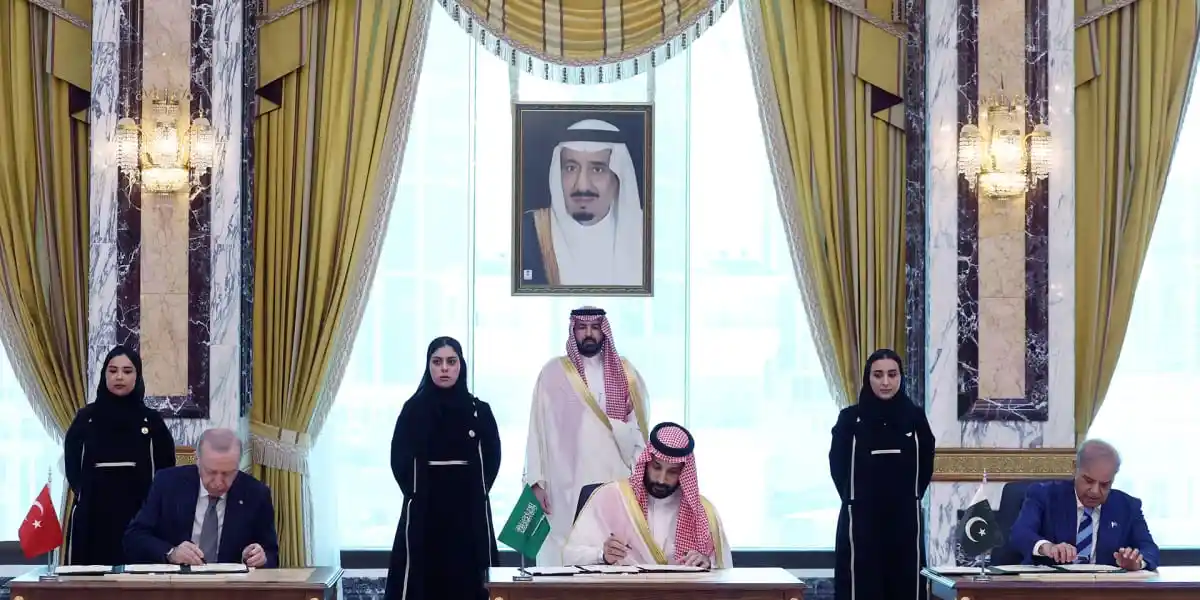
On August 07, 2026, Turkey, Pakistan, and Saudi Arabia signed the Makkah Joint Defence Agreement, which “stipulates that any armed attack against any one of the three states shall be regarded as an attack against them all.” The Makkah Defence Agreement raises important questions about alliances in the Middle East, including their formation, effectiveness, and durability.
The density of alliance formation is very high in the Middle East. Stephen M Walt notes that, between 1955 and 1979, there were “36 separate bilateral or multilateral alliance commitments in the Middle East…” A key reason for this alliance density is the fluid geopolitical dynamics. The fault lines are never static, as shifts in domestic politics also drive changes in the foreign policy orientation of some sovereign states in the region.
The collapse of Mohammad Reza Pahlavi’s regime and the rise of the Islamic Republic of Iran fundamentally altered Iran’s foreign policy orientation. Israel, which once had cordial relations with Iran, became an important adversary. In subsequent decades, Iraq, which had once received significant United States (US) support, invaded Kuwait, altering the regional dynamic. Many Arab countries, which supported Saddam Hussein during the Iran-Iraq War (1980–1988), collaborated with the US in Operation Desert Storm to push back Iraq’s invasion of Kuwait.
After the dastardly 9/11 terrorist attacks, Middle Eastern countries such as Jordan, Turkey, and the United Arab Emirates (UAE) contributed personnel to the International Security Assistance Force in Afghanistan. By contrast, many Arab countries were tepid in their support for the US’ Operation Iraqi Freedom in 2003. While some Arab countries allowed the use of bases, they were reluctant to contribute troops. During the recent Iran War, the Gulf allies of the United States, to avoid further escalation of hostilities, did not even retaliate against Iran despite coming under intense missile and drone attacks.
Alliance Characteristics
These examples do not constitute an exhaustive list of the alliances and alignments the Middle East has witnessed over the past few decades. However, they show that the Makkah Defence Agreement does not mark a significant departure but reflects the region’s long history of alliance formation and shifting alignments.
Alliance cohesion is also affected by ideological congruence among member countries. During much of the Cold War, ideological congruence played a significant role in maintaining alliance cohesion. NATO rarely included a fully communist country, and no country that actively advocated capitalism was part of the Warsaw Pact. While contemporary world politics lacks rigid ideological divides, the Makkah Defence Agreement countries’ cultural imaginations and visions for the Middle East differ. Leading political figures, such as President Recep Erdoğan in Turkey, are nostalgic about the Ottoman Empire and often want to revive similar influence in the region. Such political aspirations contest Saudi Arabia’s intent to preserve its influential role in the region. For more than a decade, Turkey and Saudi Arabia have had divergent approaches to developments in Libya, Egypt and Qatar. The fast-paced security developments will test the new friendship between Saudi Arabia and Turkey. Unlike Saudi Arabia and Turkey, Pakistan does not have an expansive regional vision for the Middle East. This implies that Pakistan will adjust to whichever political order prevails in the Middle East and is therefore not overly committed to the security interests of Saudi Arabia and Turkey.
It can be argued that an alliance’s efficacy depends less on ideological congruence and more on shared perceptions of threat. For Saudi Arabia, Iran constitutes a principal threat, as it has demonstrated considerable resilience during the recent war and has been able to attack various targets deep inside many countries in the region. After the 2023 terrorist attack in Israel and Israel’s subsequent military response, Israel-Turkey relations deteriorated dramatically. There were many instances when Turkish leaders stated that Israel is the principal threat to Turkey’s security. On the other hand, Pakistan sees India as a principal security threat.
Pakistan’s Alliance Addiction
Unlike its South Asian counterparts, Pakistan seems addicted to alliances. With the United States, Pakistan signed the Mutual Defence Assistance Agreement in 1954. Subsequently, Pakistan was a member of the Southeast Asia Treaty Organisation, (SEATO, 1954–1973), was a member of the Central Treaty Organisation (1955–1979), played an important role in facilitating the emergence of the China-Pakistan-US alignment in 1971, and was a member of the Islamic Military Counter Terrorism Coalition (2015) and signed a Strategic Mutual Defence Agreement (SMDA) with Saudi Arabia in September 2025.
Although not a formal alliance, Pakistan also has an ‘all-weather strategic cooperative partnership’ with China, and the two coordinate closely on regional and global issues. Given the close relationship and the need for Chinese support to contain India, Pakistan may find it difficult to act unilaterally on crucial issues in the Middle East without Chinese consent.
How loyal was Pakistan as an alliance partner? As a member of SEATO, Pakistan did not support the US during the Vietnam War in the 1970s. Pakistan was disappointed by the lack of adequate support from CENTO countries during the 1965 and 1971 conflicts and withdrew from the framework. After the Soviet invasion of Afghanistan in 1979, Pakistan played an important role in funneling US military aid to the Mujahideen and used that support to bolster its military capabilities vis-à-vis India. However, after the 9/11 terrorist attacks, Pakistan played both sides by supporting US military intervention and sheltering the Taliban. During the recent Iran War, Pakistan preferred to act as a neutral mediator rather than lean in support of Arab friends. Despite such a less-than-satisfactory record as an alliance partner, Pakistan has been roped into the Makkah Defence Agreement. Perhaps the presence of nuclear weapons is prompting the countries in the Middle East to engage with Pakistan. For Turkey, Pakistan is a significant defence market.
Pakistan’s participation in alliances is also driven by the need for financial resources. Given the persistent economic crisis, Pakistan often looks to the oil-rich countries of the Middle East to tide it over in the short term. However, Pakistan seems to lack a long-term economic plan. US alliance partners such as Japan, South Korea, Thailand, and others were able to leverage the alliance to access American capital and markets. Despite decades of close military relationship with the US, being part of various alliance frameworks such as SEATO/CENTO, and being a frontline state during the Afghan war, Pakistan has a unique record of failing to convert such partnerships into an economic opportunity.
Conclusion
In the coming months, more Middle Eastern countries may join the Makkah Joint Defence Agreement. In the game of accumulating allies, the Saudi-centred coalition will always have an advantage over Iran. President Trump has welcomed the agreement and said that “countries will finally be able to defend themselves in a more meaningful way.” President Trump’s endorsement may nudge some of the other US allies in the region to be favourably disposed to the agreement.
The Makkah agreement may not immediately trigger a wider war in the region. The Middle East experience shows that alliance formation serves as a signalling mechanism for possible reactions to aggression against an ally, but it may not necessarily result in a definitive military response. The efficiency and durability of alliance networks in the Middle East also depend on the trajectory of domestic politics. For instance, what if Iran undergoes a full regime change in the near future, and what if the economic and political crisis in Pakistan deepens?
While predicting the trajectory of geopolitics in the Middle East is difficult, the emergence of new alliances signals growing anxiety and political volatility in India’s immediate and extended western neighbourhood. India has a history of responding to military alliances that make their presence felt on its doorstep. Perhaps, such experience will enable India to deal with uncertainties more effectively in the near future.
The copyright of this article remains with the Politeia Research Foundation ©️PRF.