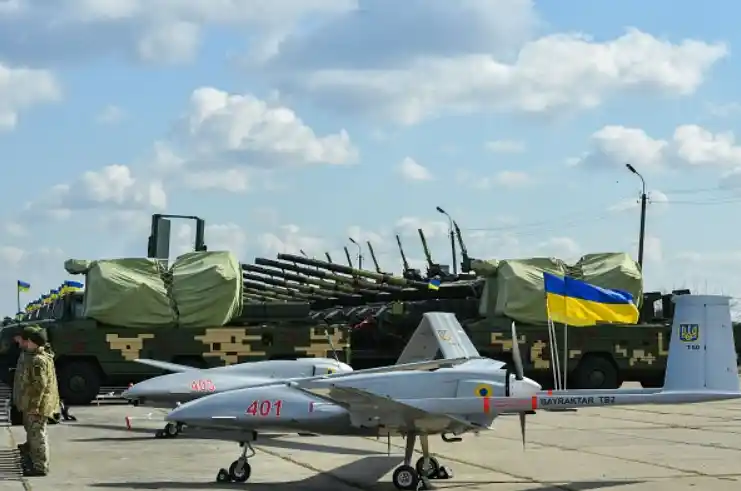
Traditionally seen as an important Indian advantage, strategic depth now faces a challenge as Ukraine’s leading drone and missile manufacturer, Fire Point, offers Pakistan its technologies and unique combat experience. A potential drone deal could add another layer of complexity to India’s security situation.
Why Fire Point Matters?
Fire Point has emerged as one of Ukraine’s leading producers of long-range unmanned systems. According to Ukrainian reports, the FP-1 has become one of the country’s primary long-range strike assets, capable of striking targets thousands of kilometres away from the front line. The company’s FP-2 is a shorter-range system designed for strikes at distances of up to 200 kilometres.
The war in Ukraine has demonstrated that relatively inexpensive, mass-produced unmanned weapons can impose substantial costs on a much larger military by repeatedly attacking not only tactical targets, but also those far behind the front line. For instance, an upgraded FP-1 flew approximately 2,500 kilometres from Ukrainian territory to attack a primary crude processing unit belonging to Gazprom at Russia’s largest refinery in Siberia. Platform units have been documented manoeuvring in the skies near Moscow and targeting local energy and logistics infrastructure. As Volodymyr Zelensky said, Ukraine has “completely eliminated the very idea of Russia having a strategic rear”. Now, Fire Point is addressing Pakistan with a similar message, which is clearly a reference to India.
A Different Kind of Risk for India
India’s main concern would not necessarily be the immediate arrival of a particular Fire Point platform. While the war with Russia is ongoing, Ukraine is unlikely to supply Pakistan with drones. New Delhi should be more concerned about the potential establishment of a technology pipeline than a weapons purchase.
Pakistan has already declared the rapid expansion and local production of unmanned aerial systems to be a top “national priority”. Islamabad aims to acquire know-how from a defence industry that has been forced by war to quickly innovate in areas such as long-range strikes, navigation, electronic warfare, resilience, and mass production by working with private commercial firms. The country has already encouraged private-sector participation in defence production, and domestic firms have expanded their work on indigenous UAVs, including testing locally developed engines and propulsion systems. The country has also expanded its military drone fleet in light of lessons learned on the battlefield in Ukraine. Therefore training, production assistance, components, software, manufacturing techniques and operational experience could ultimately be more significant than the number of imported drones.
Response Should Be Technological
India now has a strong interest in monitoring not only whether Pakistan purchases Fire Point drones, but also whether cooperation expands into local production, training or technology transfer. A Pakistani production capability based partly on Ukrainian wartime experience would be much harder to control.
Indian defence sector also needs to speed up the development of layered counter-drone and air defence capabilities, while also increasing its capacity for long-range unmanned systems. Alongside conventional surface-to-air missiles, electronic warfare, passive detection, artificial intelligence-assisted target recognition, directed-energy systems and inexpensive interceptors will become increasingly important.
The central lesson is clear: the next phase of military competition between India and Pakistan may be less influenced by the number of fighter aircraft each side possesses than by the ability to produce, deploy and defend against large numbers of increasingly capable autonomous and semi-autonomous weapons.