India has real grievances with Washington. None of them justify what abandoning these talks would cost.
I. “HE’S LIKE AN ANGEL. BUT HE’S A KILLER.”
On 17 June, on the sun-drenched margins of the G7 summit at Évian-les-Bains, President Donald Trump said something that deserves to be framed and hung in South Block. Describing Prime Minister Narendra Modi to the assembled press, Trump declared: “He’s the most beautiful-looking man. He looks so nice. He’s like an angel. But actually, he’s as tough as — he’s a killer.” The US, he added, was “very close” to a trade deal with India. Reaching across to clasp Modi’s hand: “We have the best relationship. We cannot be closer than we are.”
Newspapers the following morning reminded readers that the same administration had, the day before that meeting, quietly retired the name US Indo-Pacific Command and restored its eight-decade-old predecessor, US Pacific Command. The “Indo” that had stood for eight years as a pointed acknowledgement of India’s strategic centrality in Asia was gone, almost without ceremony, from Hawaii.
Read these two events together. A president who calls you an angel-faced killer also orders the erasure of the word that symbolised your place in his strategic geography. This is how transactional power behaves: warm at the table, indifferent on the letterhead. The renaming joins a pattern — the “dead economy” slur, the Raisina Dialogue caution against repeating the “China mistake,” the unresolved deaths of Indian sailors in a US military strike in the Gulf of Oman. Each individually deniable; together, unmistakably a message.
The irritation is earned. The error lies in allowing it to dictate terms that ought to be dictated by cold calculation alone.
II. THE TARIFF SAGA IS NOT HISTORY
The claim that “the worst tariff saga is history” happens to be wrong, and wrong in a way that matters considerably to Indian exporters.
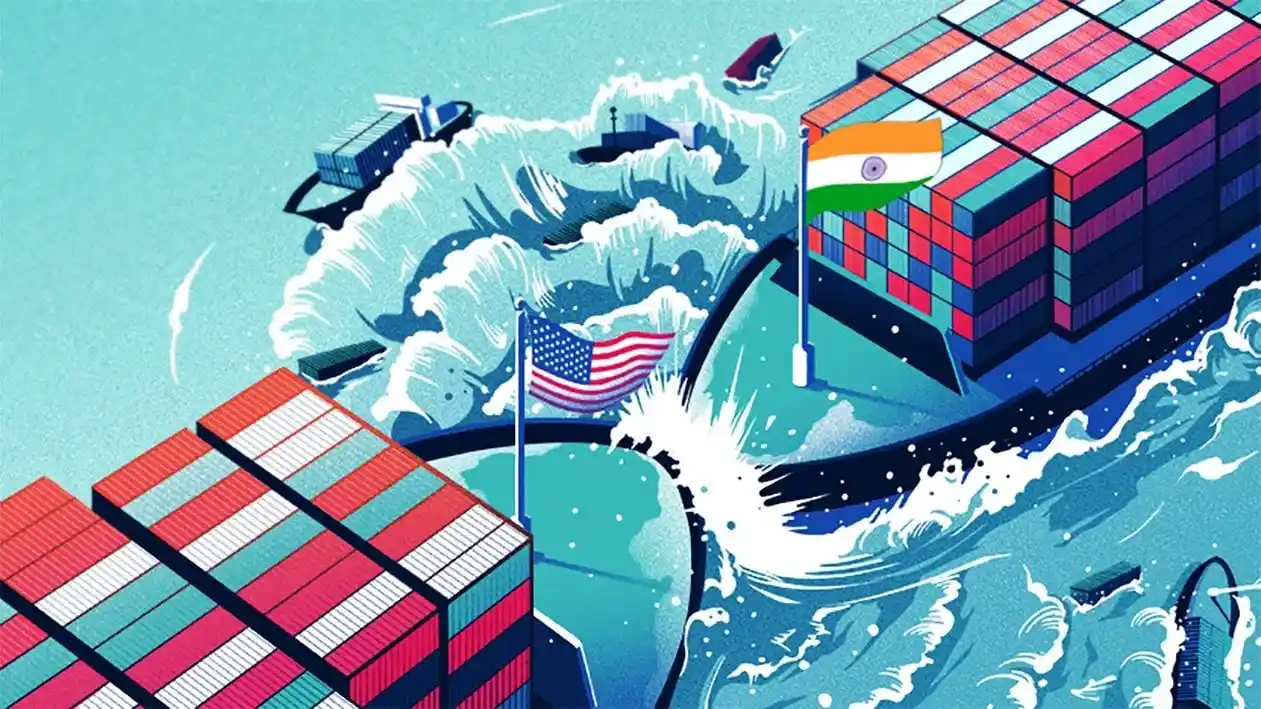
Under the framework announced on 6 February this year, the United States locked in a reciprocal tariff of 18 per cent on a substantial basket of Indian goods — textiles, leather, organic chemicals, home décor, select machinery. That rate is not a punitive overhang awaiting removal; it is the new floor, whether or not a final agreement is signed. Layered atop it is a separate 10 per cent levy due to lapse on 24 July — but only as a function of how these negotiations conclude. There is no scenario in which India disengages and reverts to a more favourable baseline.
Commerce Minister Piyush Goyal has already answered the question being asked. He has, repeatedly, declined to be rushed. The one condition still unmet — a formal guarantee that Indian exports enjoy a tariff advantage over Vietnam and Bangladesh — is not the language of a government anxious to sign at any price. “The day the US finds appropriate tools to give us a competitive advantage, the deal is on,” he told Reuters in London last week. Trump’s angel-killer compliment and Goyal’s patience-at-the-table posture are two sides of the same coin: Washington knows it is dealing with a serious negotiator. That is precisely the reason to hold the line, not vacate it.
III. THE INDUSTRIAL ARCHITECTURE AT STAKE
The trade deal is only the most visible layer of what walking away would forfeit. Beneath it lies a web of joint endeavour two democracies have been constructing for three years.
The TRUST initiative — Transforming the Relationship Utilizing Strategic Technology — launched by Modi and Trump at the White House in February 2025, built comprehensive industrial architecture spanning artificial intelligence, semiconductor fabrication, quantum computing, biotechnology, and a critical minerals framework formalised as recently as 26 May this year. Micron has committed nearly three billion dollars to a plant in Gujarat. Google has announced a six billion dollar data centre in Visakhapatnam. India has deployed 38,000 GPUs under its national AI Mission. While China remains locked out of the world’s most advanced AI hardware under US export controls, India has been formally designated a “trusted partner,” gaining preferential access to the chips on which the next generation of AI will be built. This is not a diplomatic compliment. It is a structural advantage worth tens of billions of dollars.
The ten-year defence framework signed in October 2025 places the co-production of GE’s F414 engines with Hindustan Aeronautics Limited at the centre of a decade-long industrial partnership — finally laying to rest what a former Prime Minister once described as the “technology denial regime.” India has committed to purchasing five hundred billion dollars of US energy, aircraft, technology goods and critical materials over five years — a strategic bet on a genuinely win-win partnership.
Walking away in pique over a military command’s letterhead would not punish Washington. It would place all of this under a cloud of uncertainty at precisely the moment these investments are moving from paper to construction. India would not be asserting autonomy. It would be surrendering the most consequential accumulation of industrial partnership this country has assembled since Independence.
IV. MULTI-ALIGNMENT, MODI STYLE
The argument for staying at the trade table must not become an argument for dependency. The real story of Indian foreign policy in this turbulent period is that New Delhi has no need to choose between dignity and engagement, because the architecture of its relationships has been built to preclude that false binary.
Since February 2025 alone: Modi addressed the Israeli Knesset; Putin visited New Delhi in December — his first trip since Ukraine — expanding India-Russia ties into civil nuclear cooperation, the Arctic and space; in May 2026, Modi flew to Abu Dhabi, deepening the Comprehensive Strategic Partnership amid maximum Gulf turbulence, securing strategic petroleum reserves at 30 million barrels and launching a Cochin Shipyard-Drydocks World collaboration at Vadinar; thence to Amsterdam, elevating ties to a “Strategic Partnership” in semiconductors, quantum technologies and maritime cooperation. India sits simultaneously inside BRICS and the Quad, at the SCO alongside China and Russia, and at the G20 as agenda-setter for the Global South. Modi has completed 102 international trips to 81 countries — the most widely-travelled Prime Minister in Indian history. This is multi-alignment not as doctrine but as daily practice.
V. THE RAWALPINDI VARIABLE
Even as Trump clasped Modi’s hand at Évian, his administration has spent the past year reconstructing a parallel partnership with Pakistan — defined not by democratic affinity or industrial complementarity but by tactical convenience. Field Marshal Asim Munir, Pakistan’s de facto ruler and Trump’s self-proclaimed “favourite field marshal,” visited the White House twice in 2025: first for an unprecedented private presidential lunch in June — the first time a Pakistani army chief, unaccompanied by civilian leadership, had been so received — and again in September with Prime Minister Shehbaz Sharif to formalise US investment in Pakistan’s critical minerals. Islamabad’s reward for brokering the Iran-US ceasefire talks and positioning itself as Washington’s conduit to Tehran was IMF rehabilitation, mineral MOUs, and rapid reinvention from pariah state to indispensable mediator.
Washington has played this game before — with Ayub, with Zia, with Musharraf — always prioritising a compliant military interlocutor over the long-term dividend of partnership with the world’s largest democracy. The pattern has never ended well. A near-bankrupt nuclear state propped up by army-run enterprises and external bailouts is a tactical convenience, not a strategic competitor. What it does explain — rather better than anti-India animus — is the INDOPACOM renaming and the tariff condescension: this is a congenitally transactional foreign policy that courts whoever is most immediately useful. India’s answer is not pique. It is irreplaceability — built through precisely the kind of multi-directional, multi-decade engagement that no field marshal’s White House lunch can displace.
VI. PATIENCE IS NOT SUBMISSION
India is entitled to register its displeasure through whatever channels it judges fit — formal démarche, calibrated public commentary, recalibrated Quad engagement. What India is not well served by is allowing that displeasure to dictate the terms on which it concludes, or abandons, a negotiation whose remaining stakes are concrete, quantifiable and squarely in its favour.
Mr Goyal’s team has brought the talks to the threshold of conclusion, withholding only on the single point that would convert an interim arrangement into a structurally advantageous one. That is precisely the moment at which a negotiator should not blink.
The United States remains India’s most important trade and geostrategic partner. But “most important” is not the same as “only” — and that distinction, quietly but persistently acted upon, is the whole of Indian foreign policy under this Prime Minister. A nation that signs on its own terms, secures the tariff differential, protects three years of industrial architecture, and simultaneously deepens ties with Moscow, Abu Dhabi, Amsterdam and the Global South — that nation, when it eventually tells Washington where the Quad conversation needs to go, will be heard.
Trump saw it plainly enough at Évian. He just chose, characteristically, to say it rather beautifully.